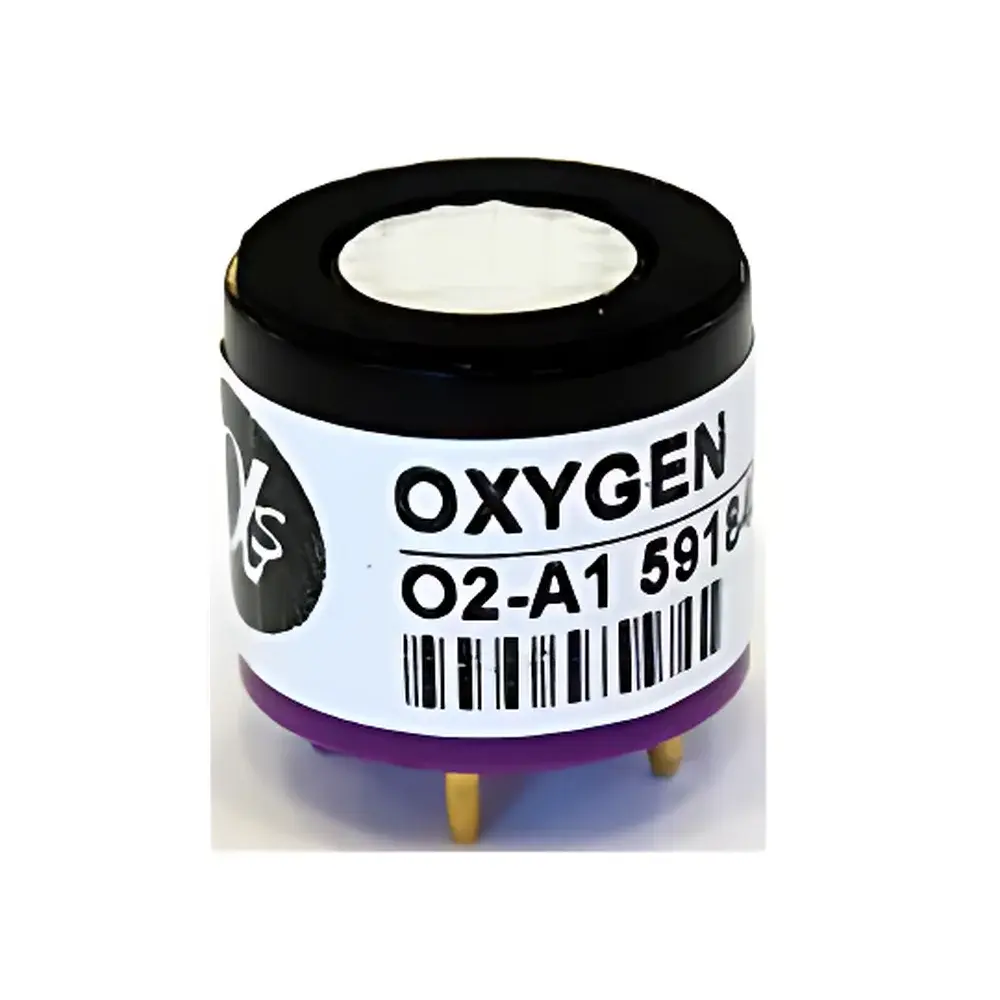
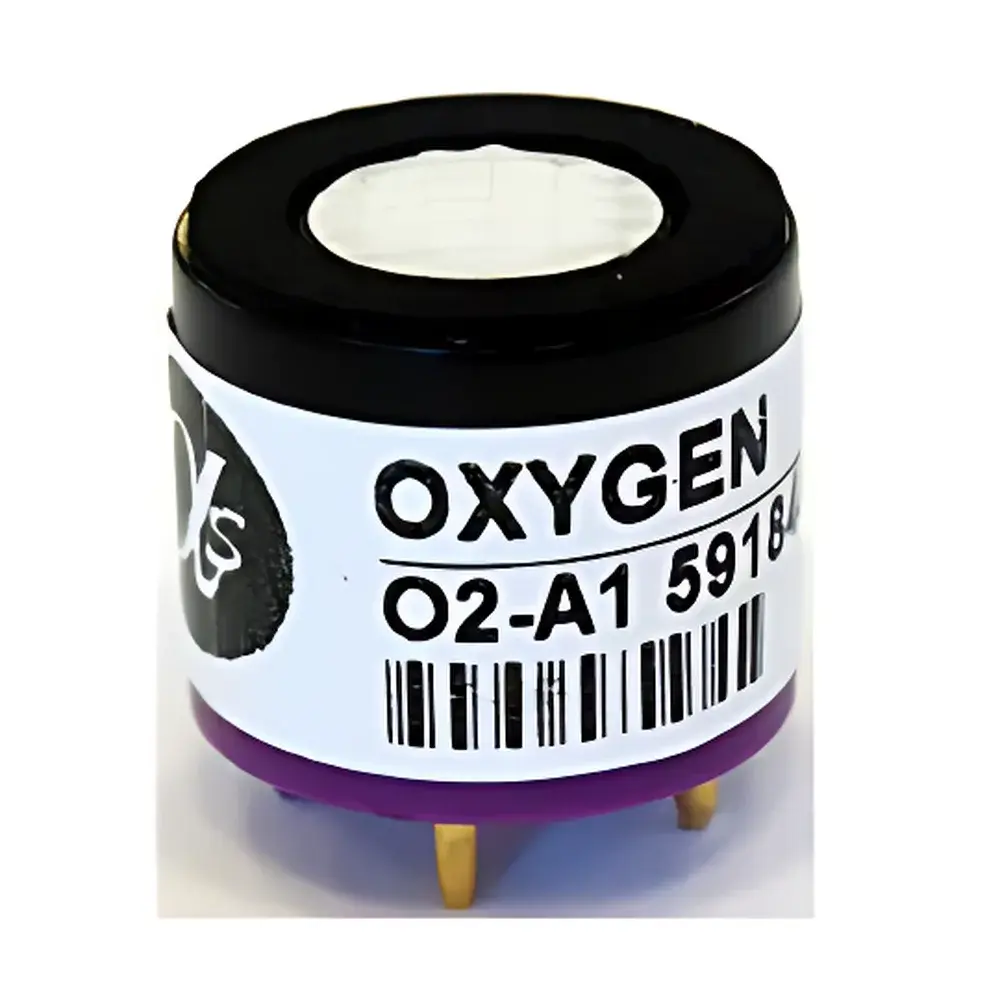
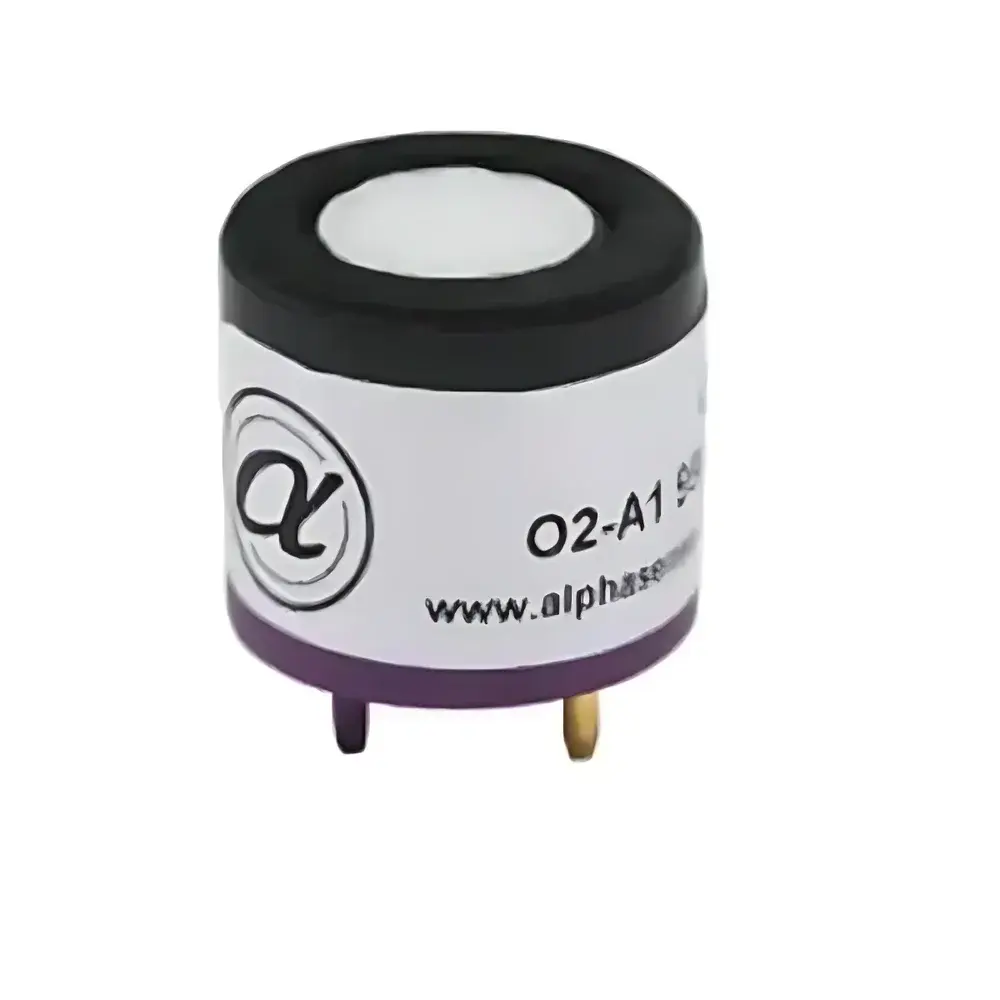
Alphasense O2-A1 Electrochemical Oxygen Sensor
| Brand | Alphasense (UK) |
|---|---|
| Origin | United Kingdom |
| Sensor Type | Electrochemical |
| Model | O2-A1 |
| Rated Service Life | 12 months |
| Output Signal | 190–240 µA in air (20.9% O₂) |
| Response Time (t₉₀) | <15 s |
| Dimensions | Ø20.3 × 16.8 mm |
| Operating Temperature Range | −20 °C to +50 °C |
| Storage Life (uninstalled) | 6 months at 20 °C |
| Compliance | RoHS, CE marked per EN 50104 for gas detectors |
Overview
The Alphasense O2-A1 is a high-stability, diffusion-limited electrochemical oxygen sensor engineered for reliable detection of molecular oxygen (O₂) in ambient air and controlled industrial atmospheres. Based on a three-electrode electrochemical cell architecture with an aqueous alkaline electrolyte, the O2-A1 operates via the catalytic reduction of O₂ at the working electrode, generating a linear current output proportional to partial pressure of oxygen. Its design adheres to fundamental principles of amperometric gas sensing—ensuring predictable sensitivity, low cross-sensitivity to CO₂, humidity, and common VOCs, and intrinsic immunity to flow rate variations within standard sampling configurations. The sensor is optimized for fixed-gas detection systems requiring long-term baseline stability and minimal calibration drift over its rated 12-month operational lifetime. It is not intended for use in inert or hypoxic environments below 1% O₂ without system-level compensation, nor in pressurized or vacuum applications outside atmospheric range.
Key Features
- Stable amperometric output: 190–240 µA in 20.9% O₂ at 25 °C — enabling direct interfacing with low-noise transimpedance amplifiers without signal conditioning
- Rapid t₉₀ response time of <15 seconds — suitable for real-time alarm triggering in personnel safety and process monitoring applications
- Compact cylindrical form factor (Ø20.3 × 16.8 mm) with integrated PTFE hydrophobic membrane — facilitating integration into portable gas detectors, fixed-point analyzers, and OEM control panels
- Engineered for reproducible batch-to-batch performance — each sensor undergoes factory calibration verification against NIST-traceable reference gases
- RoHS-compliant construction with lead-free soldering compatibility — meeting EU Directive 2011/65/EU requirements for electronic components
- CE-marked in accordance with EN 50104:2018 — confirming conformity for use in oxygen deficiency and enrichment warning devices
Sample Compatibility & Compliance
The O2-A1 is validated for continuous operation in clean, non-condensing ambient air and dry industrial gas streams containing ≤100 ppm total hydrocarbons. It exhibits negligible interference from CO₂ (±0.2% O₂ reading error at 5% CO₂), NOₓ (100 ppm, SO₂ >5 ppm), halogenated solvents, or silicone vapors — all of which may irreversibly poison the catalytic electrode surface. For regulatory deployment, the O2-A1 supports compliance with IEC 61508 SIL 2 (when integrated into certified safety instrumented systems), OSHA 1910.134 respiratory protection guidelines, and ISO 8573-1 Class 4 compressed air purity monitoring when paired with appropriate sample conditioning.
Software & Data Management
As a passive analog transducer, the O2-A1 requires external signal conditioning and digitization. When integrated into data acquisition platforms compliant with FDA 21 CFR Part 11 (e.g., LabVIEW-based QC systems or Siemens Desigo CC controllers), its linear current output enables traceable calibration logging, audit-trail-enabled zero/span verification, and automated drift compensation algorithms. Firmware-level support for dual-point calibration (zero air and span gas) is recommended every 3–6 months depending on exposure history. Raw µA outputs are compatible with Modbus RTU, CAN bus (via optional ADC modules), and USB-CDC virtual COM interfaces — permitting seamless ingestion into LIMS or SCADA architectures supporting GLP/GMP documentation workflows.
Applications
- Fixed and portable oxygen deficiency/enrichment monitors for confined space entry (OSHA-compliant)
- Medical gas supply line integrity verification in hospital pipeline systems
- Controlled atmosphere packaging (CAP) and modified atmosphere packaging (MAP) validation
- Incubator and bioreactor headspace O₂ monitoring in pharmaceutical cell culture processes
- Fire suppression system integrity checks (e.g., verifying nitrogen purge efficacy)
- Environmental chamber O₂ setpoint stabilization in materials aging studies per ASTM D5800
FAQ
What is the expected shelf life of an uninstalled O2-A1 sensor?
Uninstalled sensors retain full performance for up to 6 months when stored at 20 °C in original sealed packaging.
Does the O2-A1 require external temperature compensation?
Yes — its output exhibits a temperature coefficient of approximately −0.15%/°C; accurate readings require either hardware-based thermistor compensation or software-based correction using onboard temperature measurement.
Can the O2-A1 be used in explosive atmospheres?
No — it is not intrinsically safe (IS) rated. Integration into hazardous area equipment requires encapsulation or purging per ATEX/IECEx Zone 1/2 design rules.
Is periodic recalibration mandatory?
Yes — Alphasense recommends functional verification with certified zero and span gases every 90 days in critical safety applications, or every 180 days in general industrial monitoring.
How does humidity affect long-term stability?
Prolonged exposure to >95% RH may accelerate electrolyte evaporation; use of a sintered stainless-steel filter with integrated desiccant is advised for high-humidity deployments.