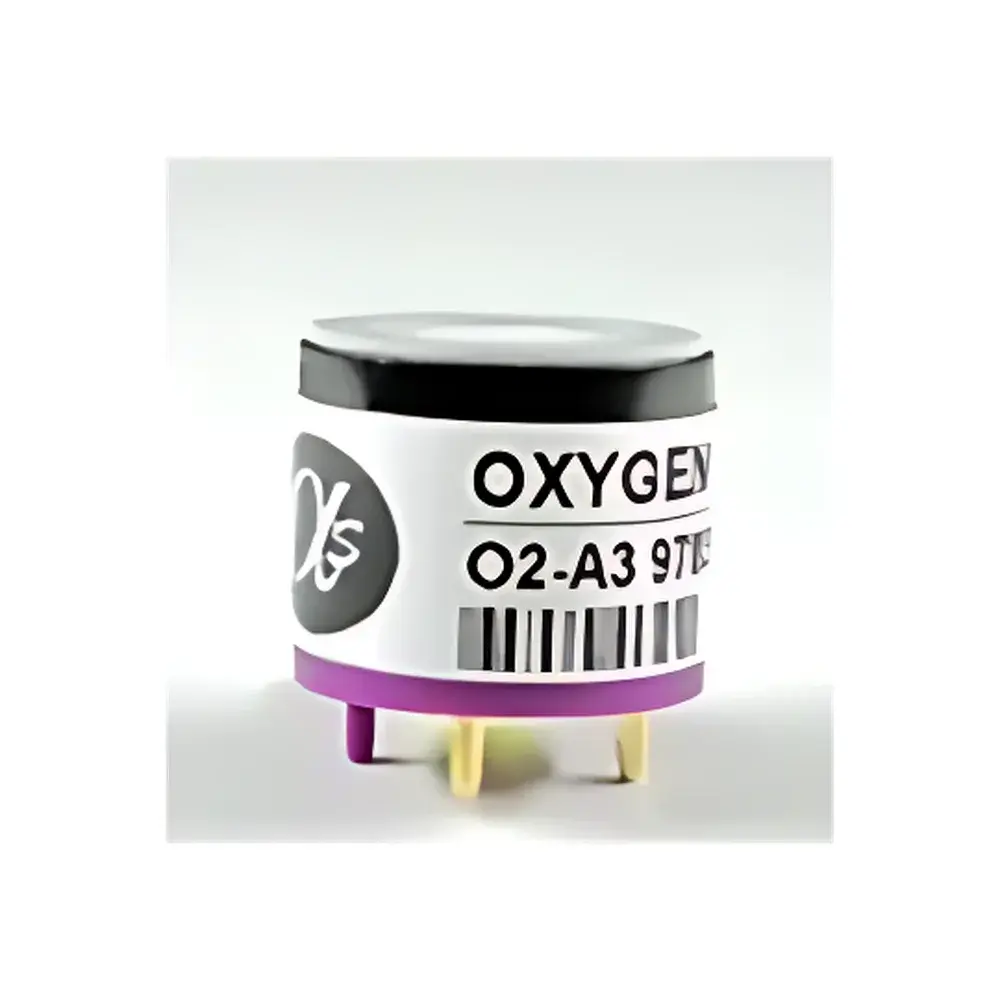
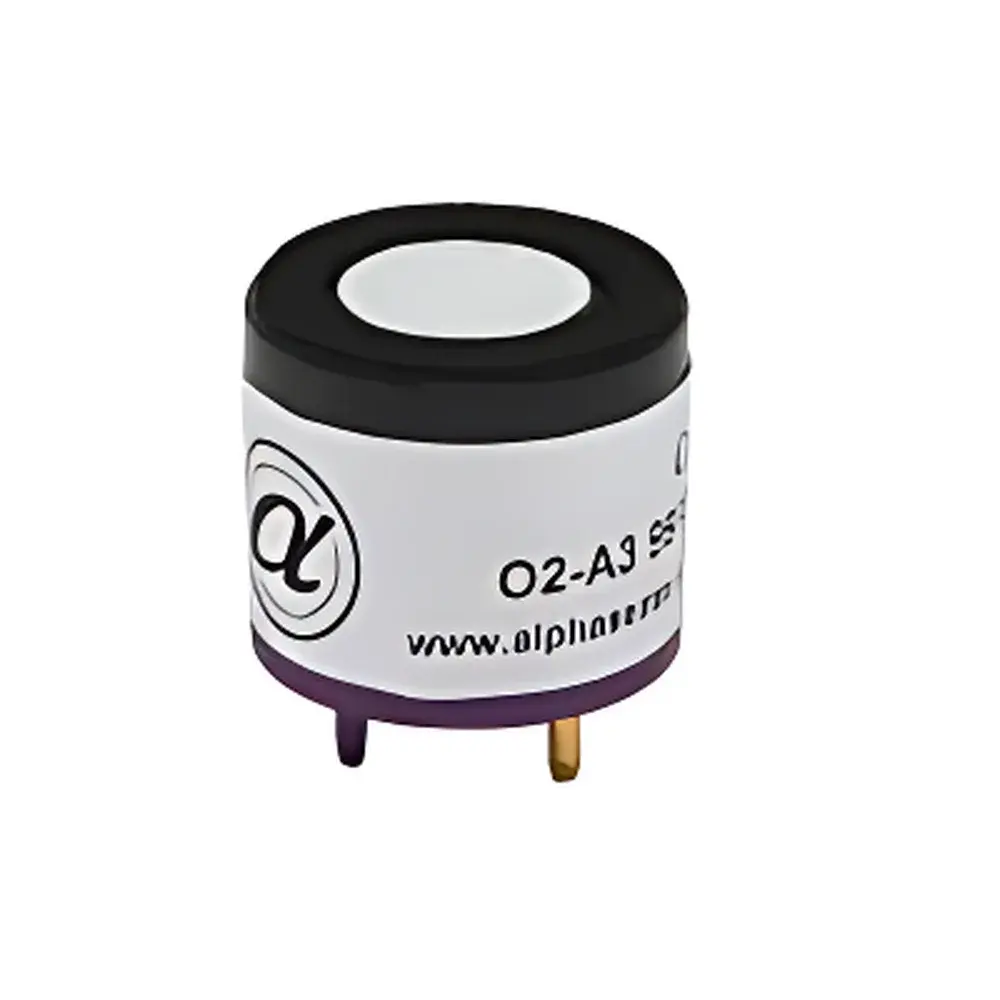
Alphasense O2-A3 Long-Life Electrochemical Oxygen Sensor
| Brand | Alphasense (UK) |
|---|---|
| Origin | United Kingdom |
| Model | O2-A3 |
| Operating Life | >36 months (to 85% of initial output) |
| Measurement Range | 0–30% O₂ (vol) |
| Output Current | 55–85 nA @ 22°C, 20.9% O₂ |
| Response Time (t₉₀) | <15 s (20.9% → 0% O₂, 47 Ω load) |
| Dimensions | Ø20.3 × 16.8 mm |
| Weight | <16 g |
| Operating Temperature | −30 to +55 °C |
| Pressure Range | 80–120 kPa |
| Humidity Range | 5–95% RH (non-condensing) |
| Storage Duration | 6 months (3–20 °C) |
| Load Resistance | 47–100 Ω |
Overview
The Alphasense O2-A3 is a rigorously engineered electrochemical oxygen sensor designed for continuous, stable, and traceable measurement of oxygen concentration in ambient or process gas streams. Based on the principle of galvanic cell electrochemistry, the sensor operates without external bias voltage—oxygen diffuses through a hydrophobic membrane into an aqueous electrolyte, where it undergoes reduction at the cathode, generating a current linearly proportional to partial pressure (and thus volume %) of O₂. This zero-power, self-powered architecture ensures intrinsic safety, low power consumption, and long-term signal integrity—making the O2-A3 especially suitable for fixed-gas detection systems, portable safety instruments, and OEM integration into environmental monitoring platforms.
Key Features
- Extended operational lifetime: Rated for >36 months of continuous operation while maintaining ≥85% of initial output signal under typical ambient conditions—validated per IEC 60079-29-1 and Alphasense internal accelerated aging protocols.
- Exceptional baseline stability: Minimal zero drift (<0.5% O₂ equivalent per year) and span drift (<2% full scale per year), enabling extended calibration intervals without compromising compliance with OSHA 1910.120 or EN 50194-1 requirements.
- Robust environmental tolerance: Fully functional across −30 to +55 °C and 80–120 kPa absolute pressure; humidity range of 5–95% RH (non-condensing) supports deployment in industrial enclosures, underground mining environments, and medical gas analyzers.
- Compact, standardized form factor: Cylindrical package (Ø20.3 × 16.8 mm, <16 g) compatible with industry-standard 12-pin or 3-pin socket interfaces; optimized for PCB-level integration or direct mounting in diffusion-based sampling housings.
- Predictable electrochemical kinetics: t₉₀ response time <15 s (20.9% → 0% O₂, 47 Ω load) ensures timely alarm triggering in confined-space entry monitors and inerting control loops.
Sample Compatibility & Compliance
The O2-A3 is calibrated for use in clean, non-corrosive gas matrices—including air, nitrogen, argon, and CO₂-rich atmospheres. It is not recommended for exposure to high concentrations of sulfur dioxide, hydrogen sulfide, chlorine, or organic solvents, which may poison the catalytic cathode or degrade the PTFE membrane. The sensor complies with RoHS 2011/65/EU and REACH Annex XVII restrictions. While not intrinsically certified as ATEX/IECEx devices, it is routinely deployed in Zone 1 and Zone 2 hazardous area systems when housed within appropriately rated enclosures meeting EN 60079-0 and EN 60079-15. Its performance characteristics align with ASTM D6159 (Standard Test Method for Determining Oxygen Concentration in Gaseous Mixtures) and ISO 8573-7 (Compressed Air – Part 7: Testing of Oxygen Content).
Software & Data Management
As a passive analog transducer, the O2-A3 outputs a temperature-dependent current signal (nA level) that requires precision low-noise amplification and cold-junction compensation. When integrated into data acquisition systems compliant with FDA 21 CFR Part 11, the sensor’s raw output supports audit-trail-enabled calibration logging, drift trending, and predictive maintenance alerts. Alphasense provides detailed application notes (AN-007, AN-012) covering signal conditioning circuit design, temperature compensation algorithms (based on integrated thermistor output), and linearization coefficients for microcontroller-based firmware implementation. All calibration certificates issued by authorized distributors include NIST-traceable reference gas verification at 0%, 20.9%, and 30% O₂.
Applications
- Fixed and portable oxygen deficiency/enrichment monitors for confined space entry (per OSHA 1910.146)
- Atmosphere analyzers in controlled-environment chambers (e.g., modified-atmosphere packaging lines)
- OEM integration into anesthesia machines, ventilators, and hyperbaric chamber controllers
- Process monitoring in metal heat-treatment furnaces (e.g., sintering, annealing)
- Environmental monitoring of landfill gas, biogas upgrading units, and fermentation headspace
- Quality assurance in nitrogen-purged electronics manufacturing and pharmaceutical inerting systems
FAQ
What is the recommended calibration frequency for the O2-A3 in continuous operation?
Calibration is advised every 3–6 months depending on operating environment severity; field verification using certified 0% and 20.9% O₂ span gases is required prior to commissioning and after any physical shock or condensation event.
Can the O2-A3 be used in high-CO₂ environments such as biogas applications?
Yes—provided CO₂ concentration remains below 95% and no acidic condensates form; prolonged exposure to >5,000 ppm CO₂ may accelerate electrolyte carbonation and require more frequent recalibration.
Is temperature compensation mandatory for accurate readings?
Yes—the sensor’s output exhibits ~0.2%/°C sensitivity; accurate measurement requires either hardware-based thermistor integration or software-based lookup-table compensation using the onboard NTC element.
Does the O2-A3 require a warm-up period before stable operation?
No—galvanic operation enables immediate output upon exposure to oxygen; however, thermal equilibrium (typically 5 °C) is necessary for compensated accuracy.