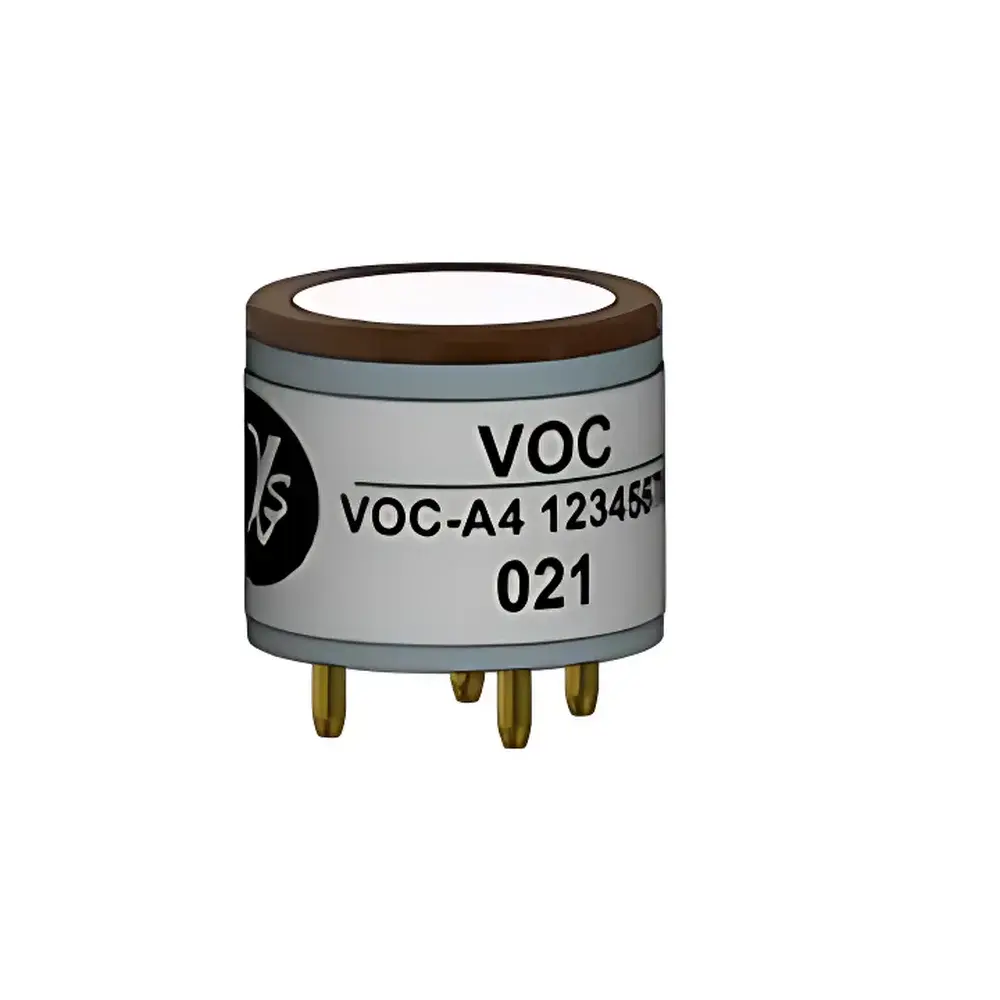
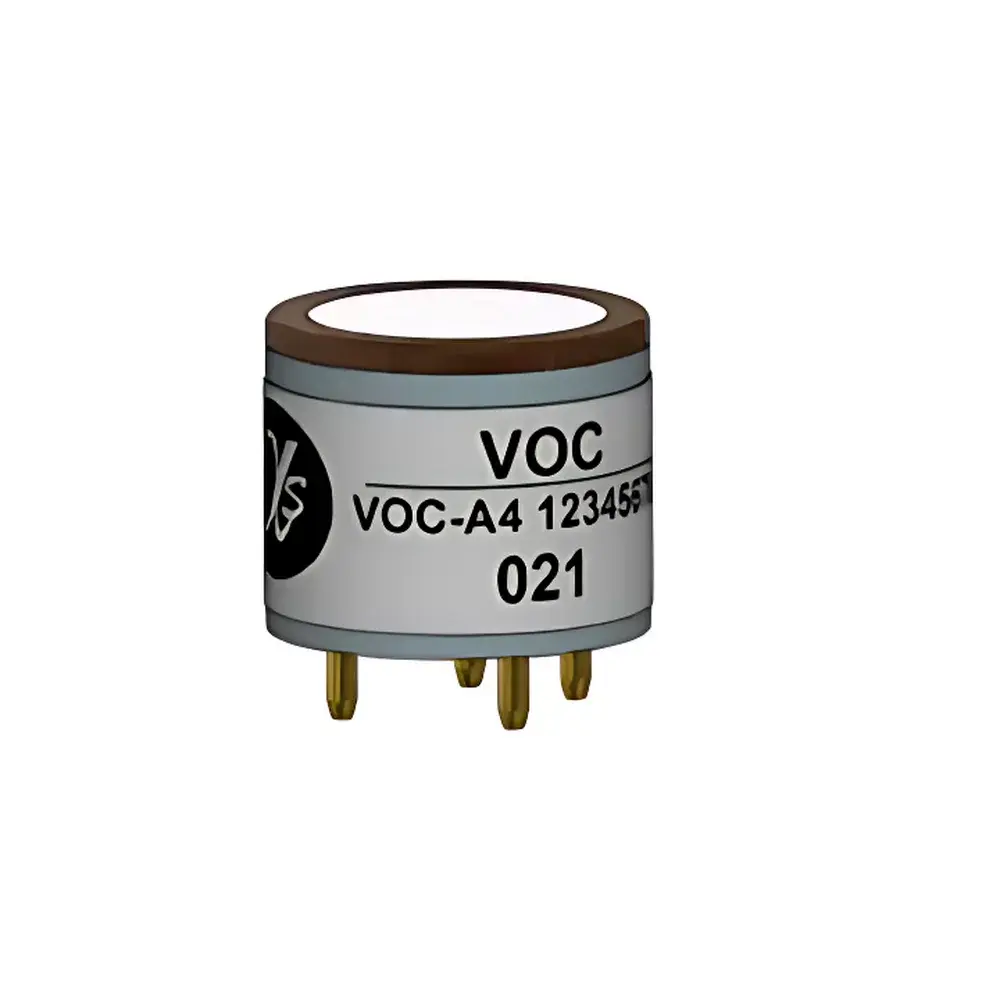
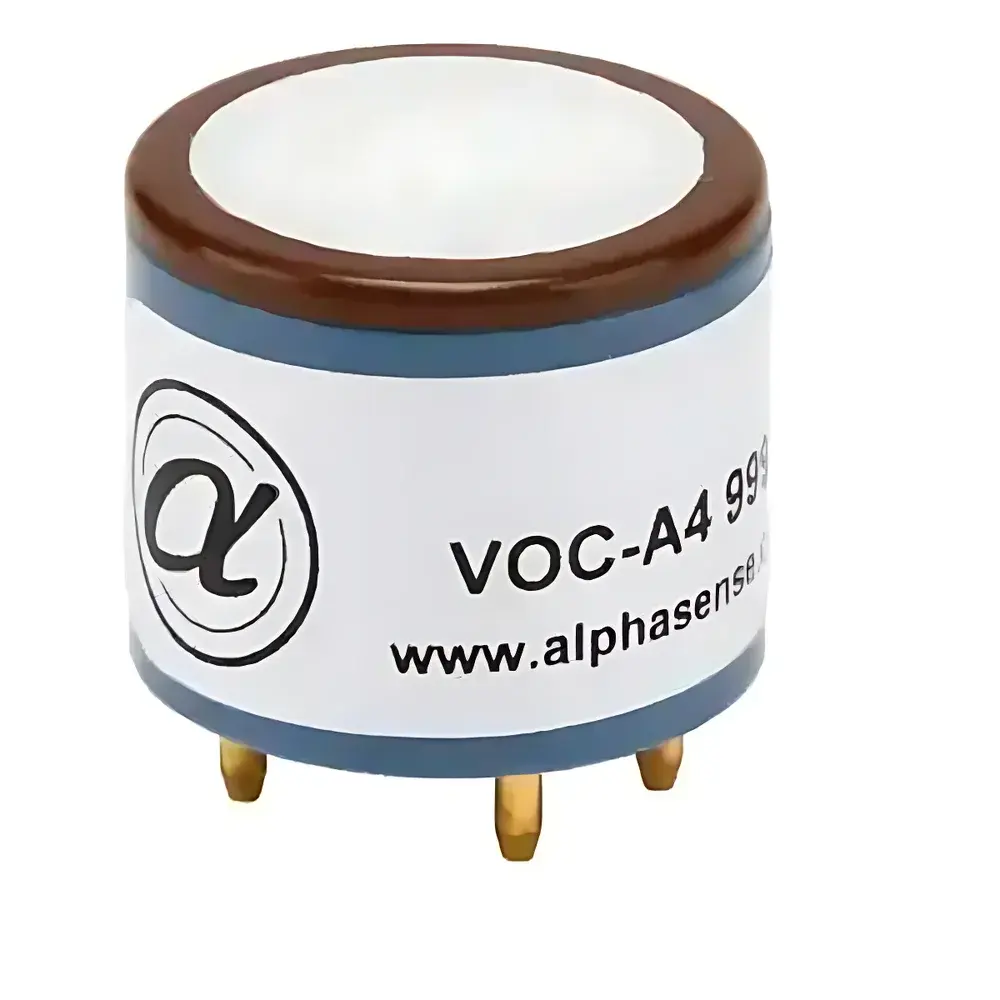
Alphasense VOC-A4 Electrochemical Gas Sensor
| Brand | Alphasense (UK) |
|---|---|
| Origin | United Kingdom |
| Model | VOC-A4 |
| Detection Principle | Amperometric 4-Electrode Electrochemical |
| Target Gases | Volatile Organic Compounds (e.g., ethanol, isopropanol, toluene) and Carbon Monoxide (CO) |
| Operating Bias Options | 0 V, 0.1 V, 0.2 V, or 0.3 V |
| Response Time (t₉₀) | <30 s |
| Dimensions | Ø20.2 × 16.5 mm |
| CO Range | 0–190 ppm (max overload: 1000 ppm) |
| CO Sensitivity | 230–410 nA/ppm |
| Ethanol (C₂H₆O) Range | 0–2 ppm (max overload: 5 ppm) |
| Ethanol Sensitivity | 200–400 nA/ppm |
Overview
The Alphasense VOC-A4 is a high-stability, amperometric four-electrode electrochemical gas sensor engineered for selective detection of low-concentration volatile organic compounds (VOCs) — including ethanol, isopropanol, acetone, and toluene — as well as carbon monoxide (CO). Designed and manufactured in the United Kingdom, the VOC-A4 operates without mandatory bias voltage in ambient air quality monitoring applications, enabling zero-bias operation for enhanced long-term baseline stability and reduced cross-sensitivity to humidity and temperature fluctuations. Its dual-gas capability allows co-deployment with complementary CO sensors (e.g., CO-A4 or CO-B4) to support algorithmic compensation strategies for VOC concentration estimation under unbiased conditions — a critical advantage in regulatory-grade urban air quality networks and indoor environmental quality (IEQ) systems. The sensor’s robust PTFE membrane and optimized electrode architecture deliver consistent signal reproducibility across extended deployment cycles, meeting the functional requirements of continuous emissions monitoring (CEM), occupational health surveillance, and smart building ventilation control.
Key Features
- Four-electrode amperometric design minimizes drift and improves signal-to-noise ratio compared to conventional two- or three-electrode configurations
- Selectively configurable operating bias (0 V, 0.1 V, 0.2 V, or 0.3 V) enables tuning for different VOC species and mitigation of interferent responses
- Sub-30-second t₉₀ response time ensures real-time tracking of transient VOC events in dynamic environments
- Compact cylindrical form factor (Ø20.2 × 16.5 mm) facilitates integration into portable analyzers, fixed-site air quality stations, and IoT-enabled sensor nodes
- Stable baseline performance over >24 months typical service life when operated within specified temperature (−20 °C to +50 °C) and relative humidity (15–90 % RH, non-condensing) ranges
- Compliant with RoHS Directive 2011/65/EU and REACH Regulation (EC) No. 1907/2006 for hazardous substance restrictions
Sample Compatibility & Compliance
The VOC-A4 is validated for use in ambient air, indoor workplace atmospheres, and controlled laboratory environments. It exhibits minimal interference from common background gases including NO₂, SO₂, H₂S, and O₃ at concentrations typical of urban ambient air (≤100 ppb). Cross-sensitivity to hydrogen (H₂) is characterized and documented in Alphasense Application Note AN-008, supporting correction algorithm implementation. The sensor meets functional alignment with ISO 16000-29 (indoor air – VOC measurement using electrochemical sensors), and its output characteristics are compatible with data acquisition systems conforming to IEC 61000-4-3 (EMC immunity) and IEC 61000-4-6 (conducted RF immunity). While not intrinsically safe certified, it may be deployed in Zone 2/22 hazardous locations when integrated into appropriately rated enclosures per ATEX 2014/34/EU and IECEx standards.
Software & Data Management
Raw current output (nA) from the VOC-A4 is linearly proportional to target gas concentration within its specified range. When interfaced with Alphasense’s standard evaluation boards (e.g., B4-USB or B4-SDI-12), the sensor supports analog (0–5 V or 4–20 mA) and digital (UART, SDI-12) outputs. Calibration data — including zero offset, sensitivity slope, and temperature compensation coefficients — are stored in onboard EEPROM and accessible via proprietary firmware commands. For regulatory compliance workflows, the sensor’s analog output can be logged by data loggers compliant with FDA 21 CFR Part 11 (when paired with audit-trail-capable software), supporting GLP/GMP-aligned environmental monitoring programs. Firmware updates and configuration changes (e.g., bias selection, filter time constants) are performed via UART using Alphasense’s Sensor Configuration Utility (SCU v3.2+).
Applications
- Ambient air quality monitoring networks (AQMS) for VOC speciation and CO co-monitoring in urban, industrial, and roadside environments
- Indoor air quality (IAQ) management in schools, offices, hospitals, and residential buildings — particularly where ethanol-based disinfectants or solvent emissions are present
- Occupational exposure assessment for workers handling alcohols, ketones, or aromatic hydrocarbons in manufacturing, pharmaceutical, and coating facilities
- Integration into low-cost, high-density sensor grids for hyperlocal pollution mapping and source apportionment modeling
- Research-grade instrumentation for laboratory studies on VOC oxidation kinetics, sensor array development, and machine learning–based pattern recognition
FAQ
Can the VOC-A4 detect formaldehyde or benzene?
The VOC-A4 is not optimized for formaldehyde or benzene detection; its primary sensitivity targets lower-molecular-weight oxygenated VOCs (e.g., ethanol, acetone) and CO. For formaldehyde, Alphasense recommends the F-100 series; for benzene, the B4-BOA sensor is preferred.
Is factory calibration traceable to NIST or UKAS standards?
Alphasense provides certificate-of-conformance with batch-specific calibration data traceable to UKAS-accredited reference gas standards (ISO/IEC 17025); full NIST-traceable calibration requires third-party lab services.
What is the recommended warm-up time before stable readings?
A minimum 120-second stabilization period is advised after power-on to ensure electrolyte equilibration and thermal settling, especially following storage below 5 °C.
Does the VOC-A4 require periodic zero-gas exposure for maintenance?
Zero adjustment is not required under normal operation; however, field zero checks using certified zero air are recommended quarterly in high-accuracy applications to verify baseline integrity.
Can multiple VOC-A4 sensors be daisy-chained on a single SDI-12 bus?
Yes — up to 62 VOC-A4 units may share one SDI-12 bus when configured with unique addresses and appropriate pull-up resistors, per SDI-12 Specification v1.4.