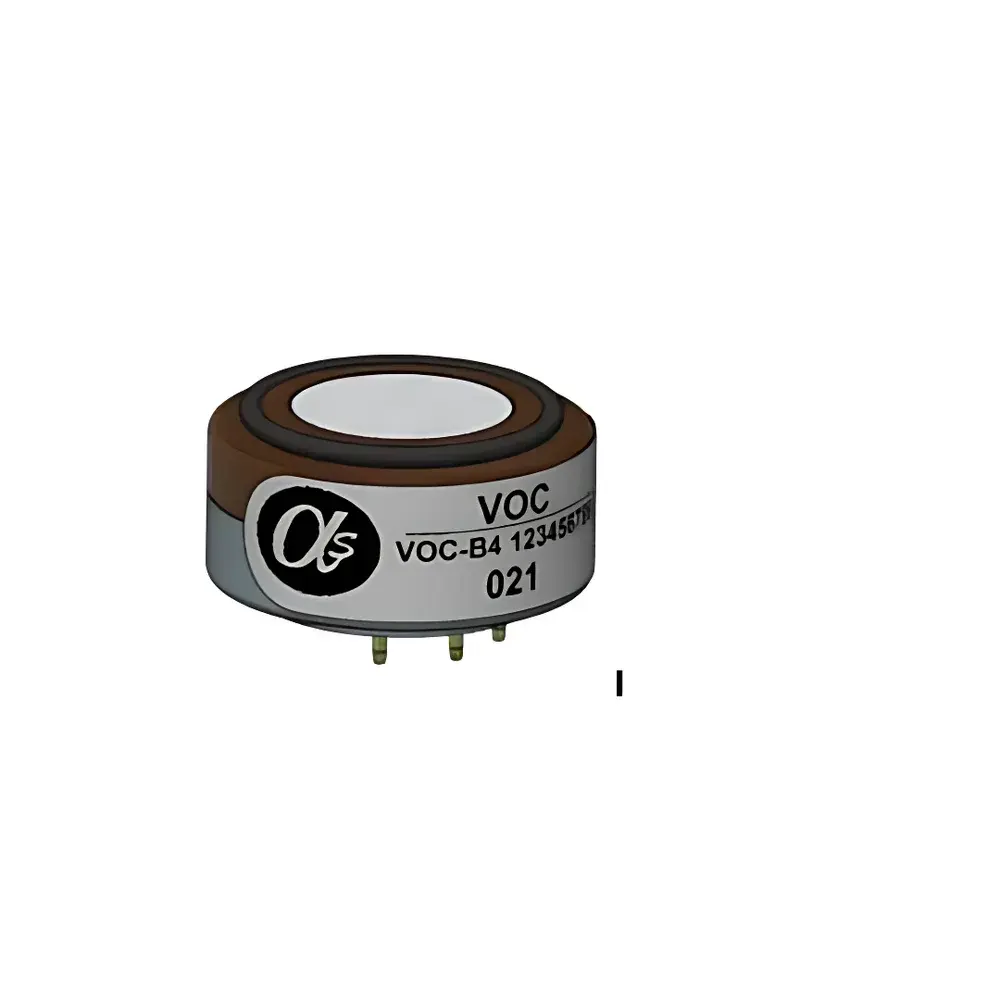
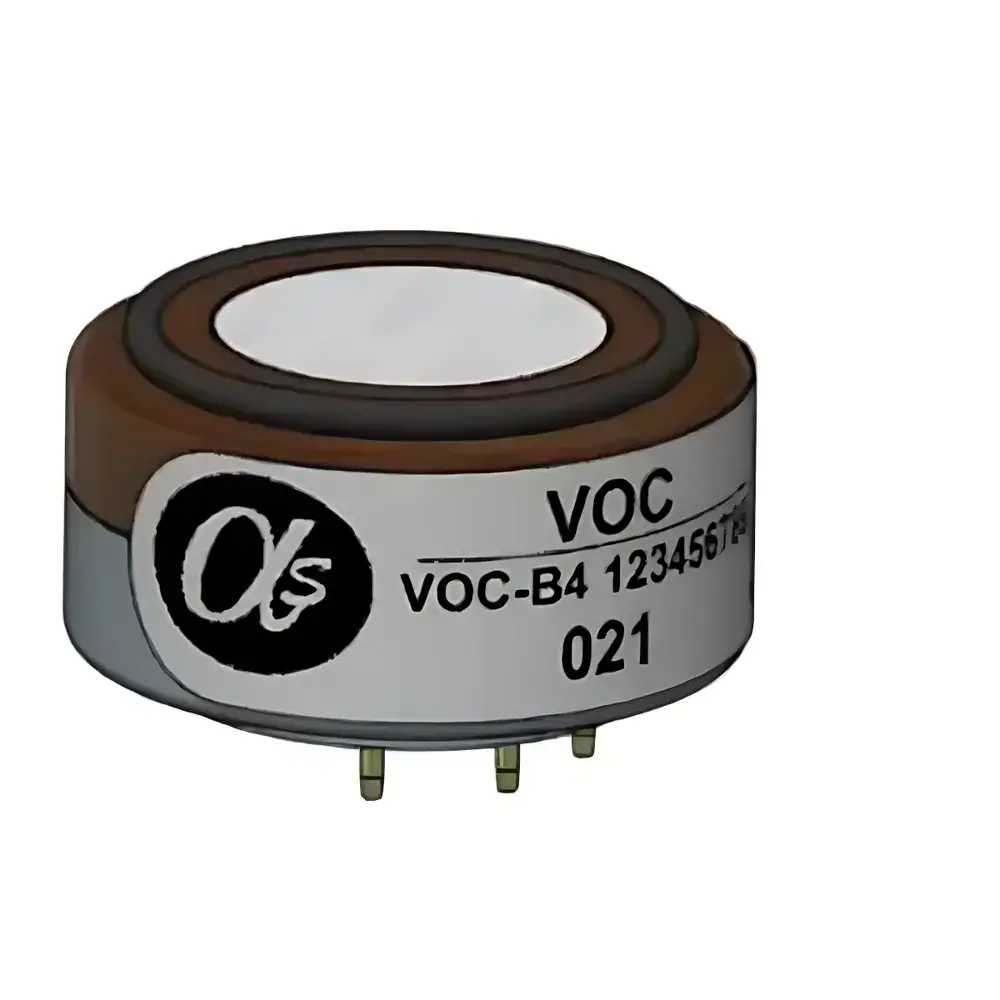
Alphasense VOC-B4 Electrochemical Gas Sensor
| Brand | Alphasense (UK) |
|---|---|
| Origin | United Kingdom |
| Model | VOC-B4 |
| Detection Principle | Amperometric 4-Electrode Electrochemistry |
| Target Gases | Volatile Organic Compounds (e.g., ethanol), Carbon Monoxide (CO) |
| Response Time (t₉₀) | <30 s |
| Dimensions | Ø32.3 × 16.5 mm |
| CO Range | 0–100 ppm (overload: 1000 ppm) |
| Ethanol Range | 0–2 ppm (overload: 5 ppm) |
| CO Sensitivity | 400–700 nA/ppm |
| Ethanol Sensitivity | 400–650 nA/ppm |
| Bias Voltage Options | 0 V, 0.1 V, 0.2 V, or 0.3 V |
| Operating Temperature | –20 °C to +50 °C |
| Humidity Range | 15–90 % RH (non-condensing) |
Overview
The Alphasense VOC-B4 is a precision-engineered amperometric electrochemical gas sensor designed for reliable, low-power detection of both volatile organic compounds (VOCs) — particularly ethanol (C₂H₆O) — and carbon monoxide (CO) in ambient air monitoring applications. As a four-electrode current-mode sensor, the VOC-B4 operates without mandatory bias voltage, enabling stable zero-bias operation ideal for long-term environmental monitoring systems where power efficiency and baseline stability are critical. Its dual-gas capability allows co-deployment with complementary sensors such as the CO-B4 or CO-A4 to support cross-compensation algorithms that improve VOC quantification accuracy in complex urban or indoor air matrices. The sensor’s robust construction, optimized electrode geometry, and proprietary electrolyte formulation deliver high reproducibility across batch production and consistent performance under variable temperature and humidity conditions (15–90% RH, non-condensing; –20 °C to +50 °C).
Key Features
- Four-electrode amperometric design for enhanced signal stability and reduced drift
- Dual-target capability: simultaneous CO and ethanol (C₂H₆O) detection with independent calibration paths
- Configurable bias voltage (0 V, 0.1 V, 0.2 V, or 0.3 V) to optimize selectivity toward specific VOC species
- Fast electrochemical response: t₉₀ < 30 seconds for both CO and ethanol
- Compact cylindrical form factor (Ø32.3 × 16.5 mm) compatible with standard gas-sampling housings and PCB-mounting fixtures
- Low-power operation suitable for battery-powered and IoT-enabled air quality nodes
- Factory-calibrated with traceable documentation supporting ISO/IEC 17025-aligned QA protocols
Sample Compatibility & Compliance
The VOC-B4 is validated for use in ambient air, indoor air quality (IAQ), and occupational hygiene applications requiring continuous, real-time VOC and CO surveillance. It complies with key international standards governing electrochemical sensor performance, including EN 50104 (for CO detectors) and ISO 16000-25 (indoor air — VOC measurement). While not intrinsically safe certified, the sensor is routinely integrated into Class I, Division 2 compliant instrumentation when housed within appropriately rated enclosures. Its materials and assembly adhere to RoHS 2011/65/EU and REACH (EC 1907/2006) directives. For regulatory-grade deployments — such as those supporting EU Air Quality Directive (2008/50/EC) reporting or EPA Method TO-15 adjunct monitoring — the VOC-B4 is deployed alongside reference-grade analyzers for periodic span validation and drift correction.
Software & Data Management
The VOC-B4 outputs a linear analog current signal (nA-level) proportional to target gas concentration, enabling direct integration with 16-bit or higher resolution analog-to-digital converters (ADCs) in host data loggers or microcontroller-based platforms (e.g., ARM Cortex-M4/M7, ESP32). Alphasense provides comprehensive technical documentation, including sensitivity matrices, cross-sensitivity profiles (e.g., H₂, NO₂, SO₂, H₂S), and temperature/humidity compensation coefficients — all essential for implementing first-principles correction algorithms. When used in systems governed by GLP or GMP frameworks, the sensor supports audit-trail-capable firmware architectures that record calibration timestamps, zero/span events, and environmental metadata per FDA 21 CFR Part 11 requirements. No proprietary software driver is required; raw signal processing is fully transparent and vendor-agnostic.
Applications
- Ambient air quality monitoring networks (urban, roadside, background stations)
- Indoor air quality (IAQ) systems in smart buildings, schools, and healthcare facilities
- Personal exposure monitors and wearable occupational safety devices
- Low-cost sensor networks (LCSNs) for hyperlocal pollution mapping and source attribution
- Research-grade field studies investigating VOC–CO correlations in traffic-influenced microenvironments
- Calibration transfer standards for validating photoionization detector (PID) and metal oxide semiconductor (MOS) sensor arrays
FAQ
Can the VOC-B4 be used for regulatory compliance reporting?
The VOC-B4 is intended for indicative and trend-monitoring applications. For official regulatory reporting (e.g., EU AQD, US NAAQS), it must be deployed as part of a validated measurement system with documented uncertainty budgets and routine co-location against reference methods.
What is the recommended operating lifetime?
Typical functional lifetime is 24 months under continuous operation at 23 °C and 50% RH; lifespan decreases under sustained exposure to >5 ppm ethanol or >500 ppm CO.
Does the VOC-B4 require external temperature compensation?
Yes — full accuracy requires real-time temperature and relative humidity input to apply Alphasense-provided compensation coefficients during signal conversion.
Is factory calibration traceable to national standards?
Yes — each sensor ships with a calibration certificate referencing NPL (UK) traceable gas standards, with uncertainty stated per ISO/IEC 17025 guidelines.
Can it detect other VOCs besides ethanol?
The VOC-B4 exhibits measurable response to acetaldehyde, acetone, and isopropanol, but ethanol remains its primary calibrated target; cross-sensitivity data is provided in the datasheet for algorithmic correction.