
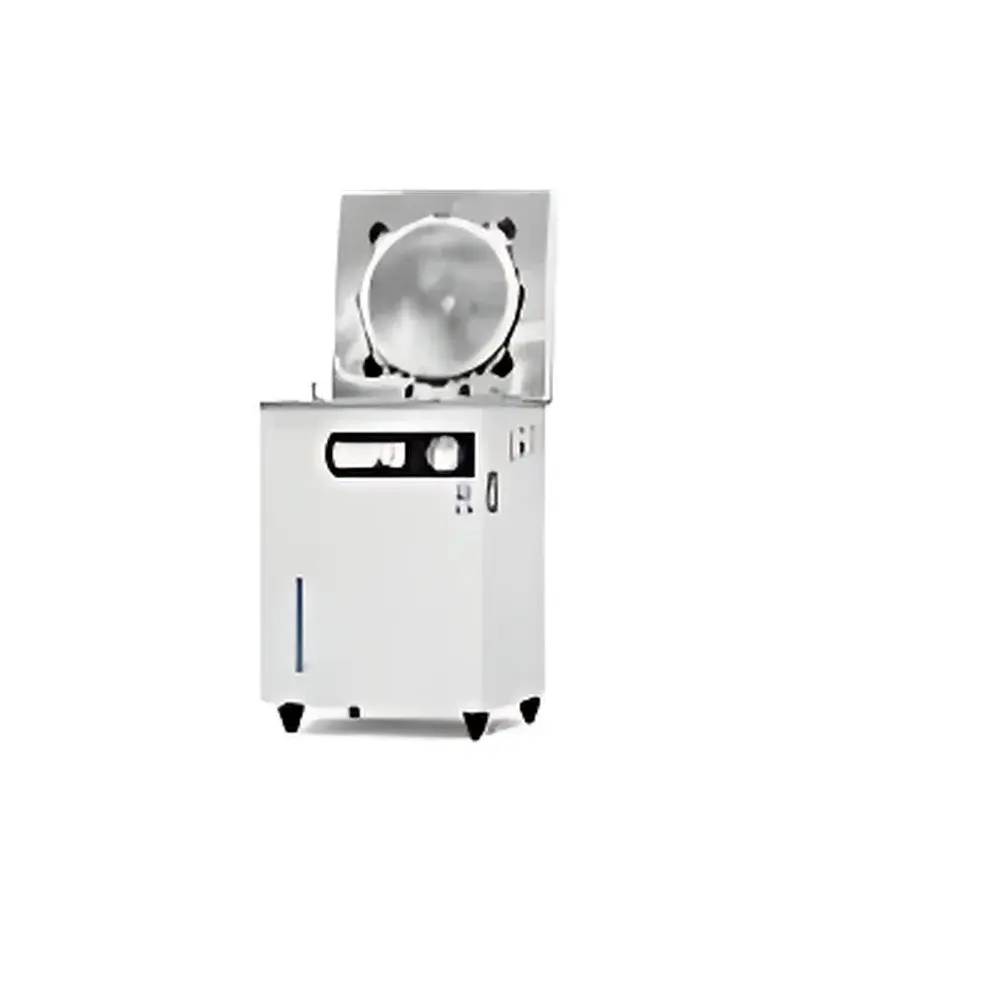
Alphavita MVS-60 Vertical Steam Sterilizer
| Brand | Alphavita |
|---|---|
| Origin | Liaoning, China |
| Model | MVS-60 |
| Sterilization Chamber Dimensions | Φ370 × 610 mm |
| External Dimensions | 550 × 550 × 820 mm |
| Chamber Volume | 55 L |
| Vessel Material | S30408 stainless steel (GB/T 24511–2017), 3 mm wall thickness |
| Design Standard | GB 150–2011 |
| Altitude Rating | Certified for operation up to 4000 m ASL |
| Safety Features | Dual dry-run protection, overcurrent protection, earth-leakage detection, four-point interlocked door system, spring-loaded safety valve, real-time overpressure alarm |
| Exhaust System | Pressure-stabilized air removal (98% air displacement), six-stage adjustable exhaust rate & temperature |
| Cooling | High-capacity external cooling fan (optional internal fan), variable-speed cooling control |
| Control Modes | Four pre-programmed cycles + user-defined program memory + pre-heating cycle + time-scheduled start |
Overview
The Alphavita MVS-60 Vertical Steam Sterilizer is a Class B gravity-displacement and vacuum-assisted steam sterilization system engineered for precision, repeatability, and regulatory compliance in academic, clinical, and industrial laboratory environments. It operates on the fundamental principle of saturated steam under elevated pressure (typically 103 kPa gauge, 121 °C or 200 kPa, 134 °C) to achieve microbial inactivation through protein denaturation and nucleic acid disruption. Designed as a vertical chamber unit with a 55 L working volume, the MVS-60 supports full-cycle sterilization of wrapped instruments, porous loads, hollow devices, and liquid media—meeting the functional requirements of EN 13060:2021 and ISO 17665–1 for small steam sterilizers. Its structural integrity is validated per GB 150–2011, the Chinese national standard equivalent to ASME BPVC Section VIII Division 1, ensuring mechanical reliability across diverse operational altitudes up to 4000 meters above sea level.
Key Features
- Seven-layer integrated safety architecture: dual independent dry-run sensors prevent heater activation without sufficient water level; electromagnetic overcurrent cutoff; Class I earth-leakage circuit interruption; mechanically interlocked four-point door latch system compliant with EN 868–10 requirements; ASME-certified spring-loaded safety valve (set at 210 kPa); and continuous chamber pressure monitoring with audible/visual overpressure alarm.
- Pressure-stabilized exhaust technology enables controlled, non-turbulent air removal—achieving ≥98% air displacement prior to steam saturation—critical for effective sterilization of porous and multi-layered loads.
- Six-step programmable exhaust modulation allows precise adjustment of exhaust rate and termination temperature, supporting load-specific cycle optimization (e.g., slow exhaust for liquids, fast exhaust for metal instruments).
- Dual-mode cooling system: standard high-CFM external axial fan with stepless speed regulation; optional internal circulation fan for uniform thermal dissipation within the chamber—reducing post-sterilization cooldown time by up to 40% compared to passive cooling.
- Intuitive 7-inch capacitive touchscreen interface with password-protected administrator mode, cycle logging, and firmware-upgradable controller architecture compliant with IEC 62304 Class B software lifecycle standards.
Sample Compatibility & Compliance
The MVS-60 accommodates a broad spectrum of sterilizable materials including wrapped surgical kits, glassware, rubber tubing, textile packs, culture media (in vented bottles), and polymer-based labware. Its chamber geometry (Φ370 × 610 mm) and 3 mm-thick S30408 austenitic stainless steel construction (per GB/T 24511–2017, equivalent to ASTM A240 UNS S30408) ensure corrosion resistance against repeated exposure to condensate and cleaning agents. The system conforms to national pressure vessel regulations (GB 150–2011) and incorporates design elements aligned with ISO 13485:2016 quality management system requirements for medical device manufacturers. While not FDA-cleared as a medical device, its operational parameters and validation support pathways align with AAMI ST79:2023 guidance for healthcare sterilization and GLP-compliant laboratory workflows.
Software & Data Management
The embedded control system records timestamped cycle data—including chamber temperature, pressure, phase duration, and fault events—for minimum 10,000 cycles. Audit trail functionality meets basic ALCOA+ principles (Attributable, Legible, Contemporaneous, Original, Accurate), with exportable CSV logs via USB 2.0 port. Optional RS-485 Modbus RTU interface enables integration into centralized laboratory infrastructure monitoring platforms. Cycle validation templates are provided for IQ/OQ documentation, and the system supports third-party thermocouple mapping per ISO 17665–2 Annex C for routine performance qualification.
Applications
This sterilizer serves core functions across biosafety level 1–2 laboratories, pharmaceutical QC labs, veterinary clinics, and university teaching facilities. Typical use cases include: terminal sterilization of microbiological growth media and reagents; decontamination of biohazardous waste prior to autoclave disposal; preparation of sterile surgical instrument sets; conditioning of filtration membranes and chromatography columns; and routine sterilization of glass and stainless-steel labware. Its pre-heating cycle enhances safety when processing Category A infectious substances (UN 2814), while scheduled start capability supports unattended overnight operation in high-throughput environments.
FAQ
What is the maximum operating altitude for the MVS-60?
The unit is certified for stable operation at elevations up to 4000 meters above sea level, with automatic pressure compensation algorithms adjusting cycle timing and temperature setpoints accordingly.
Does the MVS-60 support vacuum-assisted air removal for porous load sterilization?
Yes—it implements pressure-stabilized exhaust with programmable vacuum pulses, satisfying EN 13060 Class B requirements for wrapped and porous item processing.
Can cycle data be exported for regulatory review or audit purposes?
All sterilization cycles are logged with date/time stamps, critical parameter traces, and operator IDs; logs are exportable in CSV format via USB and retain metadata required for internal QA audits.
Is the chamber material compatible with frequent use of alkaline cleaning agents?
S30408 stainless steel provides excellent resistance to common alkaline detergents (pH ≤13) when used within recommended concentration and temperature limits per ASTM G128 guidelines.
What validation support documentation is included?
Factory-supplied IQ/OQ protocols, calibration certificates for integrated PT100 sensors, and a traceable pressure transducer certificate are provided; installation qualification checklists follow ISO/IEC 17025-aligned methodology.



