
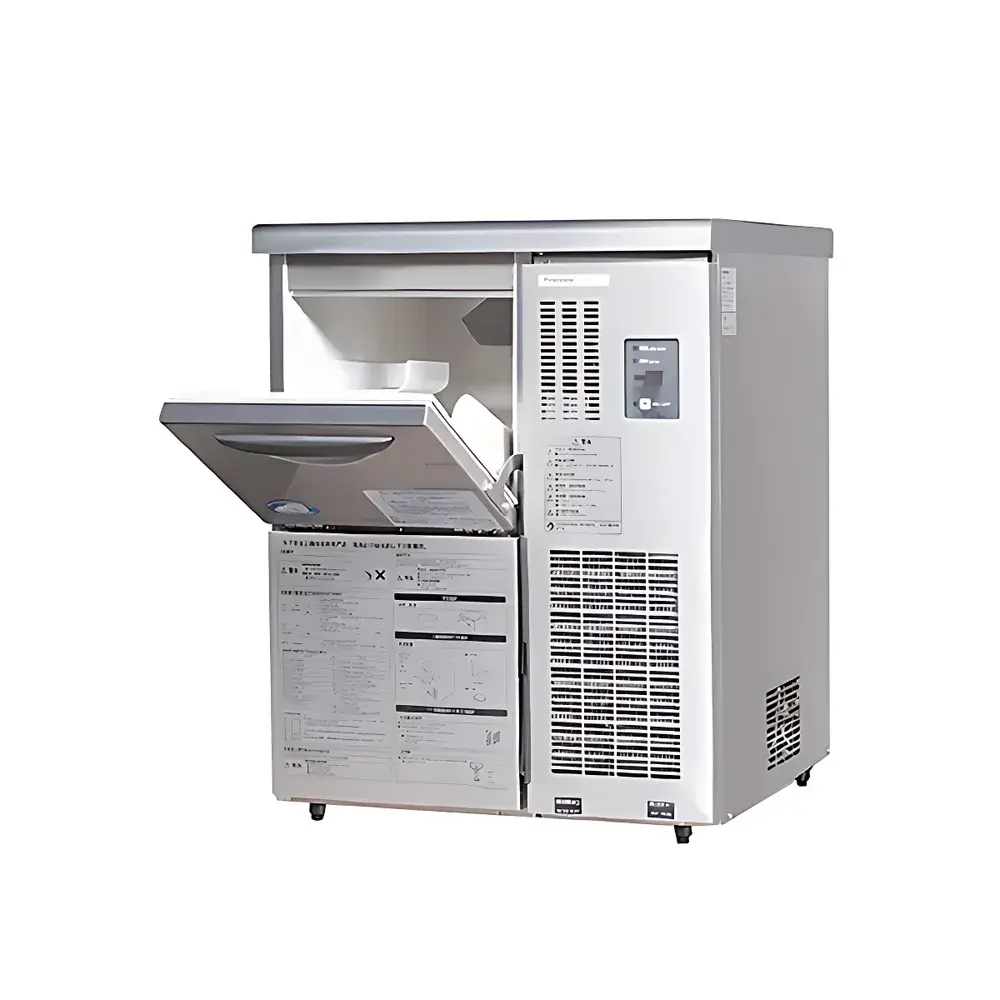
Alphavita SIM-F140BDL Flake Ice Machine
| Brand | Alphavita |
|---|---|
| Model | SIM-F140BDL |
| Ice Type | Flake Ice |
| Ice Production Capacity | 130 kg/24h (at 20°C ambient, 15°C water) |
| Storage Capacity | 28 kg (19 kg free-fall output) |
| Water Consumption | 0.16 m³/24h (20°C ambient, 15°C water) |
| Cooling Method | Hermetic Compressor with HFC Refrigerant |
| Power Input | 435 W |
| Net Weight | 72 kg |
| External Dimensions (W×D×H) | 600 × 600 × 800 mm |
| Operating Ambient Temperature | 5–35°C |
| Maximum Inlet Water Temperature | ≤35°C |
| Water Inlet Port | 1/2″ BSP |
| Drain Ports | Ice Maker Drain – 3/4″ BSP |
| Cabinet Materials | Front/Sides – Coated Stainless Steel |
| Inner Bin Material | ABS Resin |
Overview
The Alphavita SIM-F140BDL is a laboratory-grade flake ice machine engineered for consistent, low-maintenance ice production in controlled environments such as biomedical labs, pharmaceutical QC facilities, clinical sample preparation areas, and food safety testing laboratories. It employs a dual-screw extrusion principle—where chilled water is frozen on the inner surface of a rotating evaporator drum and continuously scraped off by precision-engineered augers—to generate dry, irregularly shaped flake ice with high surface-area-to-volume ratio. This morphology ensures rapid thermal transfer and minimal meltwater retention—critical for preserving sample integrity during cold-chain handling, histology specimen cooling, or enzymatic reaction quenching. Unlike cubed or nugget ice systems, flake ice machines like the SIM-F140BDL are optimized for continuous, low-temperature contact cooling rather than beverage service or display applications.
Key Features
- Dual-screw extrusion system delivering uniform flake ice with particle thickness ≤1.5 mm and bulk density of ~350–420 kg/m³—ideal for packing around temperature-sensitive biological samples.
- Hermetically sealed rotary compressor using environmentally compliant HFC refrigerant (R-404A or R-507, per configuration), designed for stable operation across ambient temperatures from 5°C to 35°C.
- Integrated microprocessor control board with real-time diagnostics, including compressor overload protection, water flow monitoring, ice bin full detection, and evaporator frost accumulation alerts.
- Thermally insulated ice storage bin featuring 60 mm thick in-situ rigid polyurethane foam (thermal conductivity ≤0.022 W/m·K), minimizing heat ingress and extending ice retention time under static conditions.
- Corrosion-resistant cabinet construction: front and side panels coated stainless steel (SUS304 equivalent), top panel mirror-finish stainless steel, rear panel electrogalvanized steel—meeting ISO 14644-1 Class 8 cleanroom-compatible surface requirements.
- Modular plumbing interface: standardized 1/2″ BSP inlet, 3/4″ BSP condensate drain, and 26 mm OD bin drain—facilitating integration into centralized lab utility networks with NSF-certified water filtration and drainage compliance.
Sample Compatibility & Compliance
The SIM-F140BDL is not intended for direct contact with sterile or injectable preparations but is widely deployed in non-sterile pre-analytical workflows where temperature stabilization is essential. Its ice output meets ASTM D4169-22 packaging performance criteria for cold-chain validation when used in conjunction with validated insulated containers. The unit complies with IEC 61000-6-3 (EMC emission limits) and IEC 61000-6-1 (immunity standards), and its electrical design conforms to UL 61010-1 / EN 61010-1 for laboratory equipment safety. While not FDA 21 CFR Part 11–validated out-of-the-box, the embedded controller supports audit-trail-ready logging via optional RS485/Modbus RTU interface for GLP/GMP-aligned data capture in regulated environments.
Software & Data Management
The SIM-F140BDL operates via an embedded 8-bit microcontroller with non-volatile memory storing up to 12 months of operational logs—including daily ice yield, cumulative runtime, fault codes, and ambient/water temperature snapshots. Optional firmware upgrade enables Modbus RTU communication over RS485, allowing integration into LabVantage, STARLIMS, or custom SCADA platforms for automated ice usage tracking, predictive maintenance scheduling, and environmental monitoring alignment with ISO/IEC 17025 clause 5.4.2 (equipment calibration and verification). No cloud connectivity or proprietary software installation is required; all diagnostics are accessible via front-panel LED indicators and numeric display.
Applications
- Cold preservation of tissue specimens prior to cryosectioning or nucleic acid extraction.
- Temperature-controlled dilution and reconstitution of thermolabile reagents (e.g., restriction enzymes, Taq polymerases).
- Active cooling of centrifuge rotors during high-speed runs to prevent thermal denaturation of proteins.
- Buffer temperature stabilization during electrophoresis setup and gel casting.
- On-demand flake ice generation for food microbiology enrichment protocols requiring rapid chilling without dilution.
- Supporting ISO 13485-certified medical device sterilization validation studies where precise cold-load simulation is required.
FAQ
What is the expected ice quality consistency under varying ambient conditions?
Ice flake size and dryness remain stable within ±8% across the rated operating range (5–35°C ambient); output mass declines linearly at ~0.65 kg/°C above 25°C ambient due to reduced condenser efficiency.
Can the SIM-F140BDL be installed in a ventilated fume hood or enclosed cabinet?
No—adequate rear and top clearance (≥150 mm each) and unrestricted airflow are mandatory for compressor heat dissipation; installation inside confined spaces voids warranty and risks thermal shutdown.
Is potable water supply mandatory?
Yes—only filtered, chlorine-treated municipal or deionized water meeting ASTM D1193 Type IV specifications is recommended to prevent scale buildup in the evaporator and extend service intervals.
Does the unit support remote monitoring or alarm relay outputs?
Standard configuration includes one dry-contact fault relay (NO/NC); optional Ethernet-to-Modbus gateway enables SNMP trap forwarding and email alerting via external network infrastructure.
What maintenance schedule is recommended for optimal longevity?
Quarterly descaling (using citric acid-based solution), biannual condenser coil cleaning, and annual refrigerant pressure verification per ASHRAE Guideline 3-2021 are advised for sustained performance beyond 8,000 operating hours.
Related Products



