
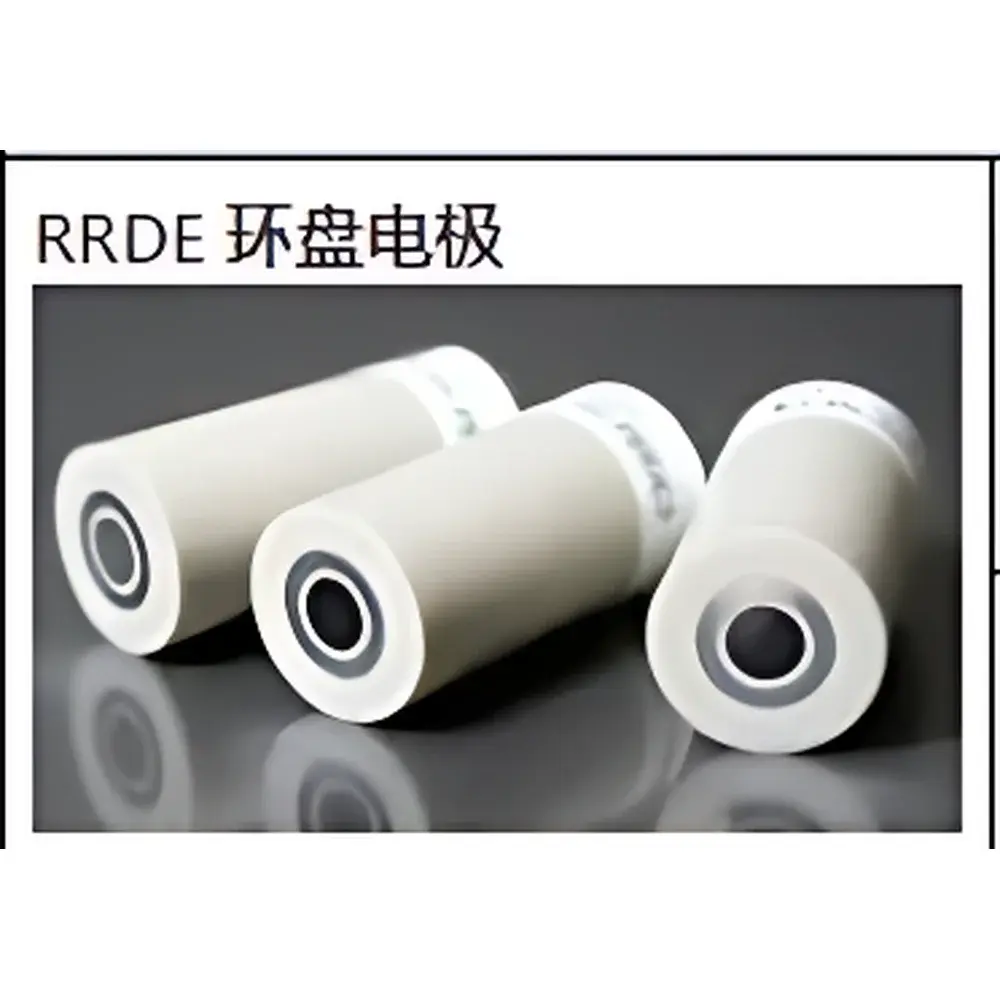
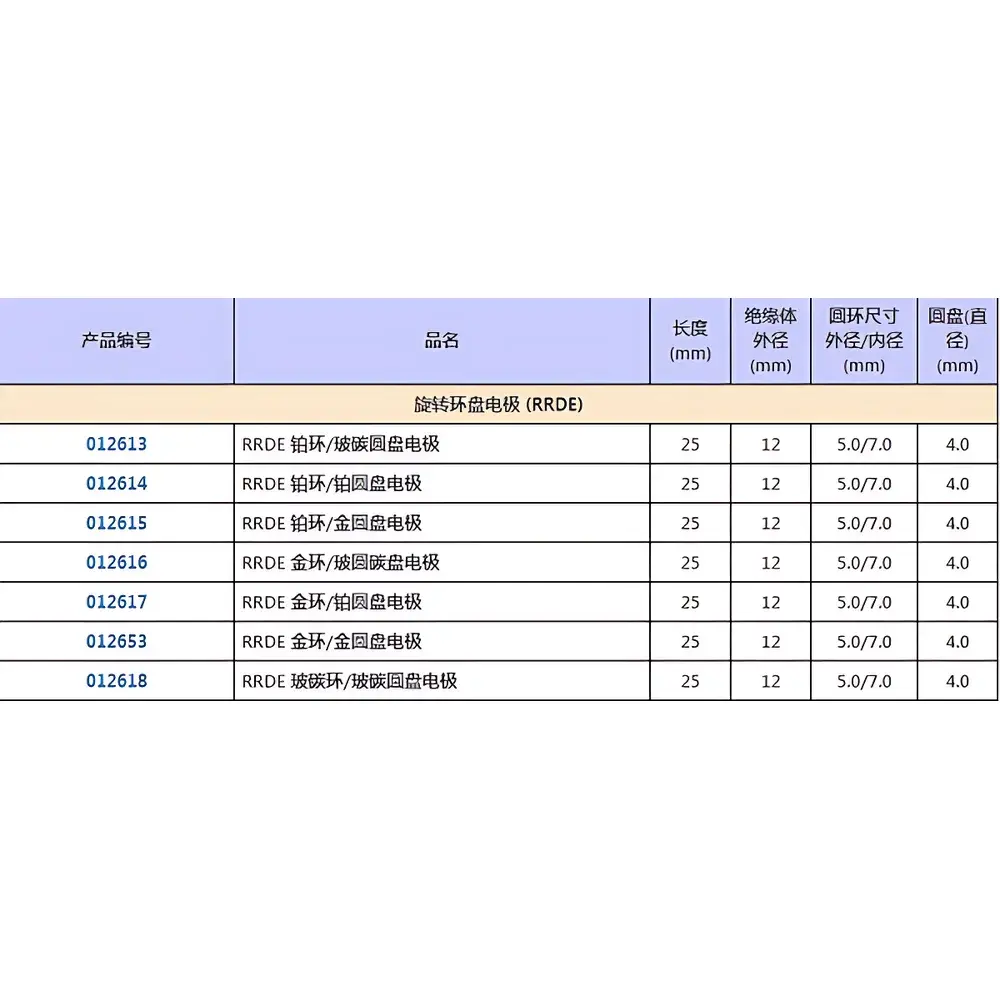
ALS 012613 Rotating Ring-Disk Electrode (RRDE) Assembly for RRDE-3A System
| Brand | ALS |
|---|---|
| Origin | Japan |
| Model | 012613 |
| Electrode Type | Rotating Ring-Disk Electrode (RRDE) |
| Ring Outer Diameter | 7 mm |
| Ring Inner Diameter | 5 mm |
| Disk Diameter | 4 mm |
| Insulator Diameter | 12 mm |
| Total Length | 25 mm |
| Insulator Material | PEEK (resistant to organic solvents) |
| Compatible System | ALS RRDE-3A Rotating Ring-Disk Electrode Instrument |
| Polishing Compatibility | PK-3 Electrode Polishing Kit |
| Electrode Material Options | Multiple disk/ring material combinations available (e.g., Pt, Au, GC, Ag, Ni, Cu, and custom bimetallic configurations) |
Overview
The ALS 012613 Rotating Ring-Disk Electrode (RRDE) is a precision-engineered working electrode assembly designed exclusively for integration with the ALS RRDE-3A rotating ring-disk electrochemical instrument. It operates on the fundamental principle of hydrodynamic electrochemistry, where controlled rotation induces well-defined laminar flow (via the Levich equation) across two concentric, electrically isolated electrode surfaces—the central disk and the surrounding annular ring. This geometry enables real-time detection and quantification of short-lived redox intermediates generated at the disk and subsequently captured at the ring, facilitating mechanistic studies of multi-step electron-transfer reactions, catalytic oxygen reduction (ORR), hydrogen peroxide detection, and electrocatalyst stability evaluation. The device is not a standalone instrument but a critical consumable component whose geometric fidelity directly determines the collection efficiency (N) and mass-transport reproducibility—key parameters required for quantitative kinetic analysis under rotating electrode conditions.
Key Features
- Precision-machined coaxial geometry: disk diameter = 4.0 mm, ring inner diameter = 5.0 mm, ring outer diameter = 7.0 mm, ensuring consistent hydrodynamic boundary layer development and validated collection efficiency (N ≈ 0.37–0.42 depending on material configuration).
- PEEK (polyether ether ketone) insulator body: chemically inert toward common organic electrolytes (acetonitrile, DMF, THF, propylene carbonate), resistant to strong acids/bases below 180 °C, and fully compatible with ALS PK-3 mechanical polishing kits for in-lab surface regeneration.
- Modular material selection: independent selection of disk and ring electrode materials—including platinum, gold, glassy carbon, silver, nickel, copper, and alloy-based composites—enabling tailored redox selectivity, overpotential control, and interfacial compatibility with target reaction systems.
- Tight dimensional tolerance: total electrode length = 25.0 mm ± 0.1 mm; insulator outer diameter = 12.0 mm ± 0.05 mm—ensuring secure, repeatable mounting in the RRDE-3A chuck without radial wobble or axial misalignment.
- No electrical cross-talk: hermetic sealing between disk and ring segments via laser-welded or epoxy-integrated PEEK barriers, verified by impedance spectroscopy (<1 nA leakage current at ±1 V bias in 0.1 M KCl).
Sample Compatibility & Compliance
The ALS 012613 RRDE is intended for use in standard three-electrode electrochemical cells under controlled rotation (100–10,000 rpm). It supports aqueous and non-aqueous electrolyte systems, including Li-ion battery electrolytes (e.g., 1 M LiPF6 in EC/DMC), fuel cell media (0.1 M HClO4, 0.1 M KOH), and corrosion testing solutions (3.5 wt% NaCl). Its PEEK construction complies with ISO 10993-5 (biocompatibility screening) and meets ASTM D5204-15 requirements for polymer stability in electrochemical environments. While the electrode itself carries no CE or FDA marking, its use within ALS RRDE-3A systems supports GLP-compliant data acquisition when paired with validated software and audit-trail-enabled potentiostats (e.g., ALS Model 660E with 21 CFR Part 11-compliant firmware).
Software & Data Management
The ALS 012613 requires no embedded firmware or calibration routines—it functions as a passive transducer. All electrochemical control and data acquisition are managed externally via the ALS RRDE-3A controller and associated software suite (ALS Electrochemical Analysis v8.x). The system supports synchronized dual-channel potential control (Edisk, Ering), real-time current logging at up to 100 kHz sampling, and automated Levich/Koutecký–Levich analysis workflows. Raw data export is provided in ASCII (.txt) and binary (.als) formats, compatible with MATLAB, Python (pandas, PyEC), and commercial platforms such as Thermo Scientific™ DeltaVision or BioLogic EC-Lab™ for advanced kinetic modeling.
Applications
- Oxygen reduction reaction (ORR) mechanism studies in PEMFC and metal–air battery catalysts, including peroxide yield quantification (HO2− %).
- Electrocatalytic CO2 reduction product distribution analysis via ring-mediated detection of CO, formate, or oxalate intermediates.
- Corrosion science: in-situ monitoring of passive film breakdown and metastable pitting events using ring-amplified transient currents.
- Enzyme kinetics: immobilized glucose oxidase or laccase activity profiling under convective mass transfer conditions.
- Electroanalytical method development for trace metal speciation (e.g., FeII/FeIII, CuI/CuII) in environmental water matrices.
FAQ
Is the ALS 012613 compatible with non-ALS rotating ring-disk instruments?
No. ALS explicitly states that the 012613 electrode is engineered for mechanical and electrical interoperability only with the RRDE-3A system. Mounting dimensions, chuck interface tolerances, and rotational balance specifications are proprietary and not guaranteed for third-party rotators.
Can the PEEK insulator be autoclaved?
No. PEEK softens above 200 °C; standard autoclaving (121 °C, 15 psi, 20 min) is permissible only if the electrode is fully dry and unmounted—however, repeated steam exposure may degrade long-term dimensional stability. Chemical sterilization (70% ethanol, UV-O3) is recommended.
What is the typical collection efficiency (N) for this geometry?
The theoretical N value is 0.372 for ideal laminar flow; experimentally measured values range from 0.365 to 0.378 when calibrated using the [Fe(CN)6]3−/4− redox couple at 1600 rpm in 1 M KCl, as documented in ALS technical bulletin TB-RRDE-004.
How often should the electrode be repolished?
Repolishing is required whenever cyclic voltammograms show peak broadening (>10% ΔEp increase), decreased peak current reproducibility (>3% RSD), or anomalous background currents—typically after 50–100 experiments in aggressive media or following exposure to particulate-containing solutions.
Related Products




