
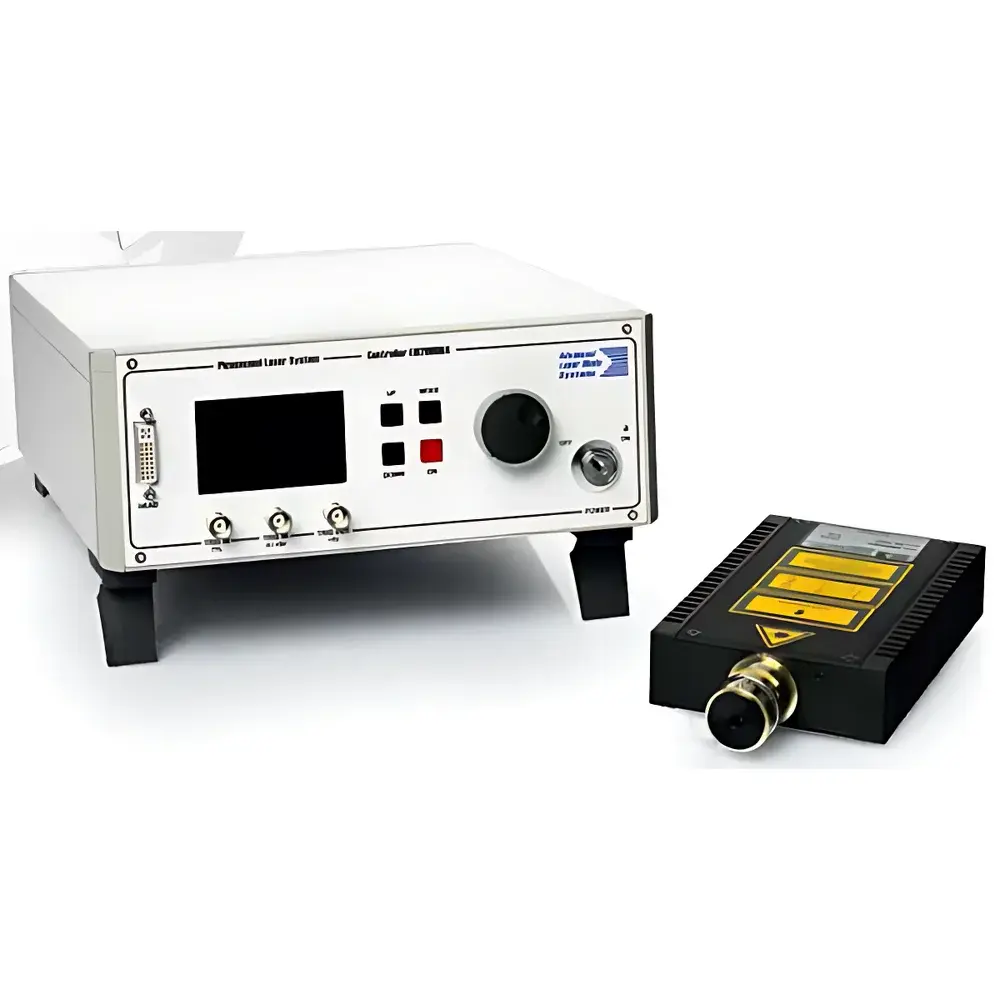
ALS PiLas Picosecond Laser Diode Module
| Brand | ALS GmbH / Advanced Laser Diode Systems |
|---|---|
| Origin | Germany |
| Type | Imported OEM Laser Source |
| Model | PiLas |
| Wavelength Range | 375 nm – 2000 nm |
| Pulse Width | 20 ps – 150 ps (up to 5 ns depending on configuration) |
| Repetition Rate | Single-shot to 120 MHz, continuously adjustable |
| Peak Power | 20 mW – 1 W |
| Average Power (at 100 MHz) | 0.5 mW – 2 mW |
| Pulse Energy | 1 pJ – 50 pJ |
| Beam Quality | M² < 1.1, TEM₀₀ |
| Polarization Extinction Ratio | > 20 dB |
| Timing Jitter | < 3 ps (rms) |
| Output | Free-space or fiber-coupled (SM/PM/MM) |
| Cooling | Air-cooled |
| Control Interface | RS232 or USB |
| Dimensions (Laser Head) | 97 × 31 × 147 mm³ |
| Weight (Laser Head) | 0.45 kg |
| Warm-up Time | < 10 min |
| Operating Temperature | 15 °C – 35 °C |
| Storage Temperature | −20 °C – 65 °C |
Overview
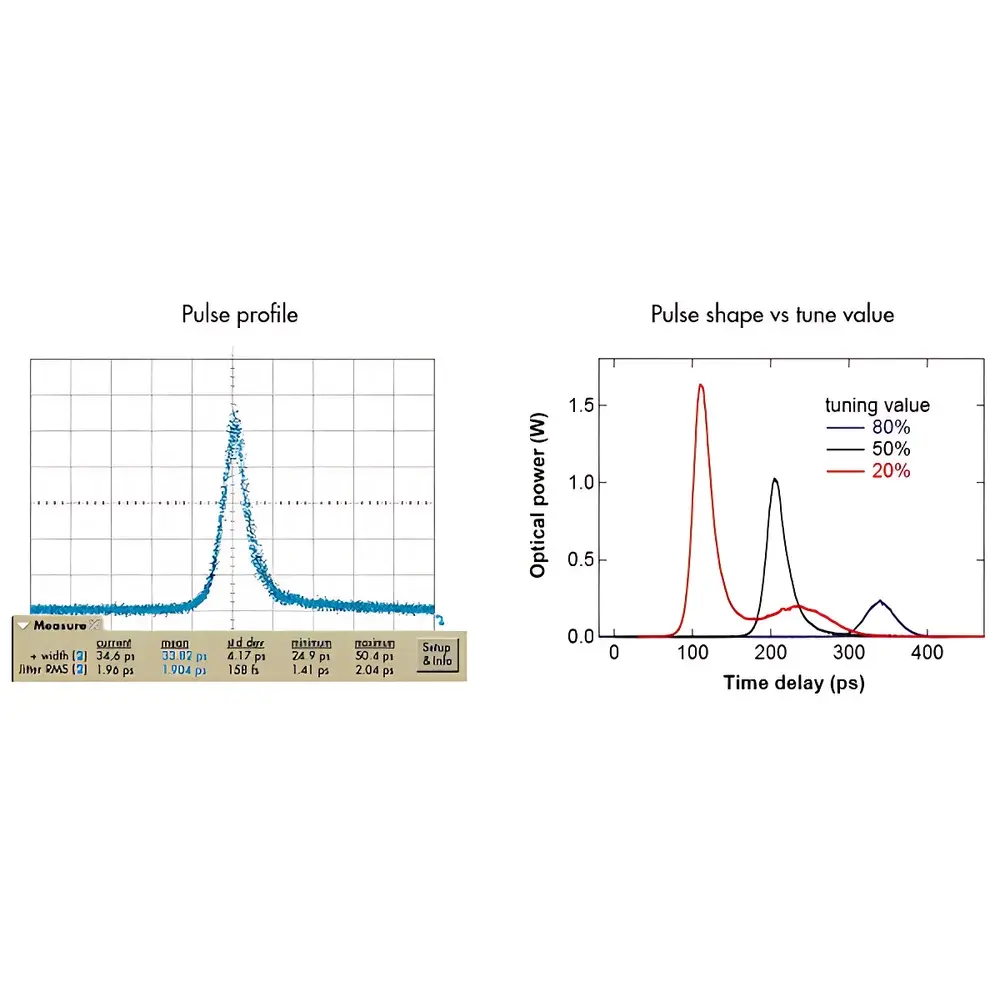
The ALS PiLas Picosecond Laser Diode Module is a compact, turnkey, gain-switched semiconductor laser source engineered for precision time-resolved optical measurements in research and industrial environments. Based on monolithic laser diode technology, the PiLas operates via gain-switching—a method that enables direct electrical pulsing of the diode without external modulation—delivering clean, transform-limited picosecond pulses with exceptional temporal fidelity. Its core architecture supports wavelength coverage from deep UV (375 nm) through visible and near-infrared up to 2 µm, accommodating standard Fabry–Pérot, DFB, and DBR laser diodes. Designed for integration into OEM systems or benchtop instrumentation, the module delivers high pulse-to-pulse stability, low timing jitter (< 3 ps rms), and diffraction-limited beam quality (M² < 1.1, TEM₀₀), making it suitable for applications demanding strict synchronization and minimal temporal broadening—such as pump-probe spectroscopy, time-correlated single-photon counting (TCSPC), and ultrafast photodetector characterization.
Key Features
- Gain-switched operation enabling intrinsic picosecond pulse generation without external modulators or cavity dumping
- Continuously adjustable repetition rate from single-shot to 120 MHz, supporting flexible experimental timing schemes
- Low timing jitter (< 3 ps rms) and high pulse-to-pulse amplitude stability (±1.5% over 24 h), critical for time-domain metrology
- Integrated air-cooling and passive thermal management—no water cooling or active chillers required
- OEM-ready mechanical design: compact laser head (97 × 31 × 147 mm³, 0.45 kg) with light-tight, dust-resistant housing
- Flexible control interface: RS232 or USB for remote parameter setting, trigger synchronization, and status monitoring
- No alignment, no calibration—factory-optimized optical path ensures long-term operational reliability
- Compliant with IEC 60825-1:2014 Class 1 or Class 3B laser safety standards depending on configuration and output power
Sample Compatibility & Compliance
The PiLas module is compatible with a wide range of photonic components and detector technologies—including photomultiplier tubes (PMTs), avalanche photodiodes (APDs), superconducting nanowire single-photon detectors (SNSPDs), and high-bandwidth oscilloscopes—due to its short pulse duration, low jitter, and precise external triggering capability (TTL-compatible, both active and passive modes). All standard configurations meet CE marking requirements for electromagnetic compatibility (EMC Directive 2014/30/EU) and low-voltage safety (LVD Directive 2014/35/EU). When integrated into GLP- or GMP-regulated workflows—e.g., in photonics component qualification or optical time-domain reflectometry (OTDR) calibration—the system supports audit-ready operation when paired with validated firmware and traceable calibration records. Optional DFB variants comply with ITU-T G.694.1 channel spacing specifications for C- and O-band telecom testing.
Software & Data Management
The PiLas is controlled via ASCII-based serial commands (RS232/USB), enabling seamless integration into LabVIEW, Python (PySerial), MATLAB, or custom C/C++ instrument control frameworks. ALS provides a Windows-based GUI application for rapid setup, real-time monitoring of laser status (temperature, current, interlock state), and waveform logging. For regulated environments, the command set supports full audit trail logging when interfaced with compliant data acquisition software adhering to FDA 21 CFR Part 11 requirements—provided user-defined electronic signatures and system access controls are implemented at the host level. Firmware updates are delivered via signed binary packages with SHA-256 checksum verification to ensure integrity and traceability.
Applications
- Time-resolved fluorescence lifetime imaging (FLIM) and TCSPC systems
- Characterization of ultrafast photodetectors (rise time, jitter, quantum efficiency)
- Pump-probe spectroscopy for carrier dynamics in semiconductors and 2D materials
- Optical time-domain reflectometry (OTDR) and distributed fiber sensing
- Ultrafast circuit testing (e.g., time-domain analysis of high-speed ICs and photonic integrated circuits)
- Calibration of streak cameras and fast digitizers requiring sub-10 ps trigger references
- Multi-wavelength excitation in nonlinear microscopy (e.g., two-photon absorption, SHG)
FAQ
What wavelengths are available in standard PiLas configurations?
Standard models cover 375 nm to 1550 nm in discrete steps; custom wavelengths up to 2000 nm are available upon request using InGaAsP or GaSb-based diodes.
Can PiLas be synchronized to an external clock?
Yes—via TTL input with programmable delay (0–100 ns, 10 ps resolution) and selectable edge triggering (rising/falling), supporting master-slave architectures in multi-laser setups.
Is fiber coupling supported, and what fiber types are compatible?
All models support optional PM, SM, or MM fiber output with FC/APC or FC/PC connectors; polarization-maintaining versions preserve >20 dB extinction ratio post-coupling.
Does PiLas require periodic recalibration?
No—gain-switched diode operation eliminates drift-prone cavity alignment; factory-set pulse parameters remain stable over >10,000 power cycles under specified environmental conditions.
How is thermal management handled at high repetition rates?
At repetition rates above 80 MHz, passive heatsinking (optional aluminum baseplate) is recommended to maintain diode junction temperature within specification and ensure long-term power stability.



