
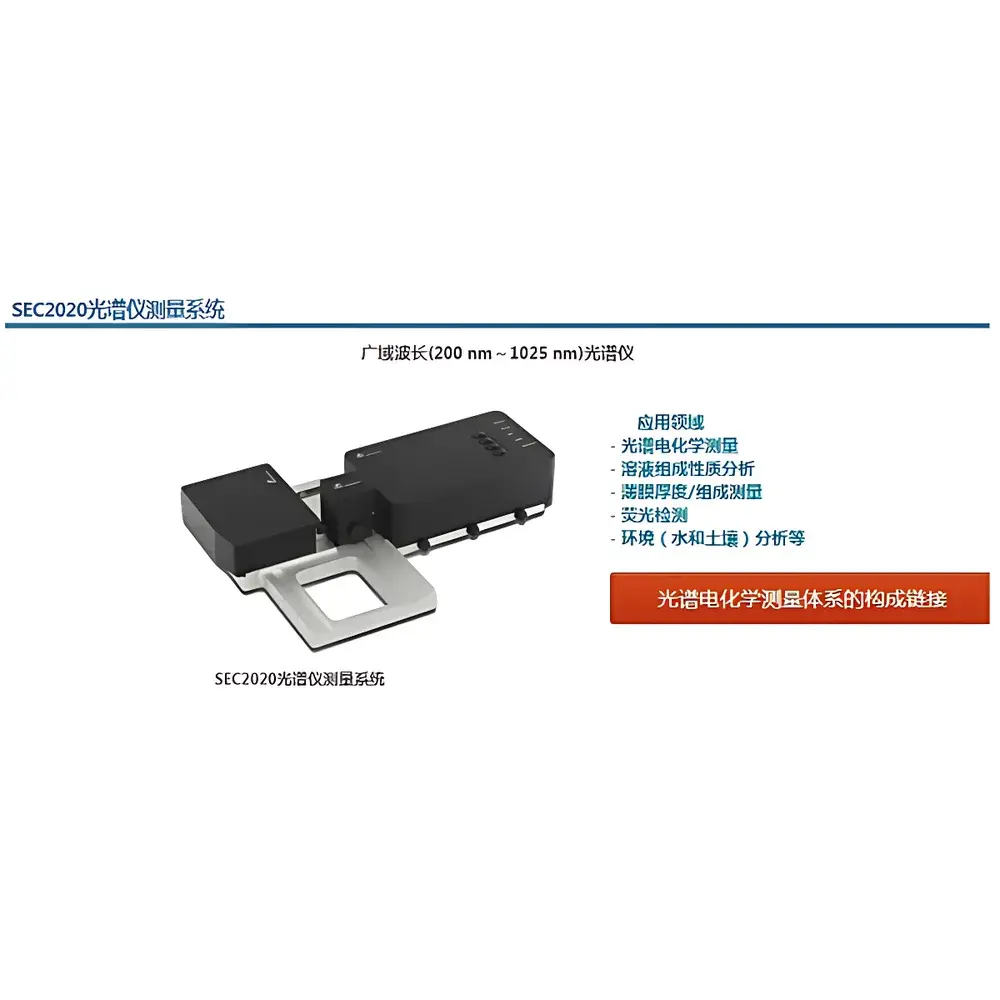
ALS SEC2020 Fiber Optic Spectrometer System
| Brand | ALS |
|---|---|
| Origin | Japan |
| Manufacturer Type | Authorized Distributor |
| Product Origin | Imported |
| Model | SEC2020 |
| Spectral Range | 200–1025 nm |
| Detector Type | Custom CMOS Array (Optimized for UV-VIS-NIR) |
| Optical Resolution (FWHM) | 1.3 nm |
| Sensitivity Range | 200–1025 nm |
| Signal-to-Noise Ratio | 1000:1 (at full integration time, 60 s) |
| Dynamic Range | 7.5 × 10⁹ (system-level, 16-bit digitization with multi-exposure synthesis) |
| Stray Light | < 0.09% at 500 nm |
Overview
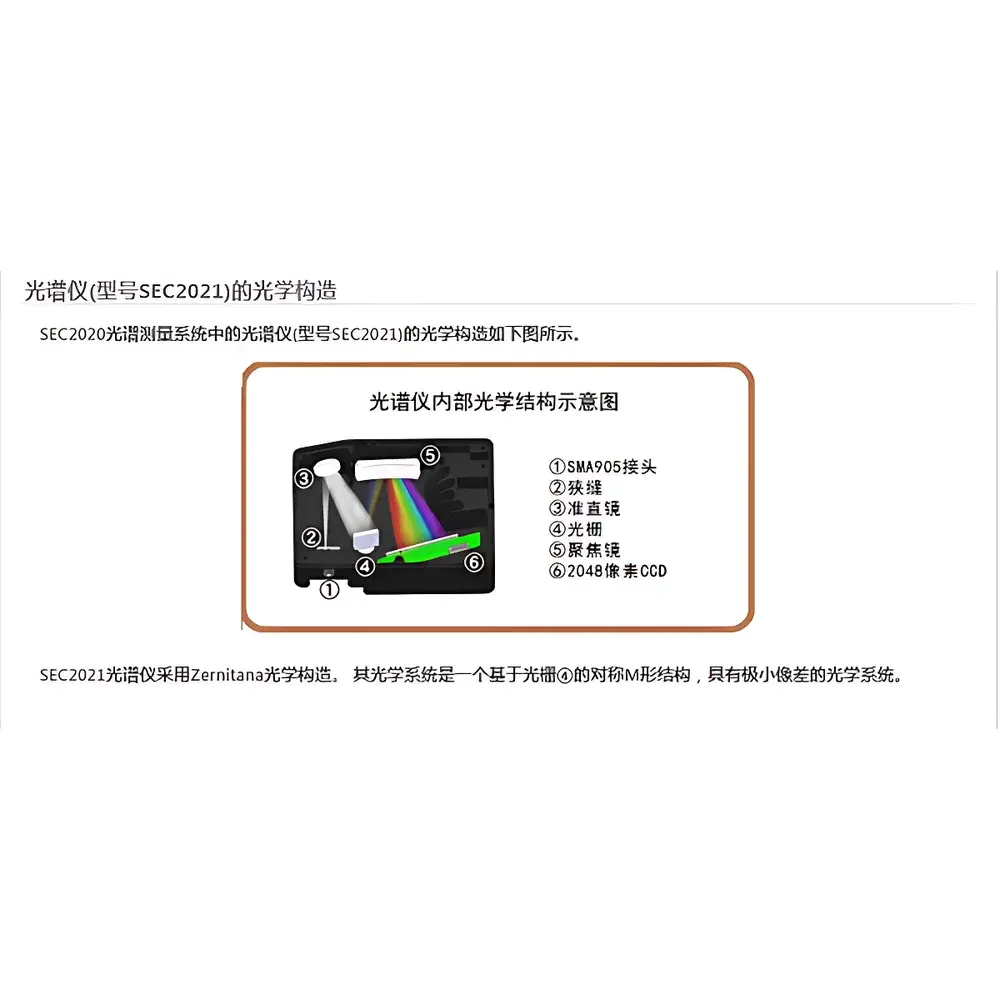
The ALS SEC2020 Fiber Optic Spectrometer System is a high-performance, modular UV-VIS-NIR spectral measurement platform engineered for precision spectroscopic applications in electrochemical, photochemical, and materials characterization laboratories. Designed as the direct successor to the discontinued SEC2000 series (production ceased January 2017), the SEC2020 integrates an optimized Czerny-Turner optical architecture with a high-efficiency holographic grating and a thermally stabilized CMOS linear array detector. Its 200–1025 nm spectral coverage enables seamless acquisition across ultraviolet, visible, and near-infrared domains—critical for applications such as in situ spectroelectrochemistry, reflectance/transmittance quantification, LED spectral profiling, and thin-film optical characterization. The system operates on fiber-coupled principles, supporting flexible experimental configurations via standardized SMA 905 interfaces, and is calibrated traceably to NIST-traceable standards at factory level.
Key Features
- UV-VIS-NIR broadband detection (200–1025 nm) with single-scan capability and no mechanical grating scanning required
- Optical resolution of 1.3 nm (FWHM) at 500 nm, achieved through diffraction-limited collimation and high-line-density grating design
- High dynamic range of 7.5 × 10⁹ enabled by adaptive exposure control and on-chip pixel binning logic
- Stray light suppression < 0.09% at 500 nm, meeting ISO 17025-compliant optical purity requirements for quantitative absorbance measurements
- Integrated compact deuterium-halogen combined light source (200–2500 nm output), mechanically decoupled from spectrometer head to minimize thermal drift
- Modular mounting base with kinematic alignment features for stable, repeatable coupling to potentiostats, flow cells, or integrating spheres
- Dedicated instrument transport case compliant with IATA packaging guidelines for laboratory equipment shipping and storage
Sample Compatibility & Compliance
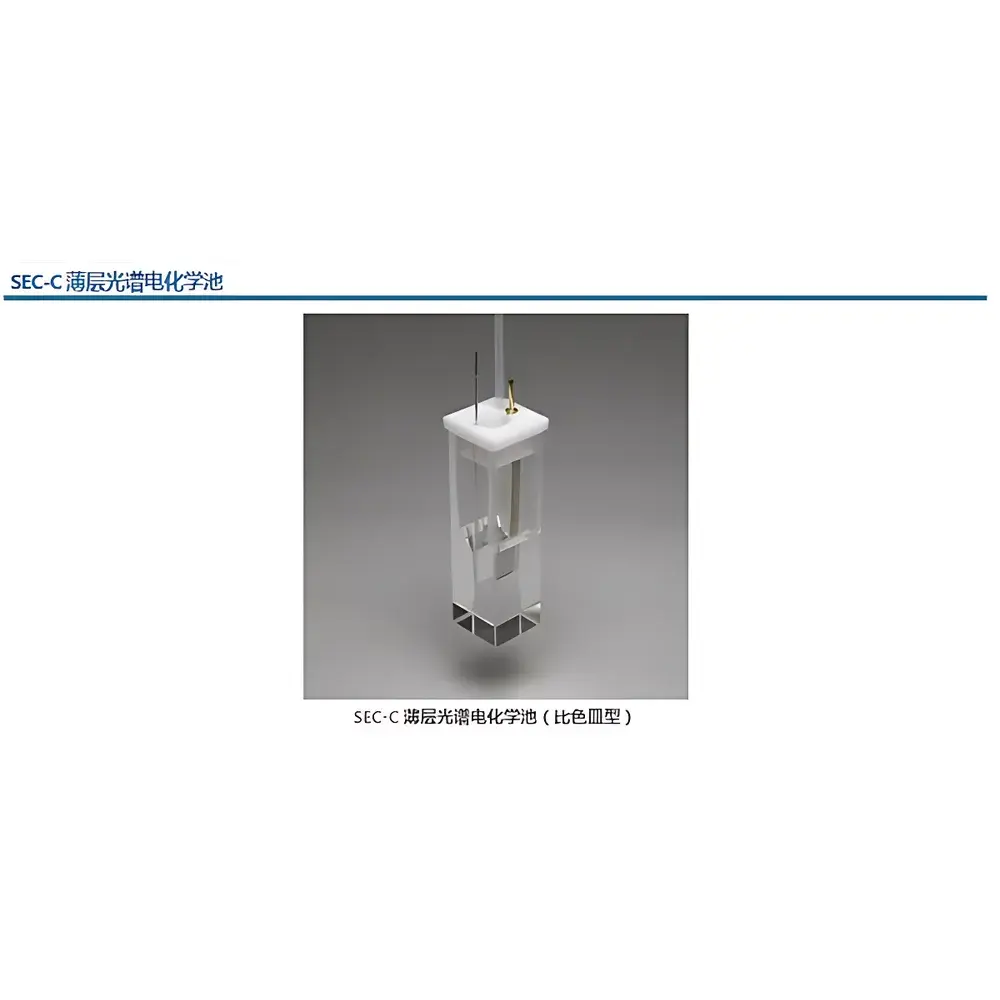
The SEC2020 is compatible with standard 400 µm core silica optical fibers (SMA 905 termination), enabling direct interfacing with electrochemical cells equipped with quartz windows, cuvette holders, fiber-optic probes (e.g., reflection, immersion, or bifurcated), and custom-built reaction chambers. It supports liquid, solid, and gas-phase samples under ambient or controlled-atmosphere conditions. The system complies with electromagnetic compatibility (EMC) requirements per IEC 61326-1:2023 and meets safety standards IEC 61010-1:2010 for laboratory electrical equipment. While not certified for GMP environments out-of-the-box, its data integrity framework—including timestamped spectra, user-defined metadata tagging, and raw binary file export—supports alignment with FDA 21 CFR Part 11 when deployed with validated third-party LIMS or ELN software.
Software & Data Management
The SEC2020 ships with ALS SpectraView v3.2—a Windows-based acquisition and analysis suite supporting real-time spectral preview, kinetic scan mode (up to 100 spectra/s), baseline correction (Rubberband, polynomial), peak integration (Gaussian/Lorentzian fitting), and absorbance/transmittance/reflectance conversion. All spectral data are saved in vendor-neutral ASCII (.csv) and HDF5 (.h5) formats, ensuring interoperability with Python (NumPy, SciPy, h5py), MATLAB, OriginPro, and Igor Pro. Audit trails record operator ID, acquisition parameters, calibration date, and firmware version per spectrum. Software updates are delivered via secure HTTPS portal with SHA-256 signature verification.
Applications
- In situ and operando spectroelectrochemistry: simultaneous potential control (via integrated potentiostat interface) and time-resolved UV-VIS-NIR spectral acquisition during redox processes
- Photocatalytic reaction monitoring: tracking transient absorption bands of reactive intermediates (e.g., TiO₂ surface states, •OH radicals) between 250–800 nm
- LED and OLED spectral power distribution (SPD) analysis, including chromaticity coordinate calculation (CIE 1931) and correlated color temperature (CCT)
- Thin-film thickness and refractive index determination using interference fringe analysis in transmission or reflection mode
- Quantitative concentration assays via Beer-Lambert law application, supported by built-in multivariate calibration tools (PLS, PCA)
- Environmental water quality screening: nitrate, nitrite, and dissolved organic carbon (DOC) estimation via characteristic UV absorption bands
FAQ
Is the SEC2020 compatible with third-party potentiostats?
Yes—the system includes TTL-triggered external start/stop functionality and analog voltage input for synchronized potential ramping; full integration guides are provided for Metrohm Autolab, BioLogic SP-300, and Gamry Interface series.
What calibration options are available?
Factory calibration includes wavelength (Hg/Ar emission lines) and radiometric (NIST-traceable tungsten halogen lamp) certificates. Optional annual recalibration service includes stray light verification and SNR validation per ASTM E275-22 Annex A3.
Can the SEC2020 operate in vacuum or inert gas environments?
The spectrometer head is sealed and rated IP52; however, the integrated light source module requires ambient air cooling and must remain external to sealed enclosures. For glovebox use, fiber feedthroughs and remote source placement are recommended.
Does the software support automated batch processing?
Yes—SpectraView v3.2 includes scriptable macros (VBScript-compatible) for unattended sequence execution, folder-based batch import, and report generation in PDF/XLSX format with embedded metadata.
Is firmware upgrade possible in the field?
Yes—firmware updates are distributed as signed .bin files and applied via USB-C connection using the included ALS Firmware Updater utility; rollback capability is retained for validation continuity.






