
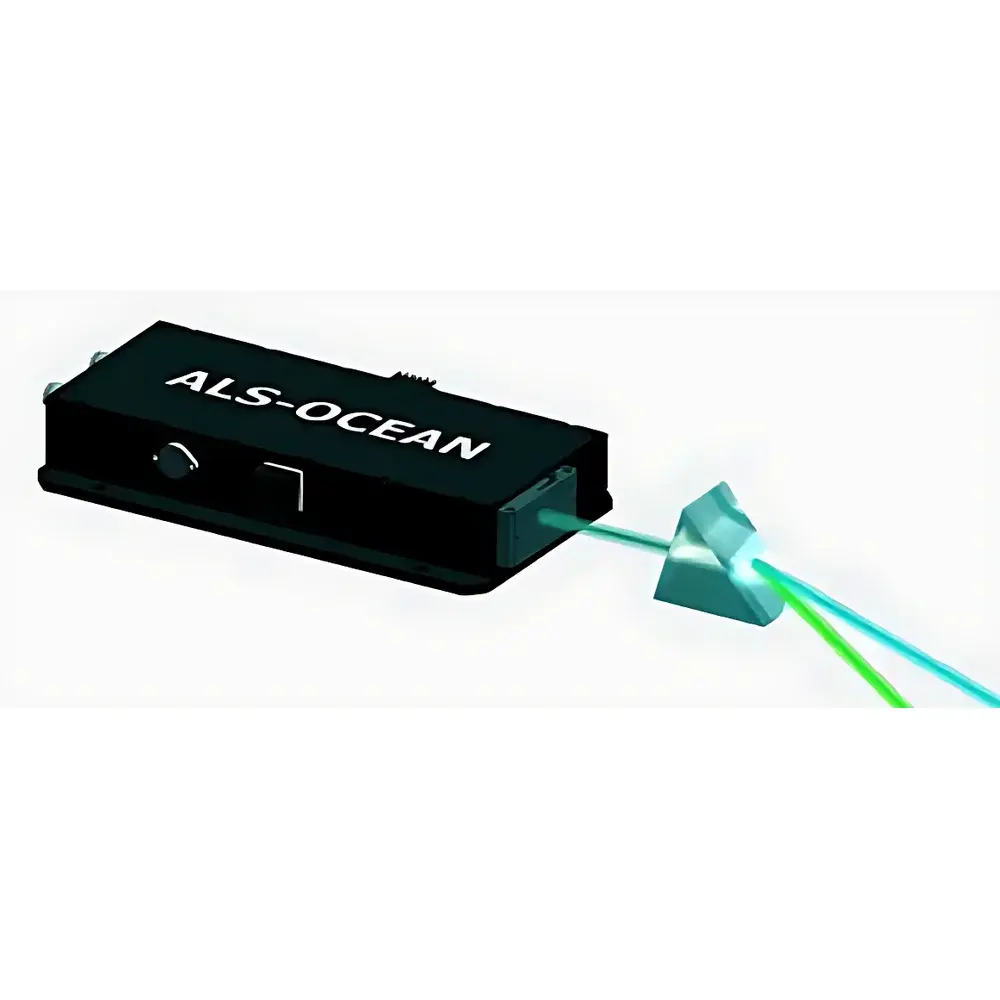
ALS-VISIBLE & ALS-OCEAN Series High-Power Narrow-Linewidth Fiber Laser Systems (488 nm / 515 nm / 532 nm)
| Key | Origin: USA |
|---|---|
| Type | Fiber-Based CW Laser System |
| Wavelength Options | 488 nm, 515 nm, 532 nm |
| Linewidth | ≤100 kHz (single longitudinal mode) |
| Output Power | Up to 10 W (diffraction-limited, TEM₀₀) |
| Wavelength Drift | <0.1 pm over several hours |
| Cooling | Passive (fanless, chiller-free optical head) |
| Configurations | Single-wavelength (ALS-VISIBLE) or multi-wavelength (ALS-OCEAN, up to 3 wavelengths in one head) |
| Beam Delivery | Collinear or parallel multi-port (2/4/8/16 outputs available) |
| Compliance | Designed for OEM integration and laboratory-grade metrology applications |
Overview
The ALS-VISIBLE and ALS-OCEAN series represent a class of high-brightness, narrow-linewidth, continuous-wave (CW) fiber laser systems engineered for demanding visible-light applications requiring spectral purity, power stability, and long-term wavelength fidelity. Operating at precisely stabilized wavelengths of 488 nm, 515 nm, and 532 nm, these lasers utilize polarization-maintaining, all-fiber architectures with integrated distributed feedback (DFB) or external cavity stabilization to achieve single longitudinal mode (SLM) emission with linewidths ≤100 kHz. The core measurement principle relies on stimulated emission within ytterbium- or frequency-doubled erbium-doped fiber gain media, followed by active or passive thermal and current control to suppress mode hopping and ensure sub-picometer wavelength stability over multi-hour operational periods. Unlike traditional ion gas lasers—particularly high-power argon-ion sources—these systems deliver diffraction-limited (TEM₀₀) output with superior beam quality (M² < 1.1), lower electrical consumption, zero ozone generation, and no high-voltage discharge requirements. They are expressly designed for integration into scientific instrumentation platforms where reliability, footprint constraints, and compliance with laboratory safety standards (e.g., IEC 60825-1 Class 4) are critical.
Key Features
- Diffraction-limited CW output up to 10 W per wavelength channel, maintaining TEM₀₀ spatial mode integrity across full power range
- Narrow spectral linewidth ≤100 kHz (SLM operation), enabling high-resolution spectroscopy, coherent detection, and nonlinear frequency conversion
- Passive thermal management: fanless, chiller-free optical head with no moving parts—ideal for vibration-sensitive environments including atomic physics setups and scanning microscopy stages
- Long-term wavelength stability: 4 hours under ambient temperature fluctuations (±1 °C), verified via wavemeter traceability
- OEM-optimized mechanical design: compact footprint (<250 × 180 × 75 mm for standard head), low power draw (<150 W total system input), and RS-232/Ethernet interface for remote control
- Multi-wavelength integration: ALS-OCEAN platform supports co-packaged 488/515/532 nm outputs in a single housing with optional collinear or spatially separated beam paths
- Scalable beam distribution: configurable multi-port output (2, 4, 8, or 16 channels) with uniform power splitting and polarization preservation—reducing cost-per-channel in parallelized assays or multi-site illumination
Sample Compatibility & Compliance
These lasers are compatible with standard SMF-28 or PM980 fiber pigtails (FC/APC or free-space collimated output options). No sample-contact hardware is required; integration occurs at the optical interface level. All units comply with IEC 60825-1:2014 (Edition 3) for Class 4 laser product safety, including interlock-ready connectors and embedded emission indicators. For regulated environments—including GLP/GMP-compliant analytical labs—the system supports optional audit-trail-enabled firmware (via Ethernet) aligned with FDA 21 CFR Part 11 data integrity principles. While not certified to ISO/IEC 17025 as a standalone measuring instrument, the lasers meet metrological traceability requirements when used with NIST-traceable wavemeters and power meters (e.g., Thorlabs S120VC, Bristol 621A). No hazardous materials (e.g., mercury, beryllium copper) are employed in optical path construction.
Software & Data Management
The laser platform includes a vendor-provided SDK (C/C++, Python, LabVIEW) supporting real-time monitoring of diode current, TEC temperature, output power (via internal photodiode), and fault status. Optional GUI software enables closed-loop power stabilization (<±0.25% RMS over 8 hours) and scheduled wavelength sweeps (0.01–10 pm step resolution). All operational logs—including timestamps, setpoints, and environmental sensor readings—are exportable in CSV or HDF5 format. Remote diagnostics and firmware updates occur over secure TLS-encrypted Ethernet connections. Integration with third-party DAQ systems (e.g., National Instruments PXIe-6363) is validated using NI-DAQmx drivers. Audit trail functionality records user login, parameter changes, and emergency stop events—supporting 21 CFR Part 11 electronic record requirements when deployed with qualified IT infrastructure.
Applications
- Confocal and super-resolution fluorescence microscopy (e.g., STED, SIM), where stable 488 nm excitation minimizes photobleaching and improves signal-to-noise ratio
- Raman spectroscopy pump sources: narrow linewidth enables high spectral resolution (<0.1 cm⁻¹) and reduces fluorescence background in biological tissue analysis
- Optical trapping and atom cooling: low intensity noise (<0.03% RMS, 10 Hz–10 MHz) and exceptional pointing stability (<1 μrad/°C) support Bose-Einstein condensate formation and magneto-optical trap (MOT) alignment
- Holographic interferometry and digital holography: coherence length >1 km (at 100 kHz linewidth) ensures high-contrast fringe visibility in dynamic deformation measurement
- Industrial metrology: Doppler velocimetry, laser triangulation, and structured light projection benefit from consistent beam profile and minimal power drift
- Replacement of legacy argon-ion lasers: same wavelength set with >5× higher wall-plug efficiency, 10× longer lifetime (>20,000 h MTBF), and reduced facility cooling load
FAQ
What is the typical coherence length of the 488 nm ALS-VISIBLE laser at 100 kHz linewidth?
Coherence length Lc ≈ c / (π × Δν) ≈ 1.0 km (theoretical), confirmed experimentally via Michelson interferometry with >95% fringe visibility at 800 m path difference.
Can the ALS-OCEAN system deliver all three wavelengths simultaneously with independent power control?
Yes—each wavelength channel features individual current and TEC control loops, enabling independent power adjustment from 10% to 100% of rated output without cross-talk or thermal crosstalk.
Is free-space collimated output available, and what is the beam divergence specification?
Standard collimated output uses aspheric optics delivering M² < 1.1 and divergence < 0.5 mrad (1/e², full angle); custom beam expanders or anamorphic prism pairs are supported upon request.
Does the system support analog modulation, and what is the bandwidth limit?
Analog modulation input (0–5 V) is provided with −3 dB bandwidth of 100 kHz for intensity control; digital TTL modulation supports up to 500 kHz square-wave switching with <10 ns rise time.
Are calibration certificates traceable to NIST or equivalent national metrology institutes included?
Factory calibration reports include wavelength accuracy (±0.5 pm, traceable to NIST SRM 2520a), output power linearity (±1.5% full scale), and polarization extinction ratio (>20 dB)—available upon order fulfillment.





