
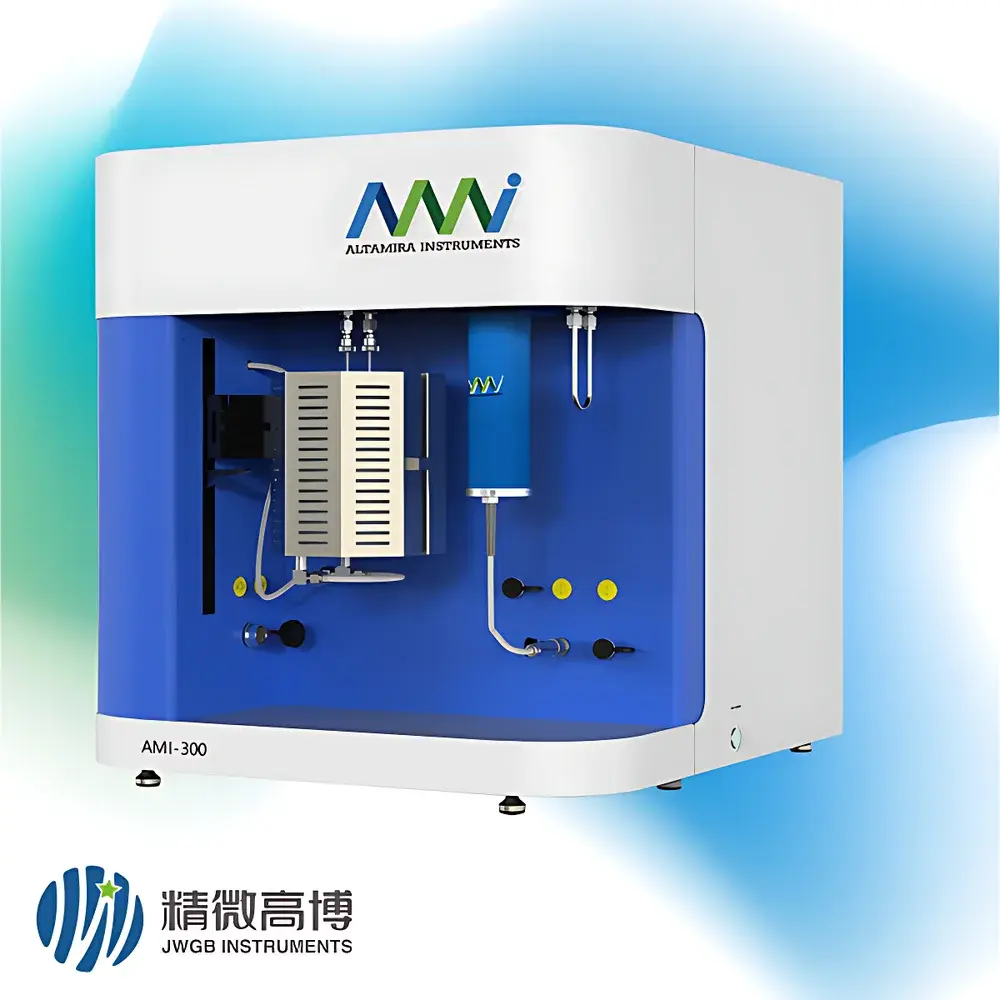
Altamira AMI-300 Automated Temperature-Programmed Chemisorption Analyzer
| Brand | Altamira (USA) |
|---|---|
| Origin | USA |
| Model | AMI-300 |
| Instrument Type | Chemisorption Analyzer |
| Measurement Principle | Continuous Flow Method |
| Gas Inlet Ports | Expandable to 12 |
| Temperature Range | Ambient to 1200°C (optional low-temp module: –130°C to 1200°C) |
| Isothermal Stability | ±0.01°C |
| Heating Rate | 1–50°C/min |
| Pressure Range | Atmospheric to 30 bar (optional up to 100 bar) |
| Core Functions | TPR, TPO, TPD, TPS, Pulse Chemisorption, Pulse Calibration |
| Detector Options | Integrated high-sensitivity TCD (dual-filament or quad-filament, W or Au/W), compatible with external MS, FTIR, FID, GC |
| Gas Handling | Built-in precision gas mixer, heated/insulated lines & valves, vapor-saturated gas generation (temperature-controlled saturator) |
| Sample Configuration | Removable clamshell furnace, quartz U-tube/bubble tube/straight-wall tubes (low-pressure) |
| Safety Systems | Multi-point temperature monitoring, over-temperature cutoff, TCD flow interlock, dry-run protection, front emergency stop |
| Software | Windows-based, fully automated experiment sequencing, real-time dual-temperature logging (furnace + bed), FDA 21 CFR Part 11–ready audit trail (optional), GLP/GMP-compliant data export |
Overview
The Altamira AMI-300 is a fully automated, continuous-flow temperature-programmed chemisorption analyzer engineered for quantitative surface characterization of heterogeneous catalysts under dynamically controlled thermal and gaseous environments. It operates on the fundamental principle of adsorption/desorption kinetics coupled with thermal ramping—where transient gas-phase concentration changes are monitored in real time as a function of programmed temperature—enabling precise determination of active site density, metal dispersion, adsorption enthalpy distribution, reducibility, oxidation state evolution, and surface reaction pathways. Unlike static volumetric systems, the AMI-300’s continuous-flow architecture minimizes dead volume through 1/16″ electropolished 316 stainless steel fluidic paths, ensuring rapid signal response, narrow peak dispersion, and high reproducibility across TPR, TPO, TPD, and TPS experiments. Its modular design supports both standard atmospheric operation and high-pressure catalytic evaluation (up to 100 bar), making it suitable for R&D labs investigating structure–activity relationships in Fischer–Tropsch synthesis, hydrodesulfurization, ammonia synthesis, automotive three-way catalysts, PEM fuel cell electrodes, and battery electrode interfaces.
Key Features
- Multi-Gas Flexibility: Standard configuration includes four independent mass flow controllers (MFCs) for carrier, pretreatment, reactant, and purge gases; expandable to 12 total inlet ports via optional manifold modules.
- Ultra-Stable Thermal Control: Dual-zone temperature regulation enables simultaneous monitoring and control of furnace shell and sample bed temperatures—critical for distinguishing bulk heating effects from localized surface reactions.
- Extended Thermal Range: Operating range spans –130°C to 1200°C (with cryo-cooling and high-temp furnace options), covering cryogenic physisorption, low-temperature CO chemisorption, and high-temperature coke oxidation or metal sintering studies.
- Integrated Vapor Delivery: Onboard temperature-regulated saturator generates reproducible, fully saturated vapor streams (e.g., H2O, NH3, SO2) without condensation risk—enabled by fully heated valves, transfer lines, and detector interfaces.
- Modular Detection Architecture: Factory-integrated quad-filament TCD (tungsten or gold/tungsten alloy) offers sub-ppm sensitivity; seamless hardware/software integration with quadrupole MS, FTIR, or GC allows correlative detection and synchronized data acquisition within a single experimental file.
- Automated Safety & Diagnostics: Real-time flow verification, thermocouple redundancy, automatic cooldown initiation upon power loss, and configurable emergency shutdown protocols comply with IEC 61508 SIL-2 functional safety guidelines.
Sample Compatibility & Compliance
The AMI-300 accommodates diverse sample geometries and chemical environments. Low-pressure configurations utilize quartz U-tubes, bubble tubes, or straight-wall reactors (0.1–1.0 g typical loading); high-pressure variants employ thick-walled 316 stainless steel microreactors rated to 100 bar. All wetted surfaces accept chemically resistant elastomer seals (Viton®, Kalrez®, Buna-N®), enabling compatibility with corrosive feeds including Cl2, H2S, NH3, and halogenated organics. The system meets ASTM D7215 (TPR of supported metals), ISO 18349 (catalyst redox behavior), and USP <621> chromatographic method validation requirements when operated with validated software modules. Optional 21 CFR Part 11 compliance package includes electronic signatures, immutable audit trails, role-based access control, and data integrity logging—fully aligned with GLP and GMP laboratory practices.
Software & Data Management
AMI-300 Control Suite is a native Windows application supporting full experimental automation—from gas sequence definition and temperature ramp programming to real-time data streaming and post-run deconvolution. Users define multi-step protocols (e.g., reduction → purge → pulse injection → desorption scan) with conditional logic (e.g., “hold at 300°C until H2 consumption falls below 0.05 mL/min”). Raw TCD/MS signals are time-stamped and synchronized with dual-temperature logs. Quantitative analysis includes peak integration using Gaussian/Lorentzian fitting, baseline correction algorithms, and stoichiometric calibration against certified reference pulses. Export formats include ASCII, CSV, and HDF5; all datasets embed metadata (instrument ID, operator, timestamp, method version) for traceability. Batch processing tools enable comparative analysis across multiple samples, while Python API support allows custom scripting for machine learning–driven feature extraction.
Applications
- Determination of metal dispersion and particle size distribution via H2 or CO pulse chemisorption
- Quantification of oxygen storage capacity (OSC) and redox kinetics in ceria-zirconia automotive catalysts
- Mapping acid site strength and density in zeolites and solid acids using NH3-TPD
- In situ monitoring of sulfur poisoning and regeneration cycles in hydroprocessing catalysts
- Thermal stability assessment of single-atom catalysts under simulated reforming conditions
- Surface speciation analysis during CO2 hydrogenation over Cu/ZnO/Al2O3 via operando TPD–MS
- Correlating surface hydride coverage with electrocatalytic activity in NiMo sulfide HER catalysts
FAQ
Can the AMI-300 perform simultaneous TCD and MS detection during a single TPR run?
Yes—the system supports hardware-synchronized acquisition from both detectors, with time-aligned data streams exported to a unified .hdf5 file containing calibrated concentration traces, temperature profiles, and pressure logs.
Is calibration traceable to NIST standards?
All MFCs are factory-calibrated against NIST-traceable flow standards; optional annual recalibration services include certificate documentation per ISO/IEC 17025.
What sample preparation is required prior to loading?
Samples must be pre-dried under vacuum or inert gas flow; no special mounting fixtures are needed—standard quartz or stainless steel tubes insert directly into the clamshell furnace.
Does the software support ASTM-compliant reporting templates?
Preconfigured report generators produce ASTM D7215–compliant outputs, including peak temperature tables, integrated area calculations, and uncertainty estimates based on signal-to-noise ratio and calibration curve residuals.
How is moisture managed in vapor-saturation experiments?
The saturator temperature is independently controlled and logged; all downstream components—including the reactor zone, transfer lines, and detector cell—are actively heated to ≥5°C above saturator temperature to prevent condensation or adsorptive滞留.
Related Products



