
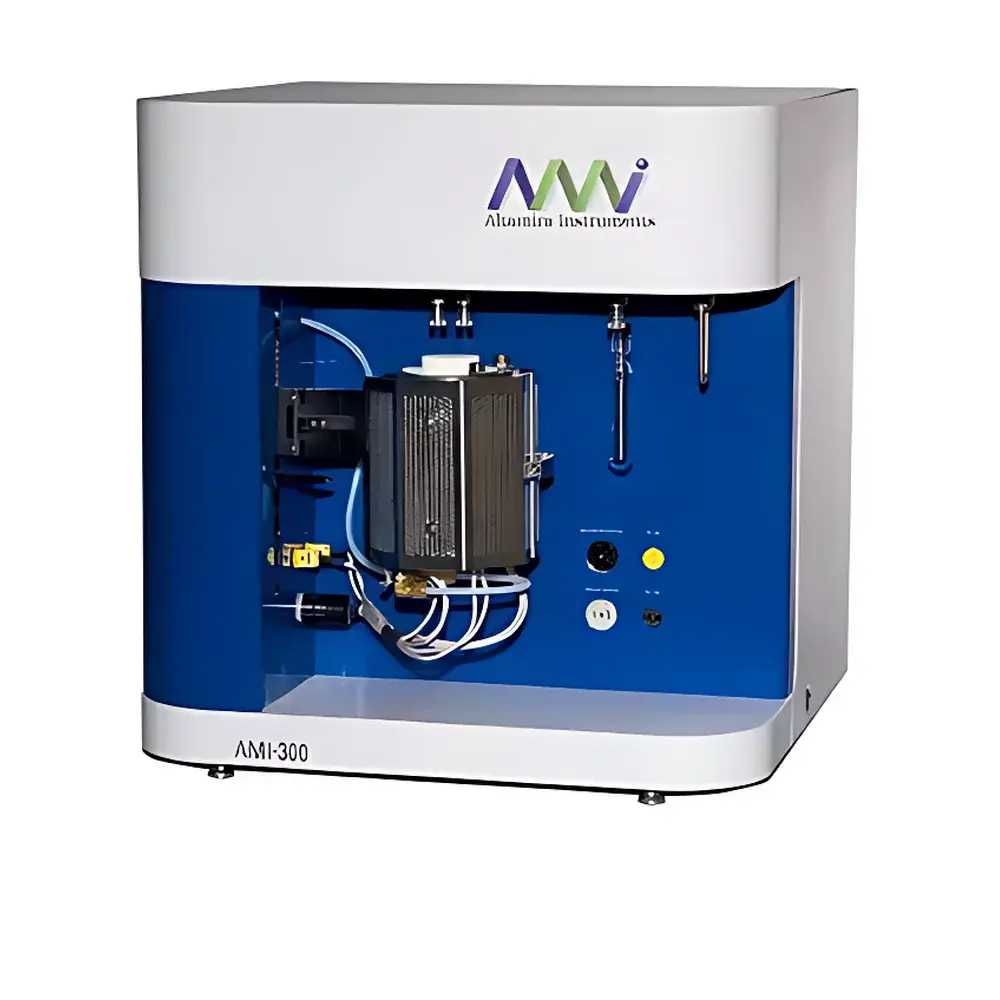
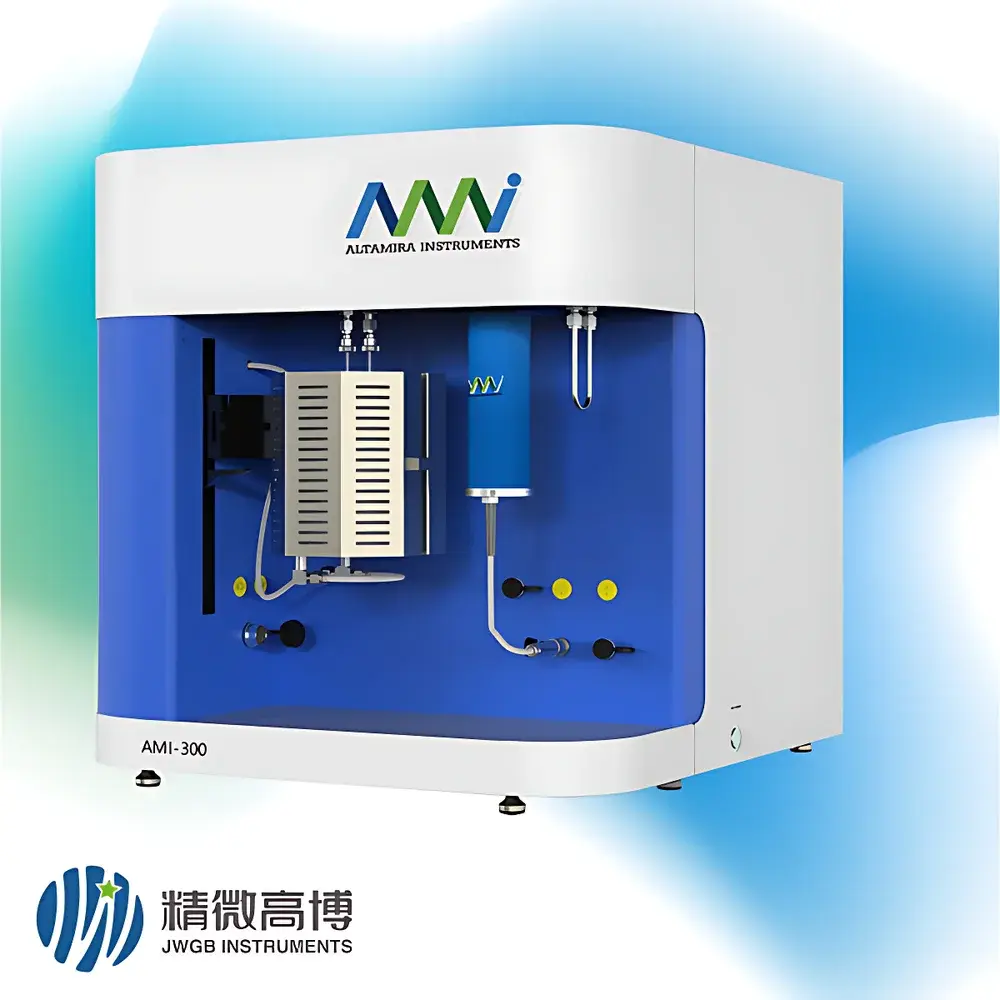
Altamira AMI-300 Automated Temperature-Programmed Chemisorption Analyzer
| Brand | Altamira (USA) |
|---|---|
| Origin | USA |
| Model | AMI-300 |
| Instrument Type | Chemisorption Analyzer |
| Measurement Principle | Continuous Flow Method |
| Gas Inlet Ports | Expandable to 12 |
| Temperature Range | Ambient to 1200°C |
| Isothermal Stability | ±0.01°C |
| Heating Rate | 1–50°C/min |
| Pressure Range | Atmospheric to 30 bar (optional up to 100 bar) |
| Analytical Modes | TPR, TPO, TPD, TPS, Pulse Chemisorption, Pulse Calibration |
| Detector Options | Integrated High-Sensitivity TCD (dual-filament or quad-filament, W or Au/W), MS/GC/FTIR/FID compatibility |
| Sample Capacity | 0.1–1.0 g |
| Sample Tube Types | Quartz U-tube, bubble tube, straight-wall tube (low-pressure) |
| Tubing | 1/16″ OD 316 SS, heated throughout |
| Gas Mixing | Internal precision gas mixer (no external mixer required) |
| Cooling | Automated air-cooling module |
| Safety Systems | Dual-zone temperature monitoring, over-temperature cutoff, TCD flow interlock, front-panel emergency stop |
| Software | Windows-based, fully automated experiment sequencing, real-time dual-temperature logging (furnace & bed), GLP-compliant data audit trail, FDA 21 CFR Part 11-ready configuration options |
Overview
The Altamira AMI-300 Automated Temperature-Programmed Chemisorption Analyzer is an engineered platform for quantitative surface characterization of heterogeneous catalysts and functional materials via dynamic thermal desorption and adsorption techniques. Based on the continuous flow measurement principle, the system precisely controls gas composition, temperature ramping, and pressure while simultaneously monitoring effluent composition using a high-stability thermal conductivity detector (TCD) or externally coupled analytical instruments (e.g., quadrupole mass spectrometer, FTIR, or GC-FID). The AMI-300 enables rigorous determination of active metal dispersion, adsorption enthalpy distribution, surface site density, reducibility (TPR), oxidizability (TPO), desorption energetics (TPD), and surface reactivity under controlled atmospheres—critical parameters in catalyst development, reformulation, and lifecycle assessment.
Key Features
- Expandable gas handling architecture with up to 12 independently controlled inlet ports—configured as 4 carrier gas lines, 4 treatment gas lines, and 2 premix channels—each regulated by high-accuracy mass flow controllers (MFCs) with NIST-traceable calibration.
- Ultra-stable temperature control across the full operating range (ambient to 1200°C), delivering ±0.01°C isothermal stability and linear heating rates from 1 to 50°C/min, with optional cryogenic extension down to –130°C.
- Minimized dead volume design: all fluidic pathways—including 1/16″ OD electropolished 316 stainless steel tubing, heated valves, and sample zone—maintain uniform temperature to prevent condensation, adsorption hysteresis, or peak broadening.
- Integrated saturated vapor generator with independent temperature regulation, enabling reproducible introduction of water, alcohols, or other condensable vapors into reactive gas streams without liquid carryover.
- Dual-temperature monitoring capability: simultaneous real-time acquisition of furnace thermocouple and embedded bed thermocouple signals ensures accurate kinetic modeling and correction for thermal lag during rapid ramps.
- Automated air-cooling system reduces cooldown time between experiments by >60% compared to passive cooling, increasing daily throughput without compromising thermal history fidelity.
- Modular detector interface supports both serial and parallel coupling to external analyzers; MS data acquisition is synchronized within the native software environment, allowing co-registered TCD and mass spectral output in a single .csv or .tdf file.
Sample Compatibility & Compliance
The AMI-300 accommodates diverse sample geometries and chemistries through interchangeable quartz (U-tube, bubble, straight-wall) and high-pressure 316 stainless steel reactor tubes. Seal materials—including Viton®, Buna-N, and Kalrez®—are selectable based on chemical resistance requirements. All wetted surfaces are inert and vacuum-compatible. The system meets fundamental requirements for ISO 18852 (catalyst characterization), ASTM D7215 (TPR of supported metals), and USP (surface area and porosity of pharmaceutical excipients). When configured with audit trail, electronic signature, and user-role management modules, it supports GLP and GMP environments compliant with FDA 21 CFR Part 11 and EU Annex 11.
Software & Data Management
Control and analysis are performed via Altamira’s proprietary Windows-based software suite, featuring intuitive graphical method builder, real-time parameter visualization, and automated report generation. Experimental sequences—including multi-step pretreatment, gas switching, temperature programming, and pulse injection—are defined prior to run initiation. Raw data files include timestamped metadata (gas flows, temperatures, pressures, detector voltages) with checksum integrity verification. Export formats include ASCII, Excel, and vendor-neutral HDF5. Advanced users may access low-level instrument registers for custom scripting (Python API available). All data changes are logged with operator ID, timestamp, and reason code—enabling full traceability for regulatory submissions.
Applications
The AMI-300 serves as a core tool in catalysis R&D labs across petrochemicals, fine chemicals, emission control, energy storage, and battery materials development. It quantifies hydrogen or CO uptake for metal dispersion calculations in Pt/Al₂O₃ reforming catalysts; evaluates oxygen mobility in ceria-zirconia three-way catalysts via TPO; maps acid site strength distribution in zeolites using NH₃-TPD; and characterizes sulfur tolerance in NiMo hydrotreating catalysts under H₂S-containing streams. Its high-pressure capability (up to 100 bar) supports Fischer–Tropsch, methanation, and ammonia synthesis catalyst screening under industrially relevant conditions. Pulse chemisorption mode delivers stoichiometric quantification of surface-active sites with sub-nmol detection limits.
FAQ
Can the AMI-300 perform simultaneous TCD and mass spectrometry detection during a single TPR experiment?
Yes—the system supports hardware-synchronized data acquisition from both detectors, with time-aligned export to a unified dataset.
Is calibration traceable to national standards?
All MFCs are supplied with NIST-traceable calibration certificates; TCD response factors are determined using certified gas standards per ISO 6142.
What safety certifications does the instrument hold?
CE-marked per IEC 61010-1; UL/CSA listing available upon request; integrated safety interlocks comply with EN 60204-1.
Does the software support automated pass/fail criteria for routine QC testing?
Yes—users can define acceptance thresholds for peak area, temperature onset, or dispersion %; results trigger visual alerts and auto-generated compliance reports.
Can the system be integrated into a centralized lab automation network?
It provides Ethernet-based remote control via TCP/IP and OPC UA protocols, compatible with major LIMS and MES platforms.



