
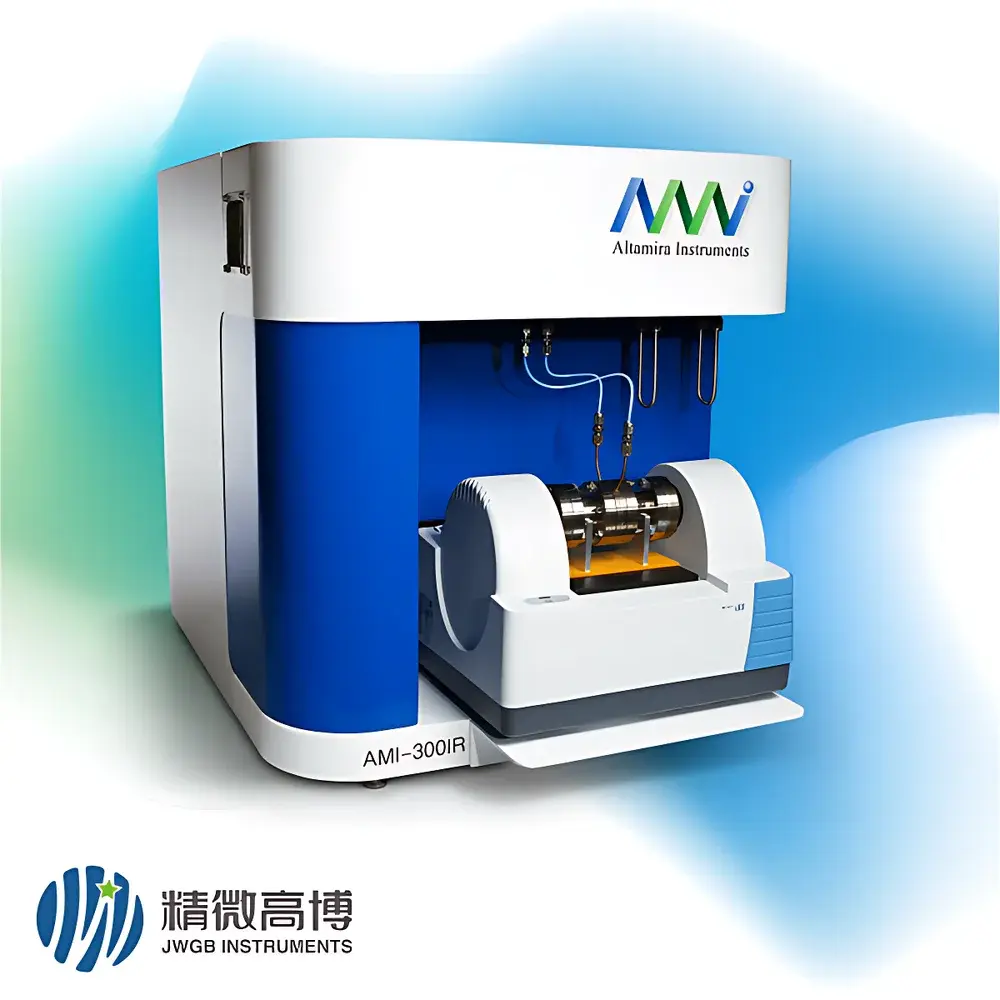
Altamira AMI-300IR In Situ FTIR-Coupled Chemisorption Analyzer
| Brand | Altamira (USA) |
|---|---|
| Origin | USA |
| Model | AMI-300IR In Situ FTIR-Coupled Chemisorption Analyzer |
| Test Principle | Continuous Flow Method |
| Gas Inlet Ports | Expandable to 12 |
| Temperature Range | Ambient to 1200 °C |
| Isothermal Stability | ±0.01 °C |
| Heating Rate | 1–50 °C/min |
| Pressure Range | Atmospheric to 30 bar (optional up to 100 bar) |
| Analytical Modes | TPR, TPO, TPD, TPS, Pulse Chemisorption, Pulse Calibration |
Overview
The Altamira AMI-300IR is a fully automated, high-precision chemisorption analyzer engineered for in situ and operando catalyst characterization under dynamically controlled thermal and gas-phase environments. It integrates continuous-flow thermoprogrammed analysis with real-time Fourier Transform Infrared (FTIR) spectroscopy—enabling simultaneous quantification of adsorbed species, surface reaction intermediates, and gas-phase product evolution during temperature-ramped experiments. Unlike static volumetric systems, the AMI-300IR employs a robust flow-through architecture based on calibrated mass flow control, minimizing dead volume and maximizing temporal resolution of transient adsorption/desorption events. Its design conforms to ASTM D7215 (Standard Test Method for Determination of Metal Dispersion in Supported Catalysts by Pulse Chemisorption) and supports GLP-compliant workflows through full audit-trail data logging and instrument parameter traceability.
Key Features
- Modular Gas Handling System: Standard configuration includes four independent, high-accuracy mass flow controllers (MFCs); expandable to twelve gas inlets via optional manifold modules—supporting complex multi-step pretreatment, co-feeding, and reactive quench protocols.
- Ultra-Stable Thermal Control: Dual-zone furnace with programmable heating rates from 1 to 50 °C/min across the full 25–1200 °C range; optional cryogenic extension enables operation down to –130 °C. Isothermal stability maintained at ±0.01 °C over 24-hour periods, critical for equilibrium adsorption studies.
- Low-Dead-Volume Fluidics: All internal tubing constructed from 1/16″ electropolished 316 stainless steel; heated valves and transfer lines prevent condensation and surface retention of polar vapors—including water, alcohols, and organic acids—ensuring fidelity in FTIR-coupled measurements.
- Integrated Saturated Vapor Generation: Onboard temperature-controlled saturator allows precise introduction of saturated vapor streams (e.g., H2O, NH3, SO2) without external bubblers or manual calibration; vapor concentration determined via thermodynamic saturation curves.
- Multi-Detector Compatibility: Native TCD detection with dual-filament (tungsten or Au/W alloy) options and selectable loop volumes (0.1–10 mL); seamless hardware/software integration with external MS, GC-FID, or FTIR spectrometers via analog/digital I/O and synchronized data acquisition.
- Automated Safety Architecture: Redundant thermal monitoring (furnace wall, sample bed, reactor outlet), TCD flow fault detection, dry-run prevention logic, front-panel emergency cutoff, and configurable pressure interlocks compliant with ISO 13850 and IEC 61508 functional safety standards.
Sample Compatibility & Compliance
The AMI-300IR accommodates diverse catalyst geometries—including powders, extrudates, monoliths, and supported nanoparticles—in quartz U-tubes, bubble-type reactors, or high-pressure 316 stainless steel cartridges. Sealing materials (Viton®, Buna-N®, Kalrez®) are selected per chemical compatibility matrix to ensure inertness toward halogenated, sulfur-containing, or strongly acidic/basic feedstocks. All fluidic components meet ASME B31.3 process piping requirements for elevated-pressure operation. The system supports 21 CFR Part 11-compliant electronic records when paired with validated software configurations, including user access controls, electronic signatures, and immutable audit trails for GMP-regulated catalyst development in pharmaceutical and fine chemical applications.
Software & Data Management
Control and analysis are performed via Altamira’s Windows-based ChemiSoft™ platform, featuring intuitive experiment sequencing, real-time signal visualization, and post-run kinetic deconvolution tools. Raw TCD and FTIR spectral data are time-synchronized and stored in HDF5 format for long-term archival and third-party analysis (e.g., Python-based PCA, peak fitting with OPUS or GRAMS/AI). Batch processing scripts enable automated calculation of dispersion, turnover frequency (TOF), activation energy (via Kissinger or Ozawa-Flynn-Wall methods), and acid/base site distribution. Export modules generate ASTM/ISO-compliant PDF reports with embedded metadata (instrument ID, operator, calibration history, environmental conditions).
Applications
The AMI-300IR serves as a core analytical platform for heterogeneous catalyst R&D across academia and industry. It quantifies active metal surface area and particle size distribution in Pt/Al2O3, Ni/MgO, or Co/Fe-based Fischer-Tropsch formulations; maps oxygen mobility and reducibility in CeO2-ZrO2 mixed oxides via TPO; identifies Brønsted vs. Lewis acid sites on zeolites using NH3-TPD coupled with in situ DRIFTS; and evaluates sulfur poisoning mechanisms in automotive three-way catalysts under simulated exhaust conditions. Additional use cases include electrocatalyst stability assessment (e.g., IrO2 anodes in PEM electrolyzers), CO2 hydrogenation selectivity screening, and solid-state battery interface reactivity profiling.
FAQ
Can the AMI-300IR be operated under ultra-high vacuum (UHV) conditions?
No—the system is designed for controlled positive-pressure flow operation (ambient to 100 bar); UHV compatibility requires separate differential pumping stages not integrated into this platform.
Is FTIR coupling limited to transmission mode only?
No—standard configurations support transmission through gas cells or KBr pellets; optional accessories include MCT detectors and ATR probes for direct solid-sample interrogation.
How is baseline drift corrected during long-duration TPD experiments?
ChemiSoft™ implements adaptive background subtraction using reference channel interpolation and real-time TCD filament resistance compensation algorithms.
Does the system support automated BET surface area analysis?
Yes—integrated gas mixing and pulse injection modules allow full automation of multipoint BET, Langmuir, and t-plot analyses without external hardware.
What documentation is provided for regulatory validation?
Altamira supplies IQ/OQ protocols, calibration certificates traceable to NIST standards, and a complete Design Qualification (DQ) package aligned with Annex 11 and USP <1058> analytical instrument qualification guidelines.



