
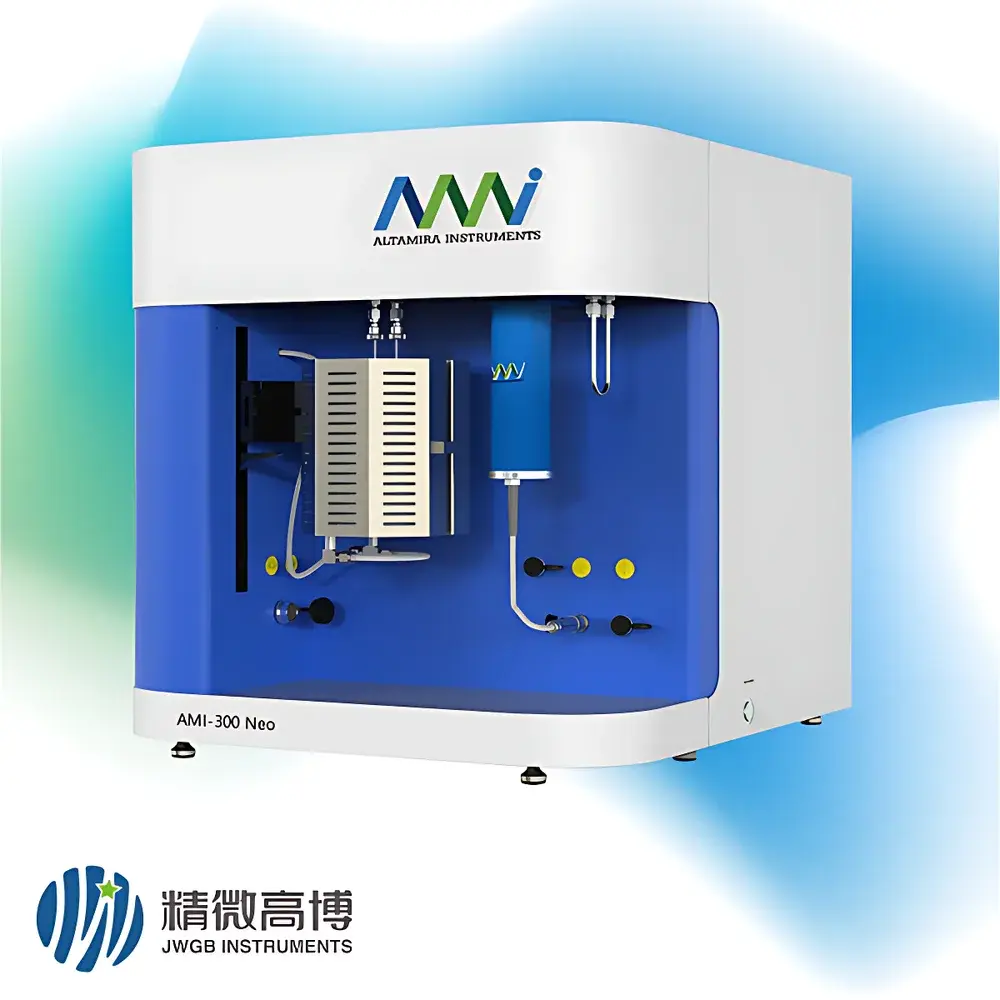
Altamira AMI-300Neo Basic Chemisorption Analyzer
| Brand | Altamira (USA) |
|---|---|
| Origin | USA |
| Model | AMI-300Neo Basic Chemisorption Analyzer |
| Test Principle | Continuous Flow Method |
| Gas Inlet Ports | Expandable to 12 |
| Temperature Range | Ambient to 1200°C |
| Isothermal Stability | ±0.01°C |
| Ramp Rate | 1–50°C/min |
| Pressure Range | Atmospheric to 30 bar (optional up to 100 bar) |
| Core Functions | TPR, TPO, TPD, TPS, Pulse Chemisorption, Pulse Calibration |
Overview
The Altamira AMI-300Neo Basic Chemisorption Analyzer is a fully automated, continuous-flow thermal-programmed characterization system engineered for precise quantification of surface-active sites on heterogeneous catalysts and functional materials. It operates on the principle of dynamic gas-solid interaction under controlled temperature ramps and programmed gas dosing, enabling reproducible measurement of adsorption/desorption kinetics, reduction/oxidation behavior, and surface reactivity profiles. Unlike static volumetric systems, the AMI-300Neo employs real-time, flow-through detection—delivering accelerated analysis cycles (typically ≤1/3 the time of conventional volumetric methods) without compromising data fidelity. Its architecture supports both routine QC validation and advanced R&D workflows in catalysis science, including metal dispersion, active site density, binding strength distribution, and catalyst deactivation mechanism studies.
Key Features
- Modular Gas Delivery System: Standard configuration includes four high-accuracy mass flow controllers (MFCs), with hardware and firmware support for expansion to twelve independently regulated gas inlets—enabling complex multi-step pretreatment, reaction, and purge sequences.
- Wide Thermal Operating Range: Programmable furnace temperature from ambient to 1200°C, with uniform ramp control across the full range (1–50°C/min). Optional cryogenic module extends low-temperature capability to –130°C for low-energy adsorption studies.
- Minimized Transport Artifacts: All fluidic pathways utilize 1/16″ electropolished 316 stainless steel tubing; dead volume is rigorously minimized to reduce peak broadening and enhance temporal resolution of transient signals.
- Integrated Saturated Vapor Generation: Onboard, temperature-controlled saturator delivers precisely metered vapor-laden carrier gas (e.g., H2O, NH3, SO2) without condensation or wall adsorption—critical for acid-base or redox-sensitive chemisorption experiments.
- Dual-Temperature Monitoring & Control: Independent thermocouples monitor both furnace zone and sample bed temperatures, allowing user-selectable control mode (furnace-set vs. bed-set) and synchronized logging for accurate kinetic modeling.
- Enhanced Safety Architecture: Redundant thermal protection includes over-temperature cutoff, TCD flow interlock, dry-run prevention, front-panel emergency stop, and real-time MFC status monitoring—designed for unattended overnight operation in GLP-compliant labs.
Sample Compatibility & Compliance
The AMI-300Neo accommodates diverse sample geometries via interchangeable quartz U-tube, bulb-type, and straight-wall reactors (low-pressure mode) or 316 stainless steel high-pressure reaction tubes (up to 100 bar). Sample mass range: 0.1–1.0 g. Seal compatibility includes Viton®, Buna-N, and Kalrez® elastomers for aggressive chemical environments. The system meets fundamental requirements for ISO 18872 (catalyst characterization), ASTM D7214 (TPR/TPO of supported catalysts), and USP (gas chromatographic method validation principles). When operated with audit-trail-enabled software and electronic signatures, it supports 21 CFR Part 11 compliance for regulated pharmaceutical and biocatalyst development.
Software & Data Management
Controlled via Windows-based AMI-Suite v5.x, the platform provides intuitive experiment scripting, real-time parameter visualization, and synchronized multi-detector acquisition. TCD and external detectors—including quadrupole mass spectrometers (QMS), FTIR, FID, or GC—can be integrated in series or parallel configurations. Raw signal data (mV vs. time/temperature) and processed results (e.g., H2-uptake, CO chemisorption, O2 consumption) are stored in vendor-neutral ASCII and HDF5 formats. Built-in tools support baseline correction, peak deconvolution, integration, and Arrhenius/Eyring kinetic fitting. Audit trails log all user actions, method changes, and calibration events—essential for GMP/GLP documentation and regulatory submission packages.
Applications
- Quantification of metal dispersion and particle size distribution in supported Pt, Pd, Ni, Co, and Ru catalysts
- Acid site density and strength profiling in zeolites, alumina, and sulfated metal oxides via NH3-TPD
- Redox behavior assessment of transition metal oxides (e.g., CeO2, MnOx) using H2-TPR and O2-TPO
- Surface oxygen mobility studies in perovskite and spinel catalysts for solid oxide fuel cells
- Deactivation mechanism analysis in hydrodesulfurization (HDS), hydrodenitrogenation (HDN), and selective catalytic reduction (SCR) catalysts
- Adsorption thermodynamics of CO, NOx, and VOCs on automotive three-way catalysts and diesel oxidation catalysts
FAQ
What detection methods are supported beyond the standard TCD?
The AMI-300Neo features dual analog/digital output ports and configurable trigger protocols to synchronize with external detectors—including quadrupole mass spectrometers (QMS), Fourier-transform infrared (FTIR) spectrometers, flame ionization detectors (FID), and gas chromatographs (GC). Both serial and parallel coupling modes are supported.
Can the system perform high-pressure chemisorption at 100 bar?
Yes—the optional high-pressure configuration includes reinforced 316 stainless steel reactor tubing, pressure-rated valves, and certified pressure transducers calibrated to 100 bar. All wetted components comply with ASME B31.3 process piping standards.
Is low-temperature operation down to –130°C available as a factory option?
Yes—the cryogenic extension kit includes liquid nitrogen-cooled jacketing, insulated transfer lines, and PID-controlled cold-stage regulation. It is fully integrated into the main software interface and retains full TCD sensitivity and thermal stability specifications.
How does the system ensure vapor-phase integrity during steam or ammonia dosing?
All gas lines, valves, and saturator outlets are actively heated and temperature-regulated (up to 200°C) to prevent condensation and minimize surface residence time—ensuring stoichiometric delivery of reactive vapors to the catalyst bed.
Does the software support automated calibration routines for pulse injection accuracy?
Yes—AMI-Suite includes guided pulse calibration workflows that auto-determine optimal loop fill time, injection duration, and detector response linearity across multiple concentration levels, generating traceable calibration reports compliant with ISO/IEC 17025 requirements.
Related Products



