
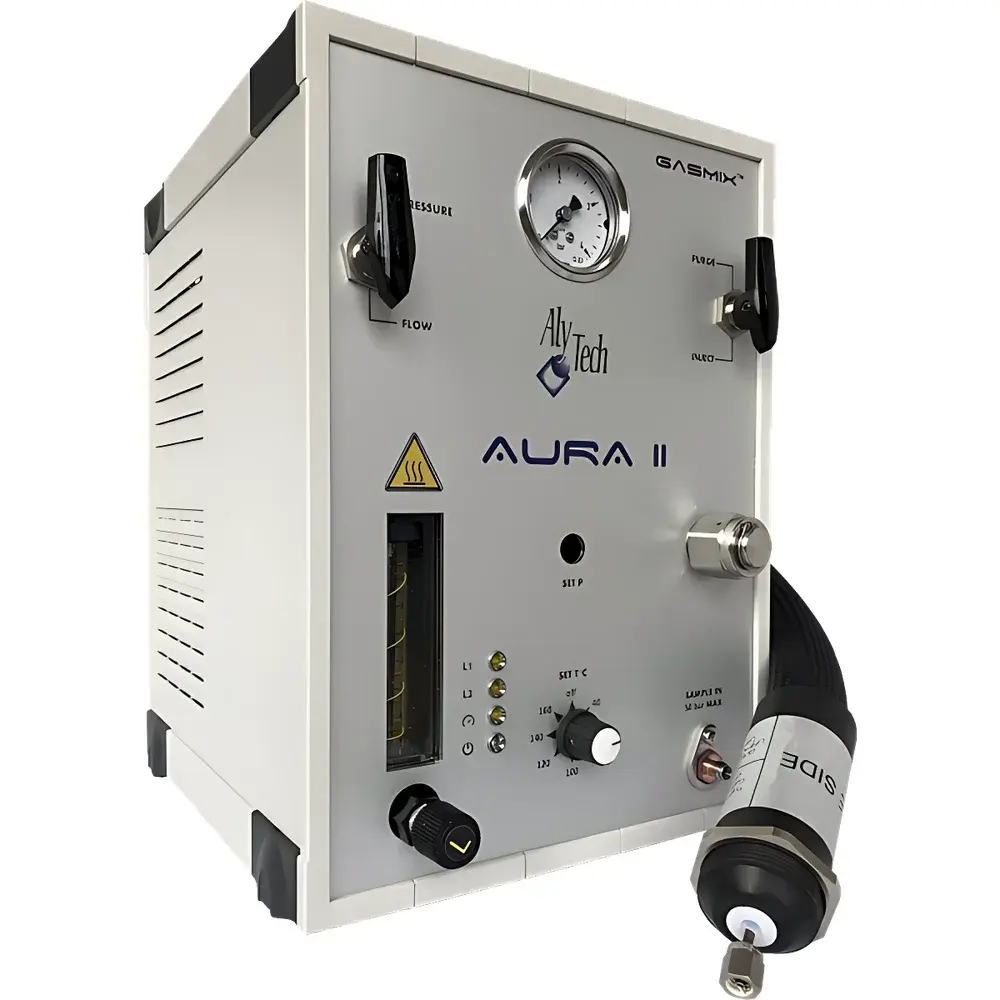
Alytech AURA II LPG Evaporator
| Brand | Alytech |
|---|---|
| Origin | France |
| Model | AURA II |
| Evaporation Temperature Range | 40–160 °C |
| Input Pressure Range | 2–50 bar (with safety valve) |
| Output Pressure Range | 1–3 bar |
| Output Flow Rate | 20–200 cc/min |
| Operating Modes | Pressure-controlled or Flow-controlled |
| Integrated In-line Filter | 0.5 µm stainless steel |
| Standard Delivery | 1 m heated flexible transfer line |
| Power Supply | External AC adapter (battery option not specified for AURA II) |
| Accuracy | <1.5% |
| Repeatability | <1% |
Overview
The Alytech AURA II LPG Evaporator is a precision-engineered thermal phase-change device designed for the controlled, pressure- and temperature-stable vaporization of liquefied petroleum gas (LPG) and other low-boiling hydrocarbon mixtures in environmental monitoring, calibration, and trace gas analysis applications. Unlike pressurized vaporization systems requiring external gas cylinders or high-pressure regulators, the AURA II operates on a non-pressurized evaporation principle: liquid-phase LPG is introduced at ambient inlet pressure and vaporized via precisely regulated conductive heating within a thermally isolated chamber. This eliminates flash vaporization risks, ensures laminar vapor flow, and delivers highly reproducible output concentrations essential for dynamic gas calibration, EPA Method 21 leak detection verification, and continuous emissions monitoring system (CEMS) span-gas generation. Its architecture complies with fundamental requirements for ISO/IEC 17025-compliant calibration laboratories—particularly where traceability, thermal stability, and absence of mechanical pulsation are critical.
Key Features
- Non-pressurized evaporation design: Eliminates need for upstream pressure regulation or cylinder-based supply, reducing system complexity and safety hazards.
- Wide operational temperature range (40–160 °C): Enables stable vaporization of diverse LPG components (propane, butane, isobutane) and higher-boiling calibration standards without condensation or fractionation.
- Dual-mode control interface: Independent selection between pressure-regulated and mass-flow-regulated output modes—optimized for integration with downstream mass flow controllers (MFCs) or pressure-driven analyzers.
- Integrated 0.5 µm stainless-steel in-line filter: Prevents particulate carryover and protects sensitive downstream sensors (e.g., PID, FID, GC detectors) from contamination.
- 1-meter heated flexible transfer line (standard): Maintains vapor-phase integrity during transport; prevents re-condensation across ambient temperature gradients.
- Robust thermal management: PID-controlled heating with ±0.2 °C stability over full operating range; verified per ASTM E2877-22 guidelines for thermal uniformity in gas calibration hardware.
- Safety-integrated design: Built-in pressure relief valve (set at 50 bar max input), redundant thermal cutoffs, and CE-marked electrical architecture compliant with IEC 61000-6-4 (EMC) and IEC 61010-1 (safety).
Sample Compatibility & Compliance
The AURA II is validated for use with commercial LPG blends (EN 589), certified reference materials (CRMs) traceable to NIST SRM 1849a, and proprietary hydrocarbon standards containing C3–C5 alkanes and alkenes. It supports both gravimetric and volumetric calibration workflows under ISO 6142-1 (gas mixture preparation) and ISO 6145-7 (dynamic dilution methods). The device meets functional requirements for GLP and GMP environments when operated within documented SOPs—including audit-ready parameter logging (via optional RS-232/USB interface) and compatibility with 21 CFR Part 11–compliant data acquisition platforms. No regulatory certification (e.g., ATEX, IECEx) is required for standard laboratory use, though explosion-proof enclosures may be added upon request for field-deployed hazardous-area applications.
Software & Data Management
While the AURA II operates as a standalone analog-controlled evaporator, it features a configurable digital interface (RS-232 and USB-C) for remote setpoint synchronization, real-time temperature/pressure telemetry, and event logging. When integrated with Alytech’s GasMix™ ecosystem (e.g., NOMAD or GMRACK dilutors), the AURA II serves as a primary vapor source in multi-stage dynamic calibration trains—enabling programmable concentration ramps, step changes, and stability hold periods. All communication protocols adhere to Modbus RTU and SCPI standards, ensuring interoperability with LabVIEW, MATLAB, and industry-standard SCADA systems. Firmware updates are delivered via signed .bin files with SHA-256 checksum verification, supporting secure firmware lifecycle management aligned with NIST SP 800-193.
Applications
- Primary vapor source for dynamic gas calibration systems used in EPA Method 21, EN 15446, and ISO 16000-6 compliance testing.
- Generation of stable, low-concentration hydrocarbon challenge gases for photoionization detector (PID) and flame ionization detector (FID) response validation.
- In-house preparation of span gases for continuous emissions monitors (CEMs) measuring VOCs, methane, and total hydrocarbons (THC).
- Supporting research in atmospheric chemistry simulation chambers requiring precise, pulse-free LPG vapor introduction.
- Traceable calibration of portable gas analyzers deployed in urban air quality networks and industrial fence-line monitoring programs.
FAQ
Does the AURA II require external zero air or nitrogen supply?
No—the AURA II is a pure evaporator; it does not generate carrier gas. It must be connected downstream to a purified air or nitrogen source (e.g., Alytech ZEPHYR or external zero-air generator) to deliver diluted test gas.
Can the AURA II handle liquefied natural gas (LNG) or ethane-rich streams?
Not recommended. Its thermal design and material compatibility (stainless-steel 316 wetted parts, Viton® seals) are optimized for LPG-range volatilities (−42 °C to 0.5 °C boiling points). LNG (−161 °C) requires cryogenic handling beyond its specification.
Is temperature calibration traceable to national standards?
Yes—each unit ships with a factory calibration certificate referencing PTB-traceable thermistors. On-site recalibration is supported using ISO/IEC 17025-accredited dry-block calibrators (e.g., Fluke 9143) per ISO/IEC 17025 Clause 6.5.2.
What maintenance intervals are recommended?
Filter replacement every 6 months or after 500 operational hours; full thermal sensor verification annually; visual inspection of heated line insulation before each deployment.
Is the 1-meter heated line compatible with custom lengths?
Yes—Alytech offers extended heated lines (up to 5 m) with matched thermal profiles and optional Teflon®-lined stainless-steel construction for aggressive chemistries.
Related Products







