
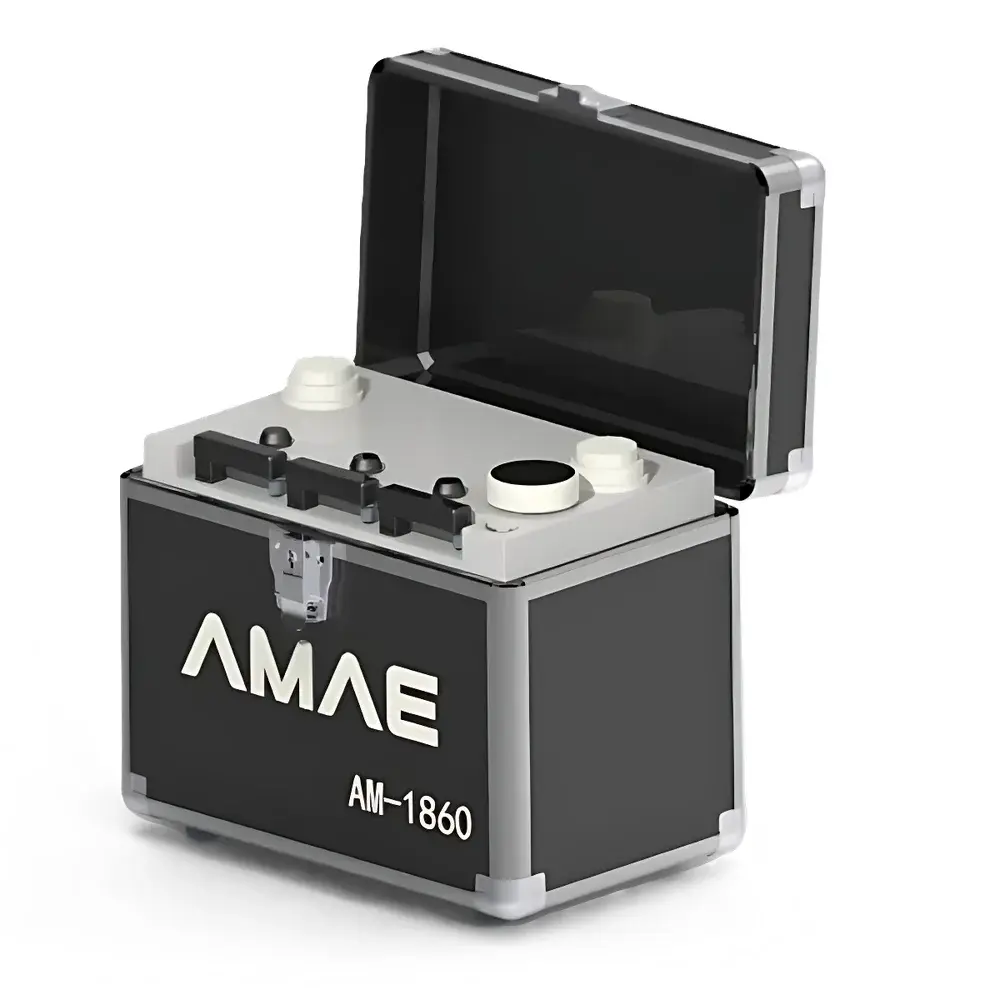
AMAE AM-1860 Portable Fixed-Reagent Dispensing Workstation
| Brand | AMAE |
|---|---|
| Origin | Guangdong, China |
| Manufacturer Type | Authorized Distributor |
| Country of Origin | China |
| Model | AM-1860 |
| Pricing | Upon Request |
| Dispensing Range | 0.5–10.0 mL |
| Dispensing Resolution | 0.1 mL |
| Display | High-Resolution Rotating Touchscreen |
| Dispensing Channels | 3 Independent Programmable Channels |
| Bottle Compatibility | Interchangeable Sample Vial Adapters (250 mL, 500 mL, 1 L) |
| pH-Based Dosage Logic | Embedded Algorithm per HJ 494–2009 & GB/T 5750.2–2023 |
| Calibration Mode | User-Adjustable Compensation Function |
| Enclosure Protection | Shock-Absorbing Housing with Illuminated Viewing Window & Leak-Resistant Reservoir Bay |
Overview
The AMAE AM-1860 Portable Fixed-Reagent Dispensing Workstation is an engineered solution for field-deployable, standardized reagent addition during aqueous environmental sampling. Designed explicitly to meet the procedural rigor of in-situ sample preservation, it implements precision positive-displacement fluid handling to deliver fixed-reagent volumes—such as sulfuric acid (for metal stabilization), sodium hydroxide (for cyanide preservation), or nitric acid (for trace element analysis)—directly into field-collected water samples. Its operational principle relies on calibrated peristaltic pumping combined with real-time firmware-controlled actuation logic, ensuring volumetric repeatability within ±0.1 mL across the full 0.5–10.0 mL dispensing range. The system is not a general-purpose pipettor but a purpose-built workstation compliant with the workflow constraints of mobile environmental laboratories, emergency response units, and public health surveillance teams operating under time-sensitive, outdoor, or low-infrastructure conditions.
Key Features
- Three independent, tactile-actuated dispensing channels—each configurable via short press (pre-set volume), long press (default 5.0 mL override), or mode-select toggle—enabling parallel treatment of multiple sample types without cross-contamination risk.
- Rotating high-resolution touchscreen interface supporting three operational modes: Manual (user-defined volume entry), Intelligent (automated dosage calculation based on selected vial capacity and target pH per HJ 494–2009 and GB/T 5750.2–2023), and Compensation (field-adjustable offset calibration to account for tubing elasticity or reagent viscosity drift).
- Modular reservoir bay with quick-release mechanism for three chemically resistant, UV-stabilized polypropylene reagent bottles (standardized 100 mL and 250 mL formats); integrated backlighting and dual-sided viewing windows allow real-time level monitoring under variable ambient lighting.
- Structurally reinforced chassis incorporating silicone-damped mounting points and impact-absorbing polymer corners, validated per IEC 60068-2-32 drop-test protocols (1 m onto plywood), minimizing risk of leakage or mechanical failure during transport or field deployment.
- No external power dependency: Operates exclusively on rechargeable Li-ion battery pack (≥8 h continuous operation at 2 mL dispense cycles; hot-swappable design supports uninterrupted multi-site sampling).
Sample Compatibility & Compliance
The AM-1860 accommodates standard EPA-compliant and ISO 5667-3–aligned sampling containers—including polyethylene, borosilicate glass, and fluoropolymer-coated vials—via mechanically indexed adapter sleeves. Its intelligent dosing algorithm references regulatory pH thresholds defined in HJ 494–2009 (e.g., pH ≤2 for heavy metals, pH ≥12 for cyanide) and maps them to empirically validated reagent concentration curves derived from GB/T 5750.2–2023 Annex B. While not certified to ISO/IEC 17025 for metrological traceability, the device supports GLP-aligned documentation through timestamped local event logging (dispense volume, channel ID, vial size, pH setting, operator code) exportable via micro-USB to CSV. It is intended for use in non-GMP environments where adherence to documented field procedures—not laboratory-grade calibration certificates—is the primary compliance requirement.
Software & Data Management
Firmware version 2.3.x embeds audit-ready data capture without cloud dependency. Each dispense event records: UTC timestamp, selected channel, programmed volume, actual delivered volume (based on motor step count + pressure feedback), vial type identifier, and user-assigned batch tag. Logs are stored in non-volatile memory (16 KB capacity, ~10,000 entries) and exportable in plain-text CSV format compatible with LIMS ingestion pipelines. No remote connectivity, OTA updates, or proprietary software installation is required—data transfer occurs via standard mass-storage USB mode. The system does not comply with FDA 21 CFR Part 11 due to absence of electronic signature architecture; however, its deterministic behavior and immutable local log structure support retrospective validation in quality-audited field programs.
Applications
- Field-based preservation of surface water, groundwater, and wastewater samples prior to transport to central analytical labs.
- Routine monitoring by municipal drinking water utilities performing compliance sampling per GB 5749–2022.
- Emergency response deployments following chemical spills or algal bloom events requiring rapid pH stabilization and metal sequestration.
- Academic and NGO-led watershed studies where portable, operator-independent reagent delivery reduces inter-observer variability.
- Training modules for environmental technicians—its intuitive UI and visual feedback reduce procedural errors during certification assessments.
FAQ
Does the AM-1860 require annual recalibration by an accredited lab?
No. It employs factory-calibrated stepper-motor-driven peristaltic pumps with built-in compensation routines; users perform field verification using gravimetric checks per manufacturer’s SOP (included). Third-party calibration is not mandated.
Can it dispense viscous or particulate-containing fixatives such as formalin or Lugol’s iodine?
Formalin (37% aqueous formaldehyde) is supported; Lugol’s iodine is not recommended due to iodine-induced elastomer degradation in standard tubing. Optional PTFE-lined tubing kits are available for halogenated reagents.
Is the device rated for use in explosive atmospheres (ATEX/IECEx)?
No. It lacks intrinsic safety certification and is intended for use only in non-hazardous locations classified per NEC Class I, Division 2.
What happens if battery power fails mid-dispense?
The firmware implements fail-safe motor shutdown and retains last-known configuration in EEPROM; no partial delivery occurs. Resume requires manual restart after recharge.
Are replacement reservoir bottles and tubing supplied as OEM consumables?
Yes. AMAE supplies sterilizable PP bottles (P/N AM-BOT-100, AM-BOT-250) and medical-grade silicone tubing sets (P/N AM-TUB-035, inner diameter 3.5 mm) with lot-traceable CoA documentation.



