
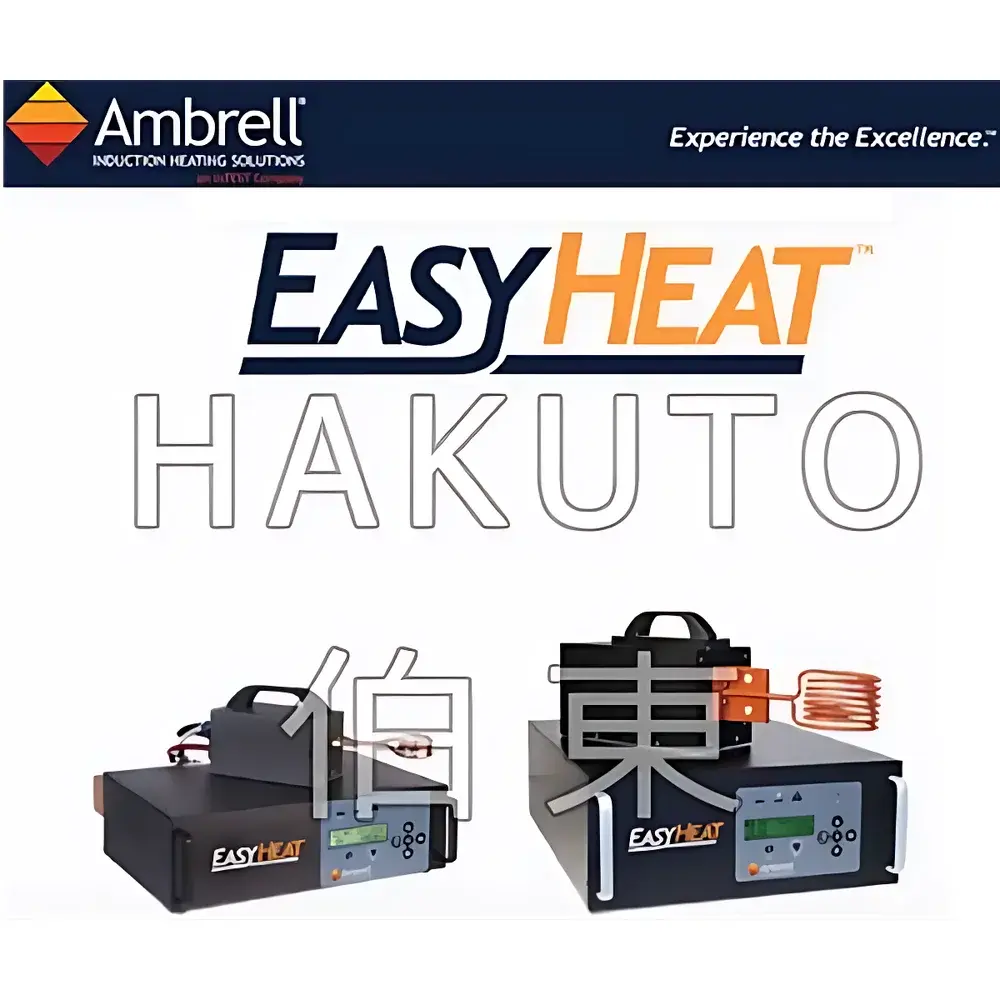
Ambrell EASYHEAT 0112 High-Frequency Induction Heating System
| Brand | Ambrell |
|---|---|
| Origin | USA |
| Model | 0112 |
| Frequency Range | 150–400 kHz |
| Power Output | 1–10 kW |
| Power Control Resolution | ±25 W |
| Cooling | Integrated Water-Cooling System |
| Heating Head Cable Length | Standard 3 m (extendable) |
| Display Languages | English, French, Italian, German, Spanish |
| Compliance | CE, UL Listed |
| Remote Interface | RS-232/RS-485 Serial Port |
| Programmable Profiles | Up to 4 user-defined heating modes |
| Optional Accessories | Optical Pyrometer (for closed-loop temperature control), Chiller/Heat Exchanger, PLC Interface Module, Foot Switch, Extended Cable Kits |
Overview
The Ambrell EASYHEAT 0112 is a high-frequency induction heating system engineered for precision thermal processing in laboratory, R&D, and light industrial environments. Operating on the principle of electromagnetic induction—where alternating current in a copper coil generates a time-varying magnetic field that induces eddy currents within electrically conductive materials—the system delivers localized, non-contact heating without flame, radiation, or thermal conduction through fixtures. With a frequency range of 150–400 kHz and adjustable power output from 1 to 10 kW, the 0112 model is optimized for rapid, repeatable heating of small- to medium-sized metallic components, including ferrous and non-ferrous alloys. Its compact architecture, integrated water-cooling circuit, and modular heating head design support flexible integration into automated test benches, QC stations, and material joining workflows such as brazing, annealing, shrink-fitting, and selective heat treatment. As part of Ambrell’s EASYHEAT platform—developed by inTEST Corporation since 1986—the 0112 meets stringent reliability benchmarks validated across more than 12,000 installed units in over 50 countries.
Key Features
- High-frequency induction operation (150–400 kHz) enables fine spatial control of heating zones and minimizes thermal diffusion into adjacent structures
- Power regulation with ±25 W resolution ensures consistent energy delivery across repeated cycles—critical for process validation and GLP-compliant thermal testing
- Integrated water-cooling system maintains stable coil and inverter performance during extended duty cycles; compatible with external chillers or heat exchangers
- Modular, mobile heating head with standard 3-meter flexible cable allows ergonomic positioning and easy reconfiguration for diverse sample geometries
- Intuitive front-panel interface supports five-language display (English, French, Italian, German, Spanish) and real-time monitoring of setpoint temperature, actual output power, operating frequency, and elapsed time
- Onboard timer and stopwatch functions enable precise dwell-time control; programmable profiles store up to four distinct heating sequences with independent ramp-hold-cool parameters
- Serial communication port (RS-232/RS-485) supports remote command execution, data logging, and integration with PLCs or LIMS platforms under FDA 21 CFR Part 11–compliant audit trail configurations
Sample Compatibility & Compliance
The EASYHEAT 0112 is designed for use with electrically conductive samples—including steels, aluminum, copper, titanium, and nickel-based alloys—across a wide range of shapes and cross-sections (e.g., rods, tubes, fasteners, electronic housings, and composite-metal joints). It does not require physical contact or preheating, eliminating contamination risks and enabling clean, oxidation-minimized thermal cycles suitable for vacuum-compatible or cleanroom-adjacent applications. The system conforms to IEC 61000-6-3 (EMC emission limits) and IEC 61000-6-2 (immunity standards), carries UL 508A and CE markings, and supports traceable calibration via on-site field adjustment protocols aligned with ISO/IEC 17025–recommended practices for measurement equipment.
Software & Data Management
While the EASYHEAT 0112 operates autonomously via its embedded controller, optional serial connectivity enables bidirectional data exchange with host systems. Users may log time-stamped operational parameters—including power, frequency, duration, and thermal feedback (when paired with an optical pyrometer)—to external databases or CSV files for statistical process control (SPC) analysis. When configured with closed-loop temperature control, the system records thermal response curves compliant with ASTM E2314 (Standard Test Method for Thermal Stability of Materials Using Induction Heating) and supports export of raw datasets for post-test regression modeling. Audit trails generated during remote operation meet basic requirements for GMP documentation integrity per Annex 11 guidelines.
Applications
- Controlled brazing and soldering of precision assemblies in aerospace and medical device manufacturing
- Localized annealing and stress-relief treatments for micro-machined metal components
- Thermal cycling validation of thermal interface materials (TIMs) and metal-polymer bonding interfaces
- Rapid prototyping of heat-affected zone (HAZ) characterization studies in metallurgical research
- In-process thermal qualification of hermetic seals, sensor housings, and MEMS packaging substrates
- Calibration and functional testing of thermocouples, RTDs, and infrared sensors under dynamic thermal loads
FAQ
What types of materials can be heated using the EASYHEAT 0112?
Conductive metals and alloys—including carbon steel, stainless steel, aluminum, copper, brass, and inconel—are suitable. Non-conductive or highly resistive materials (e.g., ceramics, plastics, graphite) require conductive susceptors or are incompatible.
Is the system compatible with automated production lines?
Yes—via RS-232/RS-485 serial interface, discrete I/O signals (optional foot switch or PLC trigger), and programmable heating profiles, the 0112 integrates into synchronized assembly or test cell architectures.
Does the unit support closed-loop temperature control?
When equipped with an optional optical pyrometer and configured for analog feedback input, the system executes PID-regulated temperature control with configurable ramp rates and hold tolerances.
What maintenance is required for long-term reliability?
Routine inspection of coolant flow rate and inlet temperature, periodic verification of coil insulation resistance (>100 MΩ), and annual calibration of power and timing functions per manufacturer-recommended intervals.
Can the heating head be used in inert or vacuum environments?
The standard heating head is rated for ambient air operation only. Custom vacuum-rated coils and feedthroughs are available under engineering consultation—not part of the base 0112 configuration.



