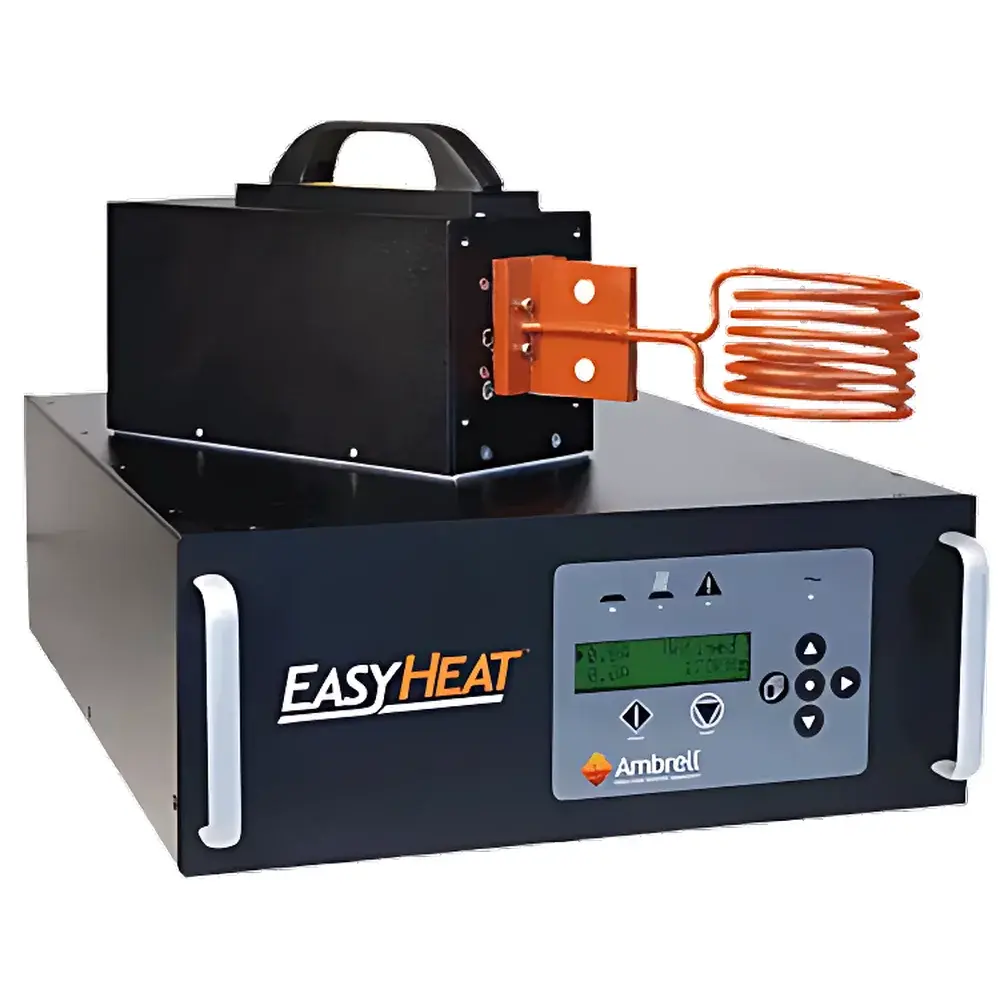
Ambrell Easyheat 4.2/6/9/10 kW Induction Heating System
| Brand | Ambrell |
|---|---|
| Origin | USA |
| Model | EASYHEAT 4.2 kW to 10 kW |
| Frequency Range | 150–400 kHz |
| Power Resolution | 50 W |
| Maximum Workhead Cable Length | 3 m (10 ft) |
| Control Interface | Sealed Touch Panel + Front-Panel LCD |
| Timer | Built-in Programmable Digital Timer |
| Remote Control Options | Contact Closure, 0–10 V Analog Input, RS-232/RS-485 Serial Port |
| Compliance | ISO 9001 Certified Manufacturing |
Overview
The Ambrell Easyheat 4.2/6/9/10 kW Induction Heating System is a compact, solid-state medium-frequency induction power supply engineered for precision thermal processing in laboratory, R&D, and low-to-mid volume production environments. Operating on the principle of electromagnetic induction—where high-frequency alternating current generates eddy currents within electrically conductive materials—the system delivers rapid, localized, and flameless heating without physical contact. Designed for reproducible thermal cycles across diverse part geometries and metallurgical compositions, the Easyheat platform supports both shallow-surface heating (e.g., case hardening, annealing of thin sections) and deeper volumetric heating (e.g., brazing, shrink fitting, preheating prior to welding). Its frequency range of 150–400 kHz enables optimal coupling with small- to medium-diameter ferrous and non-ferrous components, balancing skin depth penetration and energy transfer efficiency. All units are fully designed and manufactured at Ambrell’s ISO 9001-certified facility in Rochester, New York, ensuring traceability, consistency, and adherence to international quality management standards.
Key Features
- Modular architecture with scalable power outputs: 4.2 kW, 6 kW, 9 kW, and 10 kW configurations—each optimized for specific thermal load profiles and duty cycle requirements.
- Integrated, sealed front-panel touch interface with dual-language (English/French/German) selectable display—enabling intuitive operation in multinational lab or manufacturing settings.
- High-resolution power control at 50 W increments, supporting fine-tuned thermal ramping and stabilization for process-critical applications such as controlled-phase transformation or low-oxidation brazing.
- Detachable workhead with up to 3-meter (10-foot) coaxial cable—facilitating flexible placement near fixtures, robotic cells, or confined workspaces while maintaining electrical isolation and thermal safety.
- Built-in programmable digital timer and real-time stopwatch function—allowing precise definition of single-shot or continuous heating durations, with repeatable cycle initiation.
- Multiple remote control options: opto-isolated contact closure inputs, 0–10 V analog signal interface, and optional RS-232/RS-485 serial communication for integration into PLC-controlled or SCADA-monitored thermal workflows.
- Self-calibrating feedback loop ensures consistent output performance over time; field calibration capability eliminates downtime associated with third-party service visits.
Sample Compatibility & Compliance
The Easyheat system is compatible with a broad spectrum of electrically conductive materials—including carbon steels, stainless alloys, copper, aluminum, titanium, and nickel-based superalloys—provided geometry permits effective magnetic coupling. It accommodates parts ranging from small fasteners (<5 mm diameter) to medium-sized shafts and flanges (up to ~100 mm OD), depending on frequency selection and coil design. The system complies with IEC 61000-6-3 (EMC emission limits) and IEC 61000-6-2 (immunity requirements) for industrial environments. As an ISO 9001-certified product, it supports documentation traceability required under GLP and GMP frameworks. While not inherently FDA 21 CFR Part 11-compliant, its serial interface and analog I/O enable integration with validated data acquisition systems meeting regulatory audit requirements for thermal process validation.
Software & Data Management
The Easyheat does not include embedded PC-based software but provides deterministic hardware-level control and real-time parameter visibility via the front-panel interface. For automated data logging and process monitoring, optional serial communication (RS-232/RS-485) allows bidirectional exchange of setpoints, actual power output, operating frequency, elapsed time, and fault status with external controllers or host PCs running custom or third-party SCADA platforms. When paired with an optical pyrometer (optional accessory), closed-loop temperature regulation becomes feasible—enabling feedback-driven power modulation based on real-time surface emissivity-compensated readings. All configuration changes and operational events are timestamped internally, supporting basic audit trail generation when logged externally.
Applications
- Induction brazing of carbide tooling, hydraulic fittings, and heat exchanger assemblies
- Localized surface hardening of gear teeth, bearing races, and camshafts
- Preheating of weld joints to mitigate hydrogen-induced cracking in high-strength steels
- Rapid annealing of wire, strip, and small stamped components
- Shrink-fitting of bearings, bushings, and pulleys with tight thermal tolerances
- Thermal testing of material response under controlled, repeatable heating rates
- Lab-scale simulation of industrial induction processes for DOE-based process development
FAQ
What is the typical skin depth achievable with the Easyheat system at 300 kHz?
At 300 kHz, the theoretical skin depth in low-carbon steel (~60 µS/m conductivity, relative permeability ≈ 100) is approximately 0.18 mm—making it suitable for surface-dominant heating applications.
Can the Easyheat be integrated into a PLC-controlled production line?
Yes—via standard 0–10 V analog input or isolated contact closure signals; optional serial interface supports Modbus RTU protocol for advanced coordination.
Is cooling water required for continuous operation?
Yes—integrated recirculating coolant is mandatory. Units accept either a chiller or facility-supplied deionized water with flow rate ≥ 4 L/min and pressure ≥ 3 bar.
Does Ambrell provide coil design support?
Yes—application engineers offer free coil modeling and prototyping services using FEM-based simulation tools to optimize coupling efficiency and thermal uniformity.
What maintenance intervals are recommended?
Annual inspection of cooling circuit integrity, RF cable shielding continuity, and touch-panel calibration verification—no routine component replacement is specified under normal operating conditions.