
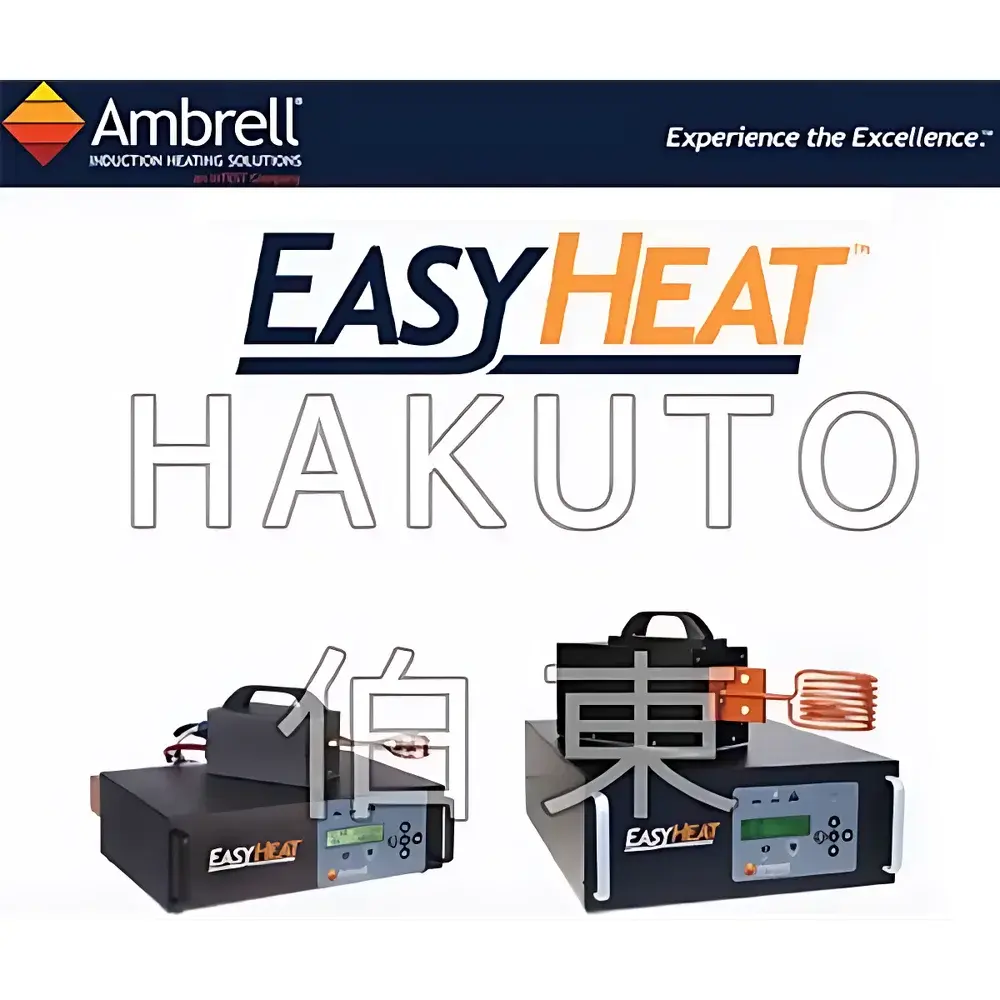
Ambrell EasyHeat High-Frequency Induction Heating System
| Brand | Ambrell |
|---|---|
| Origin | USA |
| Model | EasyHeat |
| Frequency Range | 150–400 kHz |
| Power Output | 1.2–10.0 kW |
| Input Voltage | 105–250 V (1-phase) / 187–520 V (3-phase) |
| Input Apparent Power | 1.6–12.4 kVA |
| Compliance | CE, UL Listed, RoHS Compliant |
| Software | eVIEW™ Process Monitoring & Control Suite |
| Architecture | Versatile Platform Architecture (VPA) |
Overview
The Ambrell EasyHeat High-Frequency Induction Heating System is an industrial-grade, solid-state induction power supply engineered for precision thermal processing in laboratory, R&D, and production environments. Operating on the principle of electromagnetic induction—where high-frequency alternating current generates eddy currents within electrically conductive materials—the system delivers localized, non-contact, and controllable heating without direct flame or thermal conduction. Designed for reproducible thermal cycles under controlled conditions, the EasyHeat platform supports applications requiring rapid thermal ramp rates, tight temperature uniformity, and minimal thermal impact on surrounding components. Its core architecture—the Versatile Platform Architecture (VPA)—enables modular integration with custom coils, fixtures, and automation interfaces, making it suitable for both benchtop material testing and inline process validation.
Key Features
- High-frequency solid-state inverter technology operating at 150–400 kHz, optimized for shallow-depth heating of small- to medium-sized metallic components
- Scalable power output across six models (1.2 kW to 10.0 kW), supporting flexible configuration from prototyping to pilot-line throughput
- eVIEW™ software suite enabling real-time temperature monitoring via optional IR pyrometers or thermocouple inputs, programmable thermal profiles, and full data logging with timestamped CSV export
- UL-listed and CE-marked design compliant with IEC 61000-6-3 (EMC emissions) and IEC 61000-6-2 (immunity), ensuring safe deployment in regulated laboratory and manufacturing settings
- Energy-efficient operation with >85% electrical-to-thermal conversion efficiency; no standby losses, no combustion byproducts, and zero open-flame hazard
- VPA-based hardware architecture supporting analog/digital I/O, Ethernet (Modbus TCP), and optional PLC integration for synchronized control within automated test cells
Sample Compatibility & Compliance
The EasyHeat system is compatible with ferrous and non-ferrous conductive materials—including steel, stainless steel, copper, aluminum, nickel alloys, and titanium—provided geometries permit effective coil coupling. Non-conductive substrates (e.g., ceramics, polymers) may be heated indirectly via susceptors. The system adheres to ASTM F2693–21 (Standard Practice for Induction Heating of Metals), ISO 13577–2 (Industrial Thermoprocessing Equipment Safety), and supports GLP/GMP-aligned workflows through audit-trail-capable eVIEW™ logging (user access control, parameter change history, and electronic signature readiness per FDA 21 CFR Part 11 guidelines). All units are manufactured in Rochester, NY, USA, and conform to RoHS Directive 2011/65/EU.
Software & Data Management
eVIEW™ is a Windows-based application that provides full system control, closed-loop temperature regulation (with optional feedback sensors), and comprehensive data acquisition. It supports up to 16 independent process steps per recipe, including ramp-hold-cool sequences, power limiting, and interlock-triggered shutdowns. Logged datasets include time-stamped power output, coil current/voltage, temperature readings, and alarm events—all exportable in CSV format for traceability and statistical analysis (e.g., Cpk, SPC charting). Configuration files are password-protected and version-stamped; system logs retain 30 days of operational history locally, extendable via network storage.
Applications
- Induction brazing & soldering: Precise joint heating for aerospace fasteners, medical device assemblies, and hermetic seals
- Material property testing: Controlled thermal cycling for fatigue, creep, and phase-transformation studies under ASTM E21/E1193
- Induction melting (small crucible): Rapid melt-and-pour trials for alloy development and casting simulation
- Heat treatment simulation: Localized annealing, stress relieving, and surface hardening of tool steels and turbine blades
- Plastic-metal bonding: Thermal activation of conductive adhesives or induction-heated inserts in composite joining
- Calibration & verification: Reference heating source for IR camera validation and thermocouple drift assessment per ISO/IEC 17025
FAQ
What is the minimum recommended workpiece size for reliable coupling with EasyHeat systems?
Typical minimum effective diameter is 3 mm for ferrous materials and 6 mm for non-ferrous metals, depending on coil geometry and frequency selection.
Can EasyHeat operate continuously at rated power?
Yes—models with 3-phase input (LI series) are rated for continuous 100% duty cycle; single-phase units support 80% duty cycle with adequate ventilation.
Is eVIEW™ compatible with LabVIEW or Python-based automation frameworks?
Yes—via Modbus TCP interface and documented DLL API, enabling integration with NI LabVIEW, MATLAB, or custom Python scripts using standard socket communication.
Does Ambrell provide IQ/OQ documentation packages?
Yes—validated installation and operational qualification templates aligned with ISO 9001 and GAMP5 are available upon request for regulated industries.
What coil types are supported out-of-the-box?
Standard offerings include single-turn helical, pancake, and internal-diameter coils; custom water-cooled or air-core designs are engineered per application requirements.



