
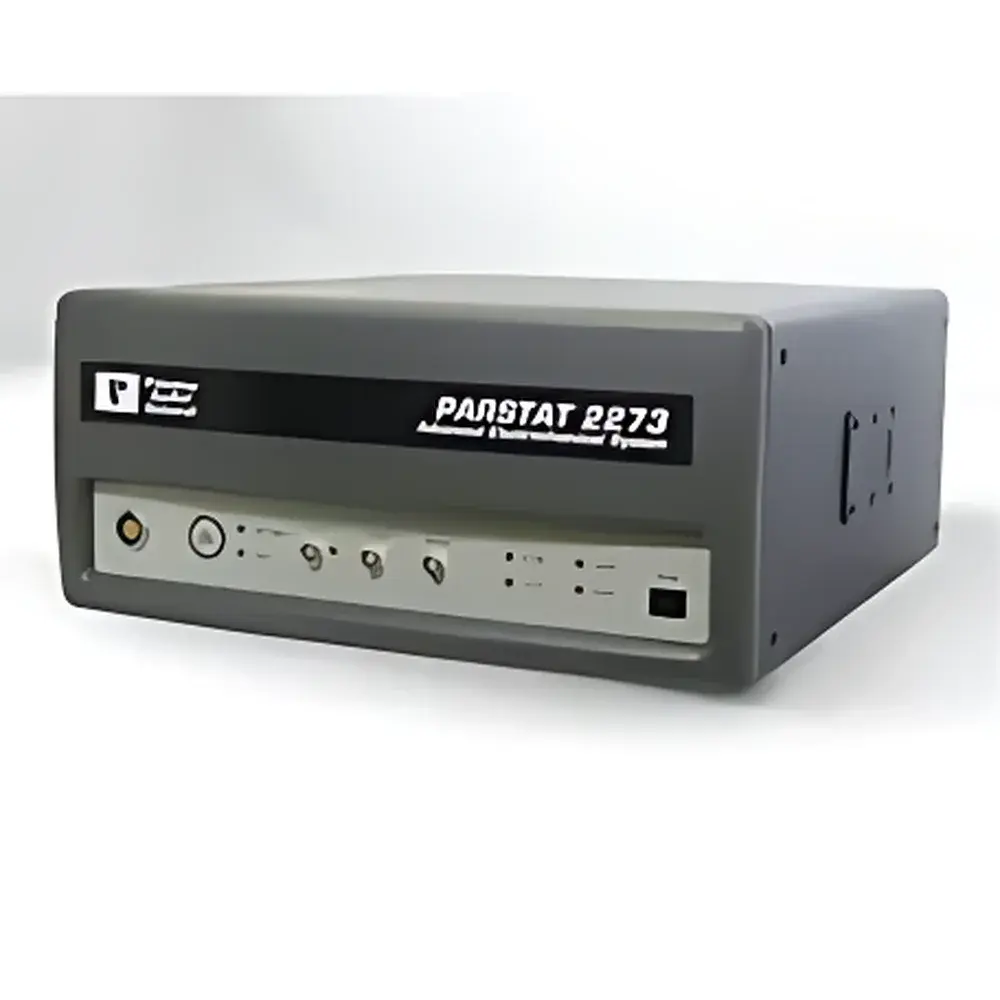
AMETEK PARSTAT 2273 Electrochemical Workstation
| Brand | AMETEK |
|---|---|
| Origin | USA |
| Model | PARSTAT 2273 |
| Instrument Type | Electrochemical Workstation |
| Current Range | 12 decades, 2 A to 40 pA |
| Current Accuracy | <0.4% (full scale, 20 µA–2 A) |
| Potential Accuracy | ±10 V |
| Potentiostatic Range | ±10 V |
| Galvanostatic Range | ±2 A (optional ±20 A) |
| EIS Frequency Range | 10 µHz to 1 MHz |
| Current Resolution | 1.2 fA |
| Input Impedance | >10¹³ Ω |
| Capacitance | <5 pF |
| Slew Rate | >15 V/µs |
| Rise Time | <250 ns |
| Minimum Time Resolution | 20 µs |
| Minimum Potential Step | 2.5 µV |
| Noise | <50 µV RMS (typical) |
| IR Compensation | Positive feedback (2 Ω to 2000 MΩ) |
| Current Interruption | 16-bit DAC |
| Voltage Output Range | ±100 V |
| Power Amplifier Output | ±100 V / ±2 A |
| Bandwidth | >15 MHz (3 dB) |
| Software | PowerSuite (PowerCV, PowerEIS, PowerPULSE, PowerSTEP, PowerCORR, PowerSINE) |
| Interface | USB |
| Operating System | Windows 98/2000/NT/XP/Vista/7 |
| Dimensions | 58 cm W × 47.6 cm D × 22.9 cm H |
| Weight | 31 kg |
| Operating Temperature | 0–50 °C (ideal at 25 °C) |
| Relative Humidity | ≤95% non-condensing |
| Altitude | up to 2000 m |
Overview
The AMETEK PARSTAT 2273 Electrochemical Workstation represents a rigorously engineered platform for high-fidelity electrochemical characterization across academic, industrial, and regulatory environments. Built upon the proven architecture of the PARSTAT 273A, the 2273 integrates enhanced potentiostat/galvanostat performance with state-of-the-art electrochemical impedance spectroscopy (EIS) capabilities. Its core measurement principle relies on precision-controlled current or potential excitation, coupled with synchronous high-resolution analog-to-digital conversion and real-time signal processing to resolve faradaic and non-faradaic responses under both steady-state and dynamic conditions. Designed for demanding applications—including battery R&D, corrosion science, fuel cell testing, sensor development, and electrode kinetics—the system delivers exceptional stability, low-noise operation, and wide dynamic range without compromise. The ±100 V compliance voltage and ±2 A standard current output enable studies of high-impedance coatings, aggressive electrolytes, and large-area electrodes—capabilities rarely unified in a single benchtop instrument.
Key Features
- True dual-channel capability supporting independent potentiostatic/galvanostatic control and simultaneous EIS acquisition
- 12-decade current range (2 A to 40 pA) with 1.2 fA resolution and <0.4% DC accuracy (20 µA–2 A full scale)
- Ultra-low input bias current (10¹³ Ω || <5 pF), essential for insulating film and semiconductor interface studies
- Wide EIS frequency coverage from 10 µHz to 1 MHz with programmable AC amplitude (down to 0.1 mV RMS) and multi-sine or single-sine modes
- High-speed analog front-end: 20 µs minimum time resolution, 2.5 µV minimum potential step, and <250 ns amplifier rise time
- Integrated positive-feedback IR compensation (2 Ω to 2000 MΩ) and current-interrupt techniques for accurate ohmic drop correction
- Modular auxiliary I/O: 5 TTL digital outputs, 2 TTL digital inputs, ±10 V analog monitoring (E, I), and ±10 V analog control outputs for rotators, stirrers, or temperature controllers
Sample Compatibility & Compliance
The PARSTAT 2273 accommodates diverse electrochemical cells—from microelectrodes and thin-film working electrodes to large-format battery pouch cells and corrosion coupons—via configurable three-electrode, two-electrode, or four-electrode configurations. Its ±100 V compliance voltage supports measurements in high-resistivity media (e.g., organic electrolytes, polymer membranes, concrete pore solutions), while the optional ±20 A current module enables high-power battery cycling and accelerated corrosion testing. The system meets fundamental requirements for GLP-compliant laboratories: PowerSuite software supports user-defined audit trails, electronic signatures, and data integrity controls aligned with FDA 21 CFR Part 11 principles. While not certified as a medical device, its hardware design conforms to IEC 61010-1 for electrical safety in laboratory equipment, and EIS protocols are compatible with ASTM G106 (electrochemical impedance), ISO 16773 (coating degradation), and USP (electrochemical sensor validation workflows).
Software & Data Management
PowerSuite is a modular, Windows-native application suite offering method-driven experiment definition, real-time visualization, and post-acquisition analysis. Core modules include PowerCV (cyclic voltammetry), PowerEIS (impedance spectroscopy with Kramers-Kronig validation), PowerPULSE (chronoamperometry/potentiometry), PowerSTEP (potential/current stepping), PowerCORR (corrosion rate calculation per ASTM G59/G102), and PowerSINE (multi-frequency EIS). All modules support scriptable automation via COM interface, batch processing, and export to ASCII, Excel, or MATLAB formats. Raw data files (.PAR) retain full metadata—including instrument configuration, calibration history, environmental logs, and operator annotations—ensuring traceability. Data encryption, role-based access control, and configurable backup policies facilitate integration into enterprise LIMS environments.
Applications
- Battery research: SEI formation kinetics, Li-ion interfacial impedance mapping, fast-charging degradation analysis, and solid-state electrolyte conductivity profiling
- Corrosion science: Polarization resistance, electrochemical noise analysis (ENA), localized corrosion detection, and coating delamination monitoring
- Fuel cell & electrolyzer development: Catalyst activity mapping, membrane hydration dynamics, and bipolar plate interfacial resistance
- Electroanalytical chemistry: DNA hybridization sensing, enzyme kinetics, and redox polymer characterization
- Materials science: Conducting polymer switching behavior, metal oxide charge storage mechanisms, and quantum dot electron transfer kinetics
- Academic teaching: Modular experiments for undergraduate electrochemistry labs, including Tafel analysis, diffusion-controlled kinetics, and Warburg impedance interpretation
FAQ
What is the maximum EIS frequency resolution achievable at 10 µHz?
At the lowest frequency setting (10 µHz), the system supports measurement durations exceeding 48 hours per spectrum; resolution is governed by total acquisition time and number of points per decade—not by fixed binning.
Can the PARSTAT 2273 perform Mott-Schottky analysis?
Yes—PowerEIS includes dedicated Mott-Schottky mode with capacitance vs. potential sweeps at fixed AC frequency, enabling semiconductor flat-band potential and donor density extraction.
Is external synchronization supported for coupling with XRD or Raman systems?
Yes—TTL trigger inputs/outputs allow hardware-level synchronization with third-party instrumentation for operando electrochemical–spectroscopic experiments.
How does the system handle high-capacitance double-layer measurements?
The >15 MHz bandwidth, 100 nF geometric capacitance.
Does PowerSuite support custom scripting for advanced experimental sequences?
Yes—VBScript and Python interfaces (via COM) permit fully automated multi-step protocols involving conditional logic, real-time parameter adjustment, and external device control.





