
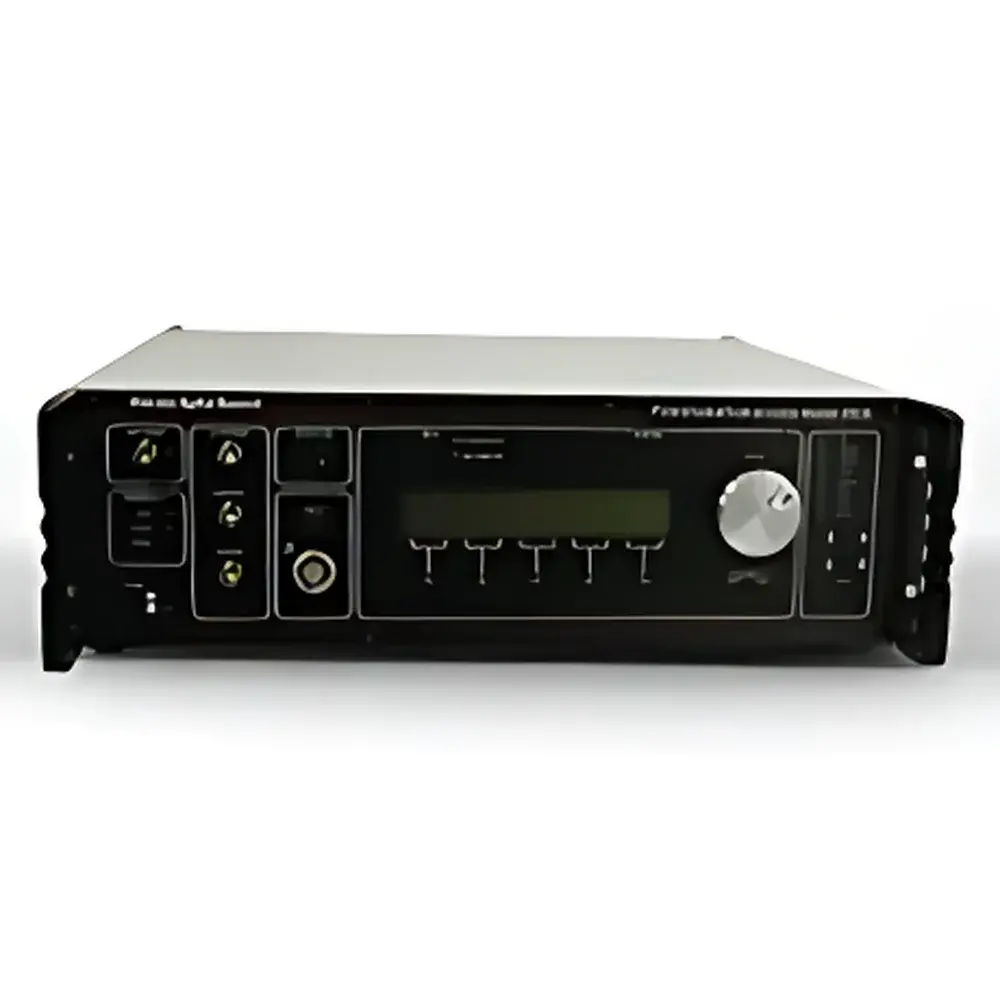
AMETEK Princeton Applied Research Model 263A Potentiostat/Galvanostat
| Brand | AMETEK Princeton Applied Research |
|---|---|
| Origin | USA |
| Model | Model 263A Potentiostat/Galvanostat |
| Instrument Type | Benchtop Electrochemical Workstation |
| Current Range | 7 decades, 100 mA to 100 nA |
| Current Resolution | 2 pA (min) |
| Potential Range | ±20 V |
| Compliance Voltage | ±20 V |
| Slew Rate | >1 V/µs |
| Rise Time | <1 µs |
| Input Impedance | >10¹² Ω in parallel with <20 pF |
| Electrometer Input Bias Current | <50 pA at 25°C |
| Minimum Time Resolution | 30 µs |
| Minimum Potential Step | 250 µV |
| Noise | <50 µV rms (typical) |
| EIS Frequency Range | Up to 100 kHz (with optional EIS module) |
| Communication Interfaces | IEEE-488 (GPIB), RS-232C |
| Software | PowerSuite (PowerSINE, PowerCORR, PowerCV, PowerSTEP) |
| Operating Temperature | 0–50 °C |
| Dimensions | 44.5 × 47.0 × 14.0 cm (W×D×H) |
| Weight | 16 kg |
Overview
The AMETEK Princeton Applied Research Model 263A Potentiostat/Galvanostat is a high-performance, microprocessor-controlled electrochemical instrumentation platform engineered for precision DC and AC electrochemical measurements. Designed around a robust analog front-end architecture with low-noise differential electrometer circuitry and high-speed digital control, the Model 263A implements true four-terminal potentiostatic/galvanostatic regulation using a three-electrode configuration (working, reference, counter). Its core operation adheres to classical electrochemical control theory—maintaining either a user-defined potential (potentiostatic mode) or current (galvanostatic mode) across the working electrode while dynamically compensating for solution resistance (iR drop) via positive-feedback iR compensation. With a maximum compliance voltage of ±20 V and a standard current output capability of ±200 mA (expandable to ±20 A with external amplifiers), the instrument supports demanding applications including battery cycling, corrosion studies, fuel cell characterization, and sensor development under controlled kinetic and mass-transport conditions.
Key Features
- Seven-decade current measurement range (100 mA to 100 nA), with selectable full-scale ranges offering <0.4% accuracy for 10–100 µA and <0.5% for 1 µA and 100 nA ranges
- Differential electrometer input with input bias current 10¹² Ω || 4 MHz (–3 dB)
- High-speed analog control loop: rise time 1 V/µs, minimum time resolution 30 µs, and minimum potential step resolution 250 µV
- Integrated iR compensation via positive feedback, adjustable from 2 Ω to 20 MΩ depending on selected current range
- Optional electrochemical impedance spectroscopy (EIS) module supporting frequency sweeps up to 100 kHz with phase and magnitude resolution suitable for equivalent circuit modeling
- Flexible connectivity: IEEE-488 (GPIB) and RS-232C interfaces for integration into automated test systems or legacy lab environments
- Two hardware variants: Model 263A-1 (rear-panel-only interface, software-controlled exclusively) and Model 263A-2 (full front-panel keypad and display for standalone operation)
Sample Compatibility & Compliance
The Model 263A accommodates a broad spectrum of electrochemical cells—from standard three-electrode beaker setups to specialized configurations requiring floating operation (optional isolated ground option). Its auxiliary input channel (Model 263A/98 option) enables synchronized acquisition from external transducers such as rotating disk electrodes (RDE), quartz crystal microbalances (QCM), and temperature controllers—enabling multi-parameter correlation in real time. The instrument meets general laboratory safety standards per UL 61010-1 and IEC 61010-1. While not pre-certified for regulated GMP/GLP environments, its deterministic timing, audit-ready data logging via PowerSuite, and support for 21 CFR Part 11-compliant software extensions (via third-party validated add-ons) make it suitable for method development and pre-validation stages in pharmaceutical, battery, and materials R&D labs. All firmware and calibration constants are traceable to NIST-maintained references.
Software & Data Management
Control and analysis are performed using the modular PowerSuite software suite, comprising PowerSINE (EIS), PowerCORR (corrosion protocols), PowerCV (cyclic voltammetry), and PowerSTEP (chronoamperometry/chronopotentiometry). Data files are stored in proprietary but openly documented binary formats (.pwr), with export options to CSV, ASCII, and Excel-compatible layouts. Each experiment records complete metadata—including instrument configuration, timestamp, environmental conditions (if logged externally), and raw digitized waveforms—ensuring full experimental reproducibility. PowerSuite supports script-driven automation via VBScript or Python (through COM interface), enabling unattended overnight experiments and integration into larger workflow orchestration platforms. All data acquisition paths maintain bit-for-bit fidelity with hardware ADC/DAC outputs; no interpolation or smoothing is applied during real-time capture.
Applications
The Model 263A serves as a foundational tool across academic and industrial electrochemistry domains. It is routinely deployed in battery research for galvanostatic charge/discharge profiling, pulse testing, and state-of-health estimation; in corrosion science for Tafel analysis, linear polarization resistance (LPR), and electrochemical noise monitoring; in electrocatalysis for CO₂ reduction and oxygen evolution reaction (OER) kinetics; and in biosensor development where low-current detection (down to sub-picoampere levels with proper shielding) and fast transient response are critical. Its compatibility with rotating electrodes and temperature-controlled cells further extends utility in kinetic studies governed by diffusion-controlled regimes (e.g., Levich and Koutecký–Levich analysis).
FAQ
Is the Model 263A compatible with modern Windows operating systems beyond Windows 7?
Yes—while originally certified for Windows 7 and earlier, the PowerSuite software operates reliably on Windows 10 and Windows 11 via compatibility mode; driver-level GPIB/RS-232 support remains functional with current National Instruments and FTDI stack versions.
Can the instrument perform true zero-resistance ammeter (ZRA) measurements?
No—the Model 263A does not include a dedicated ZRA mode; however, galvanostatic mode at 0 A setpoint with high-gain current feedback approximates ZRA behavior for corrosion coupling studies when used with appropriate cell geometry.
What is the calibration interval recommendation?
AMETEK recommends annual calibration using traceable standards; internal self-calibration routines verify gain, offset, and timing integrity prior to each experimental session.
Is floating (isolated) operation available without modification?
Floating capability requires the optional isolated ground kit (part number 263A-FLOAT), which electrically isolates the working electrode lead from chassis ground—essential for grounded counter/reference electrode configurations.
Does the EIS option support Kramers–Kronig validation?
PowerSINE includes built-in Kramers–Kronig transform checks for linearity, causality, and stability assessment of acquired impedance spectra, with pass/fail flagging based on user-defined tolerance thresholds.




