
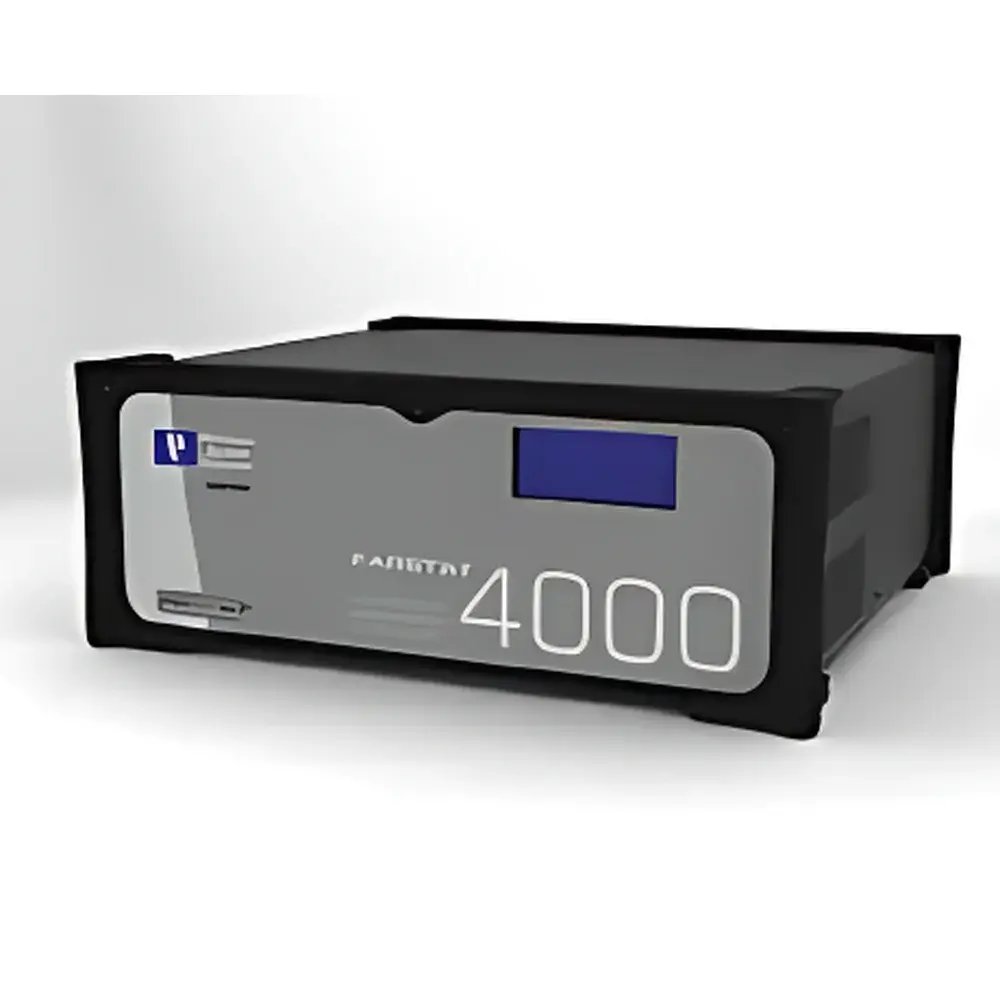
AMETEK Princeton Applied Research ParStat 4000 Electrochemical Workstation
| Brand | AMETEK Princeton Applied Research |
|---|---|
| Origin | USA |
| Model | ParStat 4000 |
| Current Range | ±4 A (standard), ±20 A (optional) |
| Current Resolution | 1.2 fA (at 40 pA range) |
| Current Accuracy | ±0.5% ±4 pA (40–200 pA), ±0.2% of reading ±0.2% of range (2 nA–20 A) |
| Potential Range | ±10 V |
| Potential Accuracy | ±0.2% of reading ±2 mV |
| Potentiostatic Bandwidth | 3.75 MHz |
| EIS Frequency Range | 10 µHz to 5 MHz |
| Sampling Rate | 1 MS/s (synchronized potential/current/auxiliary), 500 kS/s (3 × 16-bit ADC) |
| Input Impedance | ≥10¹³ Ω |
| Leakage Current | ≤2 pA (at <25°C) |
| CMRR | 60 dB @ 100 kHz |
| Compliance Voltage | ±48 V |
| Rise Time (−1.0 V to +1.0 V) | <100 ns |
| Scan Rate | up to 10 kV/s (10 mV step) |
| iR Compensation | Positive feedback & dynamic iR compensation |
| Operating Temperature | 10–50°C |
| Dimensions (L×W×H) | 515 × 490 × 195 mm |
| Weight | 23 kg |
| Certifications | CE compliant |
Overview
The AMETEK Princeton Applied Research ParStat 4000 Electrochemical Workstation is a high-performance, research-grade potentiostat/galvanostat system engineered for precision electrochemical characterization across demanding academic, industrial, and regulatory environments. Built upon over five decades of electrochemical instrumentation heritage, the ParStat 4000 employs a modular, low-noise architecture grounded in true analog front-end design and synchronized high-speed digital acquisition. Its core measurement principle relies on real-time, dual-channel (potential/current) feedback control using a high-bandwidth operational amplifier topology with active stability management—enabling accurate potentiostatic and galvanostatic operation under highly capacitive or resistive loads. The system supports full DC and AC techniques—including cyclic voltammetry (CV), chronoamperometry (CA), chronopotentiometry (CP), linear sweep voltammetry (LSV), pulse techniques (DPV, SWV), and electrochemical impedance spectroscopy (EIS)—with uncompromised fidelity from ultra-low current regimes (sub-100 fA) to high-power applications (±20 A). Designed for reproducibility and traceability, it meets foundational requirements for GLP-compliant electrochemical testing and serves as a platform for method development aligned with ASTM G5, G59, G102, ISO 16773, and USP electrochemical validation frameworks.
Key Features
- Ultra-low current capability: Standard 40 pA full-scale range with 1.2 fA resolution; optional 80 fA range with 2.5 aA resolution for nanoscale electrode and single-entity electrochemistry.
- High-voltage compliance: ±48 V output enables studies of high-resistance systems (e.g., solid-state electrolytes, coated metals, ceramic separators) without external boosters.
- Wide EIS bandwidth: 10 µHz–5 MHz frequency coverage with automatic phase calibration, supporting both slow diffusion-controlled processes and fast interfacial charge-transfer kinetics.
- Synchronized 1 MS/s data acquisition: Three independent 16-bit ADC channels (E, I, auxiliary) capture transient events with 1 µs time resolution and 4 MB onboard buffer to prevent data loss during high-throughput experiments.
- True floating ground architecture: Eliminates ground-loop interference in multi-cell or battery stack configurations; supports grounded, isolated, or differential cell setups.
- Adaptive noise filtering: Seven programmable digital filter settings (off to 200 kHz) optimize signal-to-noise ratio without phase distortion, critical for low-amplitude EIS or microelectrode measurements.
- Integrated dummy cell: Onboard DC calibration reference for daily performance verification per ASTM E2101 and ISO/IEC 17025 internal quality control protocols.
Sample Compatibility & Compliance
The ParStat 4000 interfaces seamlessly with standard three-electrode cells (working, counter, reference), rotating disk electrodes (RDE), rotating ring-disk electrodes (RRDE), microfluidic electrochemical cells, and custom battery test fixtures (e.g., coin-cell holders, pouch-cell clamps). Its high input impedance (>10¹³ Ω) and low leakage current (<2 pA) ensure minimal perturbation of high-impedance samples such as polymer electrolytes, biological membranes, and passivated metal surfaces. The instrument complies with CE electromagnetic compatibility (EMC) directives and supports audit-ready operation under FDA 21 CFR Part 11 when paired with VersaStudio software configured for electronic signatures, audit trails, and user access controls. It is routinely deployed in laboratories adhering to ISO/IEC 17025 accreditation for materials corrosion testing (ASTM G102), battery cycle-life evaluation (IEC 62660-1), and sensor calibration (ISO 15197).
Software & Data Management
VersaStudio software provides a unified, scriptable environment for experiment design, real-time visualization, and post-acquisition analysis. It supports method templates compliant with ASTM E1492 (CV parameters), ASTM G106 (EIS fitting), and IEC 61960 (battery discharge profiling). All raw data are stored in open-format .txt and .csv files with embedded metadata (timestamp, technique, parameter set, instrument ID), enabling integration into LIMS and statistical process control (SPC) platforms. The software includes built-in equivalent circuit modeling (ZView-compatible), Tafel analysis, diffusion coefficient calculation (Randles–Sevcik), and automated baseline correction. Audit trail logging records every parameter change, file export, and user login event—meeting GLP/GMP documentation standards. Remote operation via USB 2.0 is supported on Windows 7 through Windows 11 (64-bit), with minimum system requirements of 4 GB RAM and SSD storage for high-frequency EIS batch processing.
Applications
The ParStat 4000 serves as a foundational tool in advanced electrochemical R&D and QA/QC. In energy storage, it characterizes Li-ion, Na-ion, and solid-state battery electrodes across charge/discharge cycles, quantifies SEI growth via low-frequency EIS, and evaluates interfacial resistance in symmetric cells. For corrosion science, it performs potentiodynamic polarization, electrochemical noise analysis (ENA), and localized electrochemical impedance mapping (LEIM) on coated steels and aluminum alloys per ASTM G59 and ISO 16773. In electrocatalysis, its high-speed sampling captures transient intermediates during CO₂ reduction or OER, while its sub-picoampere sensitivity enables single-nanoparticle collision detection. Additional use cases include biosensor calibration (glucose oxidase kinetics), conductive polymer switching behavior, photoelectrochemical water splitting, and fundamental studies of electron transfer kinetics at ultramicroelectrodes.
FAQ
What is the minimum detectable current with the standard ParStat 4000 configuration?
The base system achieves 1.2 fA resolution at the 40 pA current range, with accuracy specified as ±0.5% ±4 pA between 40 pA and 200 pA.
Can the ParStat 4000 perform simultaneous EIS and DC polarization?
Yes—via the “Hybrid EIS” mode, which superimposes small-signal AC perturbations onto controlled DC bias (e.g., potentiostatic hold), enabling in-situ impedance monitoring during battery charging or corrosion potential stabilization.
Is the instrument suitable for battery cycling tests requiring long-term stability?
Yes—the thermal design maintains <0.5 °C internal drift over 24 h at 25 °C ambient, and the onboard temperature sensor logs environmental conditions alongside electrochemical data for correlation analysis.
Does the ParStat 4000 support third-party automation (e.g., via LabVIEW or Python)?
Yes—COM object interface and SCPI command set enable full remote control, including sequence execution, parameter sweeping, and real-time data streaming for integration into automated test benches.
How is calibration verified and maintained?
Daily verification uses the internal dummy cell; annual recalibration follows NIST-traceable procedures performed by AMETEK-certified service engineers, with certificate-of-conformance documentation provided.
Related Products





