
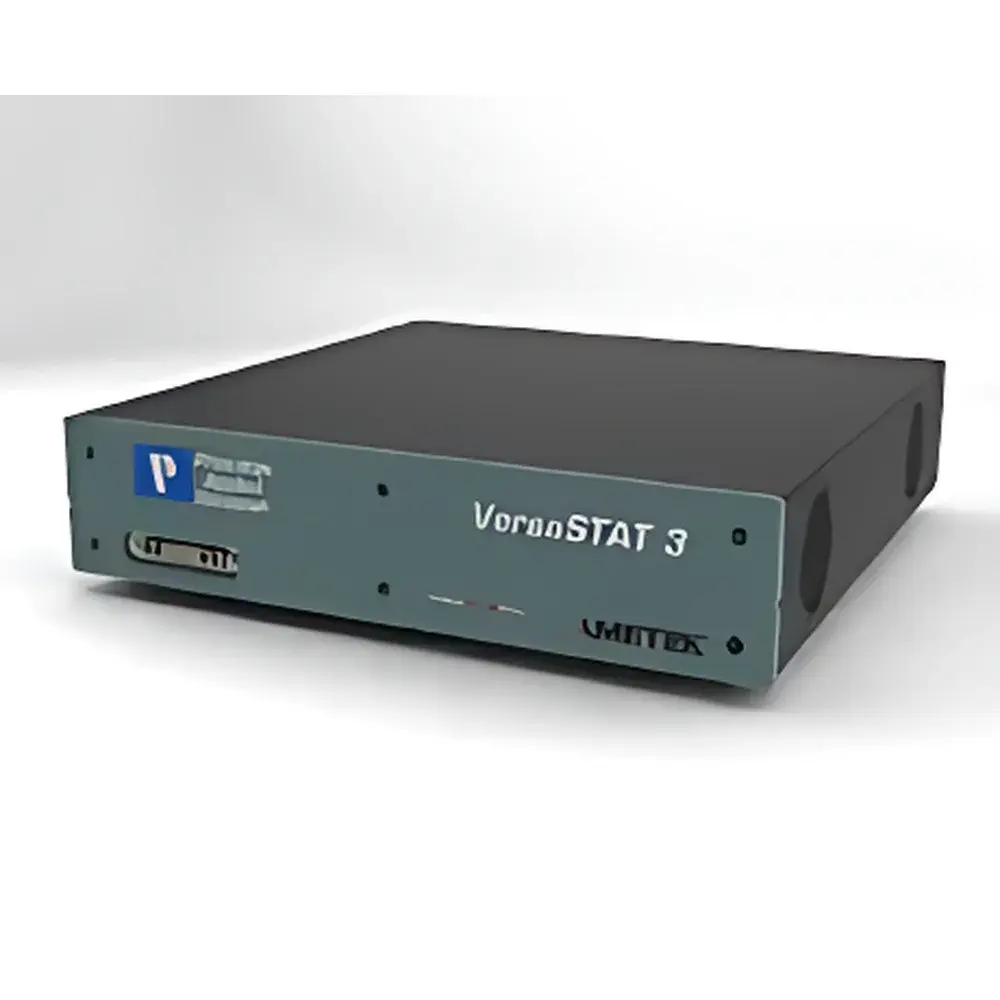
AMETEK Princeton Applied Research VersaSTAT 3 Electrochemical Workstation
| Brand | AMETEK-Princeton Applied Research |
|---|---|
| Origin | USA |
| Manufacturer Type | Authorized Distributor |
| Origin Category | Imported |
| Model | VersaSTAT 3 Electrochemical Workstation |
| Current Range | ±650 mA (standard), ±2 A (internal optional) |
| Current Accuracy | ±0.2% of reading or ±0.2% of range |
| Potential Accuracy | ±2 mV |
| Potentiostatic Range | ±10 V |
| EIS Frequency Range | 10 µHz to 1 MHz |
Overview
The AMETEK Princeton Applied Research VersaSTAT 3 Electrochemical Workstation is a high-performance, modular potentiostat/galvanostat engineered for precision electrochemical research and industrial testing. Built upon over four decades of expertise in electrochemical instrumentation, the VersaSTAT 3 implements a dual-channel, high-bandwidth analog architecture with synchronized 16-bit, 500 kS/s data acquisition across potential, current, and auxiliary inputs. Its core measurement principle relies on real-time feedback-controlled voltage/current sourcing combined with low-noise differential electrometer design—enabling stable potentiostatic and galvanostatic operation across wide dynamic ranges. The system supports fundamental techniques including cyclic voltammetry (CV), linear sweep voltammetry (LSV), chronoamperometry (CA), chronopotentiometry (CP), and electrochemical impedance spectroscopy (EIS), with full compliance to ASTM G59, G102, G106, and ISO 16774 standards for corrosion evaluation. Designed for laboratory environments requiring reproducible, traceable, and audit-ready data, the VersaSTAT 3 integrates seamlessly into GLP/GMP workflows through hardware-level synchronization, deterministic timing resolution down to 10 µs, and built-in digital I/O for external device triggering.
Key Features
- High-fidelity analog front-end: Differential electrometer with ≥1012 Ω input impedance, ≤5 pA leakage current, and 60 dB CMRR at 100 kHz
- Flexible current capability: Standard ±650 mA output with optional internal ±2 A upgrade; extended current support up to ±20 A via external amplifiers
- Precise potential control: ±10 V range, 300 µV resolution at full scale, ±0.2% accuracy ±2 mV, and <350 ns rise time (–1.0 V to +1.0 V)
- Integrated frequency response analyzer (FRA): Optional EIS module covering 10 µHz–1 MHz with 0.1 mV RMS minimum AC amplitude and programmable iR compensation (both positive feedback and dynamic)
- Dual-mode operation: Simultaneous potentiostatic and galvanostatic control with automatic range switching across eight current decades (200 nA to 650 mA, or 200 nA to 2 A with option)
- Hardware-synchronized data acquisition: Three independent 16-bit ADC channels sampling at up to 500 kS/s, with selectable noise filtering (off / 1 kHz / 200 kHz)
- Robust interface architecture: USB 2.0 communication, TTL-compatible digital I/O (5 outputs, 2 inputs), auxiliary voltage input (±10 V, 10 kΩ), and analog output (±10 V, 1 kΩ) for peripheral device control
Sample Compatibility & Compliance
The VersaSTAT 3 accommodates a broad spectrum of electrochemical cells—from microelectrodes (<10 µm diameter) and rotating disk electrodes (RDE) to large-area corrosion coupons and fuel cell test stations. Its high input impedance and low noise floor ensure reliable measurements in low-conductivity media (e.g., organic electrolytes, biological buffers) and high-resistance systems (e.g., coated metals, solid-state batteries). All hardware modules comply with CE marking requirements and meet IEC/EN 61010-1 safety standards for laboratory electrical equipment. For regulated environments, the system supports FDA 21 CFR Part 11-compliant data integrity when used with validated VersaStudio software configurations—including electronic signatures, audit trails, and user access controls. It is routinely deployed in accordance with ASTM D1141 (synthetic seawater), ASTM G5 (potentiostatic polarization), and ISO 9223 (corrosivity classification) protocols.
Software & Data Management
VersaStudio software provides a unified, Windows-based platform for method development, real-time visualization, and post-experiment analysis. The software includes pre-configured application templates for corrosion (LPR, Tafel, EIS under polarization), battery cycling (GITT, PITT), sensor calibration, and nanomaterial characterization. All experiments are stored in a structured binary format (.v3d) with embedded metadata (instrument ID, operator, timestamp, calibration history). Raw data export supports CSV, ASCII, and MATLAB-compatible formats. Version-controlled experiment files include full parameter logging, enabling full experimental reproducibility. For quality-critical labs, VersaStudio can be configured with role-based permissions, automated backup routines, and integration with LIMS via ODBC drivers.
Applications
- Corrosion science: Quantitative assessment of coating degradation, passivation behavior, localized corrosion initiation, and inhibitor efficiency using EIS, LPR, and potentiodynamic polarization
- Energy storage & conversion: Characterization of Li-ion, Na-ion, and solid-state battery electrodes; PEM fuel cell catalyst activity; electrolyzer efficiency mapping
- Bioelectrochemistry: Enzyme kinetics, redox protein studies, and biosensor development under physiological pH and temperature conditions
- Electroplating & surface engineering: Real-time monitoring of deposition kinetics, bath composition stability, and nucleation overpotential analysis
- Nanomaterial electrochemistry: Charge transfer resistance mapping of graphene, MXenes, and metal–organic frameworks (MOFs) in non-aqueous media
- Sensor development: Amperometric detection limits, selectivity profiling, and long-term stability validation under flow-cell configurations
FAQ
What is the maximum achievable current resolution with the VersaSTAT 3?
The system achieves 6 pA resolution in the 200 nA current range, enabled by its 16-bit digitization and low-noise electrometer design.
Can the VersaSTAT 3 perform simultaneous EIS and DC polarization?
Yes—using the optional FRA module and VersaStudio’s multi-technique sequencing engine, users can acquire impedance spectra at defined DC bias points during potentiodynamic sweeps.
Is the instrument compatible with third-party rotating electrode controllers?
Yes—the auxiliary voltage output (±10 V, BNC) and TTL trigger lines allow direct synchronization with commercial RDE and RRDE systems.
Does the VersaSTAT 3 support remote operation or networked data acquisition?
While native Ethernet connectivity is not included, USB-over-IP solutions and Windows Remote Desktop enable secure off-site operation in controlled IT environments.
How is calibration traceability maintained?
Each unit ships with NIST-traceable calibration certificates for voltage, current, and timing domains; field recalibration is supported via VersaStudio’s built-in calibration wizard and reference standards.






