
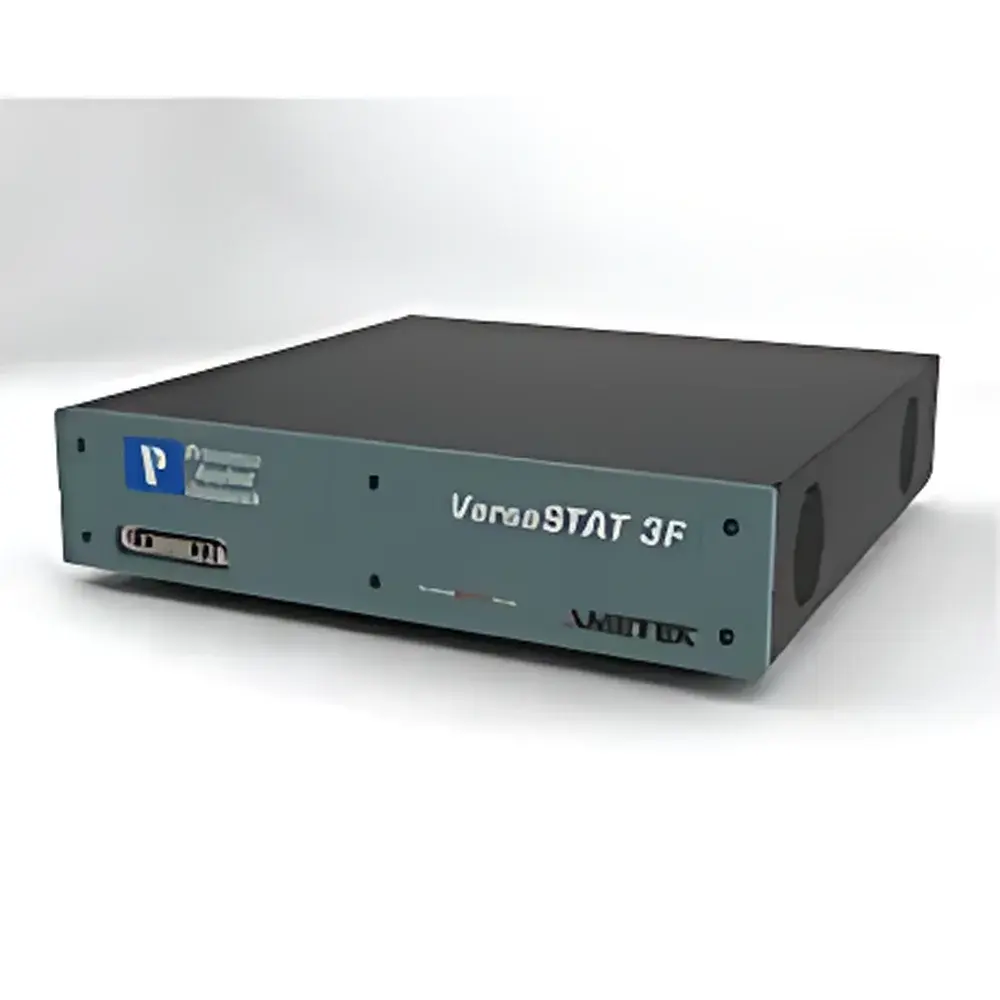
AMETEK Princeton Applied Research VersaSTAT 3F Electrochemical Workstation
| Brand | AMETEK Princeton Applied Research |
|---|---|
| Origin | USA |
| Model | VersaSTAT 3F Electrochemical Workstation |
| Current Range | ±650 mA (standard), ±2 A (internal optional) |
| Current Accuracy | ±0.2% of reading + ±0.2% of range (20 nA to 2 A) |
| Potential Accuracy | ±2 mV |
| Potentiostatic Range | ±10 V |
| EIS Frequency Range | 10 µHz to 1 MHz |
| Floating Ground Architecture | Yes (isolated electrode connections and rear-panel interfaces) |
| Data Acquisition | 3 × 16-bit, 500 kS/s |
| Input Impedance | ≥10¹² Ω |
| Leakage Current | ≤5 pA at <25°C |
| CMRR | 60 dB @ 100 kHz (typical) |
| Compliance | CE certified, compatible with GLP/GMP environments requiring audit-trail-capable software (via VersaStudio with optional 21 CFR Part 11 modules) |
Overview
The AMETEK Princeton Applied Research VersaSTAT 3F Electrochemical Workstation is a precision-engineered potentiostat/galvanostat designed specifically for experiments involving grounded or earth-referenced electrochemical cells. Unlike conventional grounded instruments, the VersaSTAT 3F implements a true floating ground architecture—its working electrode (WE), reference electrode (RE), counter electrode (CE), and all rear-panel I/O interfaces are galvanically isolated from earth ground. This design eliminates ground-loop interference and enables stable, low-noise measurements on systems such as high-pressure autoclaves, pipeline corrosion test rigs, tensiometers, storage tanks, and multi-instrument coupled electrochemical setups where one or more electrodes are physically or electrically referenced to earth. The instrument retains the core performance of the VersaSTAT 3 platform—including ±650 mA maximum output current and ±10 V potential control—but integrates the advanced noise suppression capabilities of the VersaSTAT 4 series, including programmable notch filtering (50/60 Hz rejection) and dedicated EIS filters optimized for frequency response analysis (FRA) applications. Its dual-mode operation (Normal vs. Floating) allows seamless transition between standard benchtop configurations and complex grounded-cell deployments without hardware modification.
Key Features
- Floating ground architecture with full galvanic isolation of WE, RE, CE, and auxiliary I/O ports—enabling reliable measurement on earth-referenced cells
- High-fidelity analog front-end: differential electrometer with ≥10¹² Ω input impedance, ≤5 pA leakage current, and 60 dB CMRR at 100 kHz
- Ultra-low current detection: 4 nA minimum range with 120 fA resolution; accuracy <0.5% ±20 pA in the 4 nA range
- Built-in FRA module supporting electrochemical impedance spectroscopy (EIS) from 10 µHz to 1 MHz, with configurable AC amplitude (0.1 mV RMS min) and logarithmic/linear sweep modes
- Programmable digital filtering: five selectable bandwidth-limiting filters plus application-specific Notch Filter (50/60 Hz) and EIS Filter sets
- High-speed data acquisition: 3 × 16-bit simultaneous sampling at up to 500 kS/s; temporal resolution down to 10 µs for transient analysis
- Flexible control modes: potentiostatic, galvanostatic, zero-resistance ammetry (ZRA), and hybrid techniques with dynamic iR compensation and positive feedback iR correction
- Robust power stage: ±12 V output, >8 V/µs slew rate, <350 ns rise time (–1.0 V to +1.0 V), and selectable stability mode (high-speed vs. high-stability)
Sample Compatibility & Compliance
The VersaSTAT 3F is routinely deployed in industrial corrosion monitoring, battery R&D, fuel cell characterization, and electrocatalysis studies where experimental cells cannot be isolated from facility grounding. Its floating design ensures compatibility with ASTM G59 (potentiodynamic polarization), ASTM G102 (electrochemical impedance), ISO 16773 (coating degradation), and USP (electrochemical sensor validation). When operated with VersaStudio software configured for audit trail and electronic signature support (optional 21 CFR Part 11 add-on), the system meets regulatory requirements for GLP and GMP laboratories conducting electrochemical quality control or method validation. All signal paths comply with IEC 61000-4-5 surge immunity and IEC 61326-1 EMC standards. CE marking confirms conformity with EU safety and electromagnetic compatibility directives.
Software & Data Management
VersaStudio software—supplied standard—provides intuitive experiment setup, real-time visualization, and post-acquisition analysis for voltammetry, chronopotentiometry, EIS, and pulse techniques. It supports synchronized acquisition of primary (E, I) and auxiliary (e.g., temperature, rotation speed, pH) signals via BNC analog inputs. Data files are stored in open-format binary (.DTA) with embedded metadata (instrument ID, calibration history, user notes), enabling traceability and third-party processing in MATLAB, Python (via PyGamry or EC-Lab-compatible libraries), or Origin. Batch scripting, automated sequence execution, and customizable report generation streamline high-throughput testing. For regulated environments, optional 21 CFR Part 11 compliance modules provide role-based access control, electronic signatures, and immutable audit trails—fully aligned with FDA expectations for instrument qualification and data integrity.
Applications
- Corrosion science: In-situ monitoring of coated steel in grounded immersion cells, pipeline coupon testing, and electrochemical noise analysis under field-representative grounding conditions
- Battery research: Half-cell and full-cell cycling with grounded current collectors; impedance mapping of solid-electrolyte interphases (SEI) under realistic thermal and mechanical constraints
- Electrocatalysis: Rotating disk electrode (RDE) and rotating ring-disk electrode (RRDE) studies where the cell body or stirrer is earthed
- Fuel cell diagnostics: Membrane electrode assembly (MEA) testing in pressurized, grounded hardware fixtures
- Sensor development: Amperometric biosensors integrated into grounded microfluidic platforms or industrial process lines
- Materials electrochemistry: Conductive polymer redox switching, electrophoretic deposition, and anodization of grounded substrates (e.g., aluminum heat exchangers)
FAQ
What distinguishes the VersaSTAT 3F from the standard VersaSTAT 3?
The VersaSTAT 3F incorporates full galvanic isolation of all electrode connections and rear-panel interfaces—enabling operation with grounded electrochemical cells—while retaining the ±650 mA current capability and core firmware of the VersaSTAT 3. It adds the VersaSTAT 4’s enhanced noise-filtering architecture, including dedicated EIS and 50/60 Hz notch filters.
Can the VersaSTAT 3F operate in both floating and grounded modes?
Yes. The instrument features a software-selectable Normal (grounded) or Floating mode. In Floating mode, internal grounding is decoupled from earth; in Normal mode, it reverts to standard single-ended referencing.
Is the built-in FRA module sufficient for full EIS characterization?
Yes. The integrated frequency response analyzer supports 10 µHz–1 MHz sweeps with programmable AC amplitude, phase-sensitive detection, and Kramers-Kronig validation—meeting ASTM E1466 and ISO 17025 requirements for impedance metrology.
Does VersaStudio support automated compliance reporting for regulated labs?
With the optional 21 CFR Part 11 software package, VersaStudio provides electronic signatures, audit trails, and user permission management—validated for use in pharmaceutical, medical device, and aerospace QA/QC workflows.
What auxiliary equipment can be synchronized via the analog I/O ports?
The two analog inputs (±10 V, 10 kΩ) accept signals from external sensors (e.g., thermocouples, strain gauges, pH meters); the analog output (±10 V, 1 kΩ) drives peripheral devices such as motor controllers for RDEs or solenoid valves in flow cells.




