
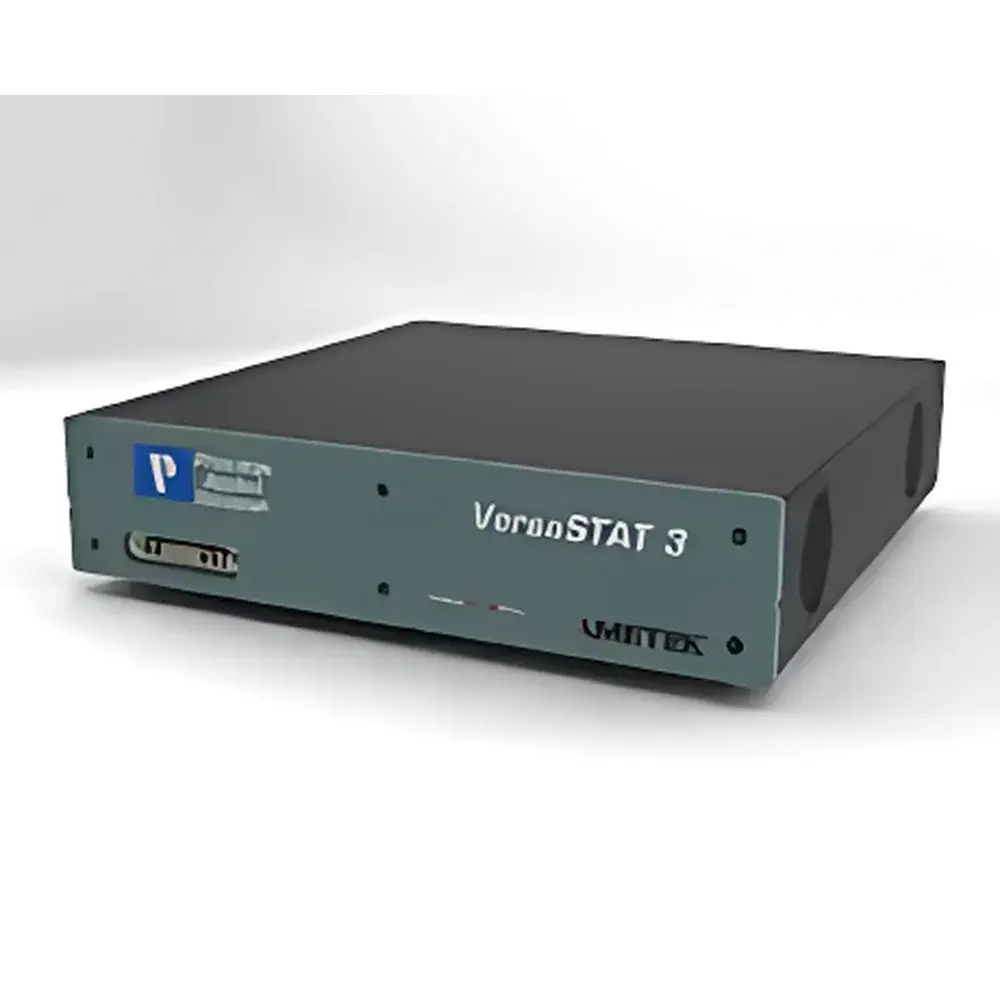
AMETEK Princeton Applied Research VersaSTAT 4 Electrochemical Workstation
| Brand | AMETEK |
|---|---|
| Origin | USA |
| Model | VersaSTAT 4 Electrochemical Workstation |
| Current Range | ±1 A (standard), ±2 A (internal optional) |
| Current Accuracy | <0.5% ±20 pA at 4 nA |
| Potential Accuracy | ±0.2% of reading ±2 mV |
| Potentiostatic Range | ±10 V |
| EIS Frequency Range | 10 µHz to 1 MHz |
Overview
The AMETEK Princeton Applied Research VersaSTAT 4 Electrochemical Workstation is a high-performance, modular potentiostat/galvanostat designed for rigorous electrochemical research and development in academic, industrial, and regulatory environments. Built upon the proven architecture of the VersaSTAT 3 platform, the VersaSTAT 4 integrates enhanced analog front-end design, ultra-low-noise current measurement circuitry, and real-time digital signal processing to deliver exceptional resolution, stability, and speed across a broad spectrum of electrochemical techniques. Its core measurement principle relies on precision-controlled voltage/current sourcing combined with high-fidelity, multi-channel synchronized data acquisition — enabling accurate implementation of cyclic voltammetry (CV), chronoamperometry (CA), chronopotentiometry (CP), electrochemical impedance spectroscopy (EIS), and pulse-based methods including differential pulse voltammetry (DPV) and square-wave voltammetry (SWV). With native support for both DC and AC electrochemical analysis, the system meets the evolving demands of battery materials screening, corrosion science, sensor development, fuel cell catalyst evaluation, and coating integrity assessment.
Key Features
- Ultra-low-current capability: 120 fA resolution and <0.5% ±20 pA accuracy at the 4 nA range, enabling reliable measurements in corrosion inhibition, biosensor interfaces, and low-conductivity electrolytes.
- High-current flexibility: Standard ±1 A output with internal ±2 A option; compatible with external current amplifiers up to ±20 A for full-cell battery cycling and high-power electrode testing.
- Sub-microsecond temporal resolution: 2 μs time resolution (500 k samples/s) ensures fidelity in fast-scan CV, transient response analysis, and kinetic studies requiring precise timing control.
- Dual analog filtering: Programmable low-pass filters for both current and potential channels improve signal-to-noise ratio in capacitive or high-impedance systems — critical for stable EIS acquisition on coated substrates or thin-film electrodes.
- Integrated Frequency Response Analyzer (FRA): Optional built-in FRA supports EIS measurements from 10 µHz to 1 MHz with RMS amplitude as low as 0.1 mV, compliant with ASTM G106 and ISO 16773 standards for corrosion monitoring.
- Robust potentiostatic control: >8 V/μs slew rate, <350 ns rise time (–1.0 V to +1.0 V), and 1 MHz bandwidth ensure rapid settling and minimal distortion during high-speed potential sweeps up to 5000 V/s.
Sample Compatibility & Compliance
The VersaSTAT 4 supports three-electrode configurations (working, reference, counter) and accommodates a wide variety of electrochemical cells — including standard glassware, rotating disk electrodes (RDE), rotating ring-disk electrodes (RRDE), microelectrodes, and custom flow cells. Its high-input-impedance differential electrometer (≥1012 Ω || ≤5 pF) minimizes loading effects on high-resistance samples such as polymer electrolytes or biological membranes. The instrument complies with CE marking requirements and operates within GLP/GMP-aligned workflows when paired with audit-trail-enabled software configurations. While not inherently 21 CFR Part 11 compliant out-of-the-box, its VersaStudio software architecture supports integration with validated electronic lab notebook (ELN) systems and can be configured for FDA-regulated environments through documented user access controls, electronic signatures, and raw data export in vendor-neutral formats (e.g., ASCII, CSV, binary).
Software & Data Management
VersaStudio software — included as standard — provides intuitive method setup, real-time visualization, and post-experiment analysis tools for all supported techniques. It features synchronized acquisition of potential, current, auxiliary voltage, and digital I/O signals with timestamped metadata. Data are stored in a structured binary format (.vmp) with embedded experimental parameters, allowing traceable reprocessing and cross-platform compatibility. The software supports automated sequence scripting, multi-step protocols, and conditional branching for unattended operation. Export options include industry-standard formats for further analysis in MATLAB, Origin, or Python-based platforms (e.g., PyEIS, ECpy). For enterprise deployment, VersaStudio supports network licensing and centralized configuration management via Windows Group Policy.
Applications
- Battery R&D: Characterization of Li-ion, solid-state, and next-generation chemistries using galvanostatic intermittent titration (GITT), hybrid pulse power characterization (HPPC), and EIS-based state-of-health (SoH) modeling.
- Corrosion science: Evaluation of inhibitor efficiency, pitting susceptibility, and coating delamination via polarization resistance (Rp), electrochemical noise (EN), and low-frequency EIS.
- Electrocatalysis: Quantification of oxygen reduction reaction (ORR) kinetics, hydrogen evolution activity, and catalyst stability under accelerated stress tests (AST).
- Sensor development: Amperometric detection limits, selectivity profiling, and interference rejection studies in physiological or environmental matrices.
- Materials electrochemistry: Redox behavior of conducting polymers, metal-organic frameworks (MOFs), and 2D nanomaterials under controlled mass transport conditions.
FAQ
What is the minimum detectable current with the VersaSTAT 4?
The system achieves 120 fA resolution in the 4 nA current range, with absolute accuracy specified as <0.5% ±20 pA at that range.
Can the VersaSTAT 4 perform EIS on high-impedance samples such as painted steel or concrete?
Yes — its differential electrometer input impedance (>1012 Ω), programmable analog filtering, and low-noise design enable stable EIS acquisition down to 10 µHz on resistive coatings and porous media.
Is external hardware required to run battery cycling tests?
No — the standard ±1 A output suffices for most coin-cell and small-format pouch cell testing; optional ±2 A internal upgrade or external amplifiers extend capability to larger-format cells.
Does the VersaSTAT 4 support dynamic iR compensation?
Yes — both positive feedback and dynamic iR compensation algorithms are implemented in real time during potentiostatic experiments to correct for uncompensated solution resistance.
What operating systems are officially supported?
Windows 7, 10, and 11 (64-bit); legacy support for Windows XP and Vista is discontinued in current VersaStudio versions.
Related Products






