
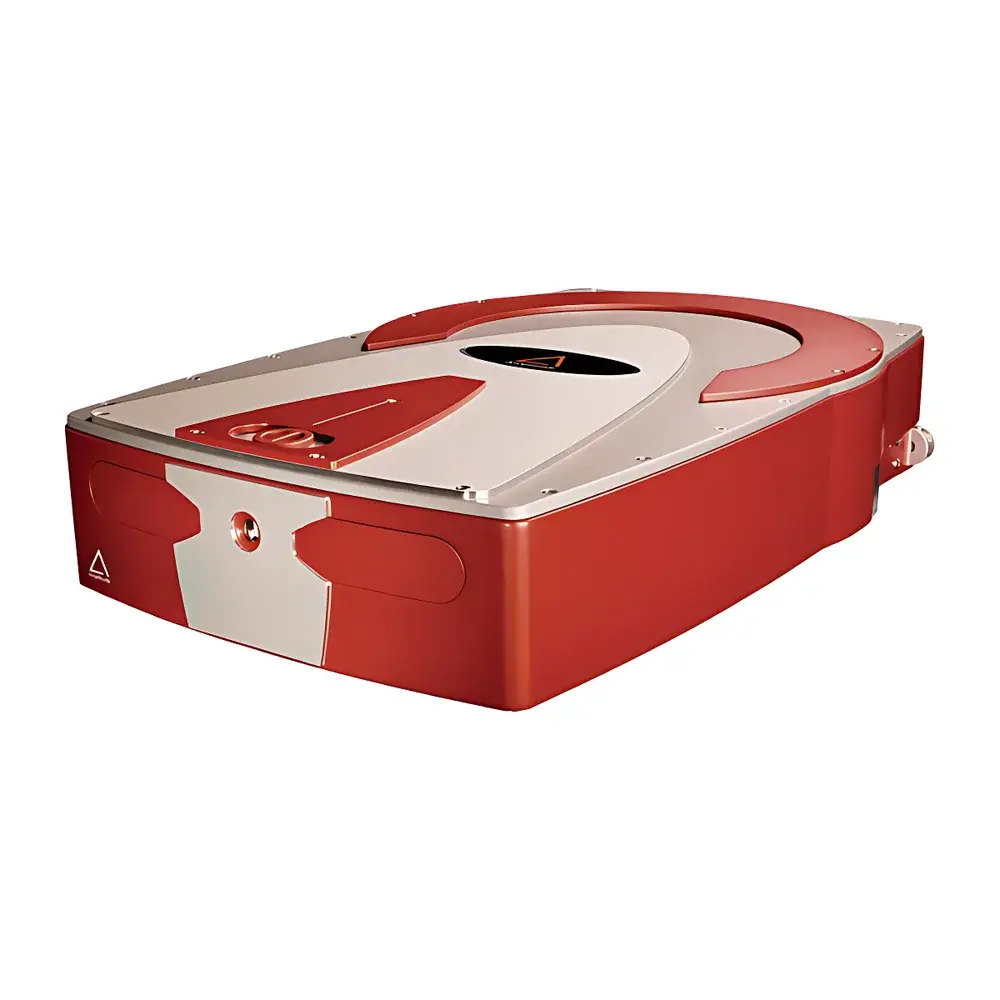
Amplitude Satsuma Compact High-Repetition-Rate High-Power Femtosecond Laser
| Brand | Amplitude |
|---|---|
| Origin | France |
| Model | Satsuma |
| Laser Type | Solid-State Femtosecond Oscillator-Amplifier System |
| Cooling | Air-Cooled |
| Average Power | Up to 20 W |
| Pulse Energy | Up to 150 µJ |
| Repetition Rate | High (Multi-kHz to MHz range) |
| Pulse Duration | <500 fs (standard), optional <100 fs configurations |
| Output Options | Fundamental IR (1030 nm), SHG (515 nm), UV (343 nm), Deep UV (257 nm) |
| Triggering | FemtoTrig™ single-pulse selection |
| Burst Mode | FemtoBurst™ (adjustable pulse count, inter-pulse spacing 25–100 ns) |
| Synchronization | SuperSync Control for sub-100 ps timing jitter with external scanners or diagnostics |
| Compliance | CE-marked, RoHS-compliant, designed for 7×24 industrial operation |
| Certifications | ISO 9001 manufacturing environment, compatible with GLP/GMP-aligned lab infrastructure |
Overview
The Amplitude Satsuma is a compact, air-cooled, solid-state femtosecond laser system engineered for high-repetition-rate and high-pulse-energy operation in demanding industrial, biomedical, and scientific environments. Based on chirped-pulse amplification (CPA) architecture with Yb-doped gain media, the Satsuma delivers ultrashort pulses (<500 fs, optionally <100 fs) at fundamental wavelengths of 1030 nm, with harmonics available via integrated or external nonlinear conversion. Its design prioritizes thermal stability, long-term amplitude noise suppression (<0.5% RMS over 8 hours), and mechanical robustness—enabling consistent ablation thresholds and minimal heat-affected zones in precision material processing. Unlike water-cooled high-power systems requiring dedicated chillers and infrastructure, the Satsuma achieves up to 20 W average power and 150 µJ pulse energy within a footprint under 600 × 400 × 200 mm, making it uniquely suitable for integration into cleanroom-compatible OEM platforms, clinical ophthalmic workstations, and benchtop ultrafast spectroscopy setups.
Key Features
- FemtoBurst™ Burst Mode: Programmable pulse trains with user-defined burst count (1–100 pulses), intra-burst repetition rates from 10 MHz to 40 MHz, and inter-pulse delays adjustable between 25 ns and 100 ns—optimized for controlled subsurface modification in transparent materials and efficient plasma-mediated ablation.
- FemtoTrig™ Single-Pulse Selection: Hardware-level external TTL triggering with latency <50 ns and jitter <20 ps, enabling deterministic pulse-on-demand operation synchronized to motion stages, detectors, or pump-probe delay lines.
- SuperSync Control: Digital synchronization interface supporting IEEE-1588 Precision Time Protocol (PTP) and LVDS clock distribution, ensuring sub-100 ps timing alignment with high-speed galvanometric scanners, SPIM systems, or time-resolved detection electronics.
- Harmonic Versatility: Factory-integrated or field-upgradable harmonic generation modules: second-harmonic (515 nm), third-harmonic (343 nm), and fourth-harmonic (257 nm) outputs—each with >60% conversion efficiency and beam pointing stability <5 µrad over 24 h.
- Industrial-Grade Architecture: All-aluminum monolithic baseplate, vibration-damped optical mounts, and sealed cavity design compliant with IEC 60825-1 Class 4 laser safety requirements. Rated for continuous operation under ambient temperatures from 15 °C to 30 °C and relative humidity ≤60% non-condensing.
Sample Compatibility & Compliance
The Satsuma is validated for interaction with a broad spectrum of optically transparent and absorbing materials—including fused silica, sapphire, BK7, LiNbO₃, polyimide, ITO-coated glass, silicon wafers, and biological tissues—without requiring vacuum or inert gas environments. Its pulse parameters meet critical thresholds for cold ablation (fluence >0.1 J/cm², peak intensity >10¹³ W/cm²) while maintaining sub-micron feature fidelity in micromachining applications. The system conforms to EU Directive 2014/30/EU (EMC), 2014/35/EU (LVD), and 2011/65/EU (RoHS). It supports audit-ready documentation packages aligned with ISO/IEC 17025 calibration traceability and FDA 21 CFR Part 11 electronic record integrity when paired with compliant data acquisition software. Full compliance documentation—including Declaration of Conformity, laser safety reports, and mechanical drawings—is provided upon delivery.
Software & Data Management
Control is executed via the cross-platform Amplitude Laser Manager (ALM) application, offering GUI- and API-based interfaces (Python SDK, LabVIEW VIs, MATLAB drivers). ALM provides real-time monitoring of pulse energy (via internal pyroelectric sensor), repetition rate, cavity alignment status, and thermal load across critical optics. All operational parameters—including burst configuration, harmonic selection, and trigger delay—are stored in encrypted binary logs with ISO 8601 timestamps. Audit trails include operator ID, parameter changes, and system warnings, satisfying GLP/GMP data integrity requirements. Remote diagnostics via secure SSH tunneling enable predictive maintenance alerts based on cumulative pump diode operating hours and cavity mode deviation trends.
Applications
- Industrial Microfabrication: Display panel repair (OLED, LCD), via drilling in IC packaging substrates, waveguide inscription in photonic integrated circuits, and selective metallization removal in flexible PCBs.
- Ophthalmology: Femtosecond LASIK flap creation, corneal ring segment implantation, and presbyopia correction via intrastromal lenticule formation—leveraging low collateral damage and reproducible incision geometry.
- Scientific Research: Pump-probe transient absorption spectroscopy, time-resolved Raman imaging, terahertz generation via optical rectification in ZnTe, and multi-photon fluorescence excitation in deep-tissue neuroscience models.
- Advanced Manufacturing: Glass cutting (display cover, automotive HUDs) using the optional GLASS module; simultaneous multi-focus ablation with adaptive optics; and hybrid additive-subtractive processes in ceramic and composite laminates.
FAQ
What is the typical pulse duration and bandwidth specification?
Standard configuration delivers pulses <500 fs FWHM at 1030 nm (transform-limited, spectral bandwidth ~6 nm). Optional nonlinear compression modules achieve <100 fs with <20 nm bandwidth.
Can the Satsuma be integrated into a Class 100 cleanroom environment?
Yes—its fully sealed optical path, zero-oil air cooling, and particulate emission testing per ISO 14644-1 Class 5 protocols make it suitable for semiconductor fab tool integration.
Is remote firmware update supported?
Yes—secure OTA updates are performed via authenticated HTTPS endpoints, with SHA-256 signature verification and rollback capability.
Does the system support third-party OPA integration?
Yes—standard LEMO sync outputs and 10 MHz reference clock facilitate seamless coupling with Amplitude Mango OPA or equivalent parametric amplifiers.
What maintenance intervals are recommended?
No routine optical alignment required. Annual inspection includes diode current calibration, thermal sensor validation, and harmonic crystal degradation assessment—documented per ISO/IEC 17025 procedures.




