
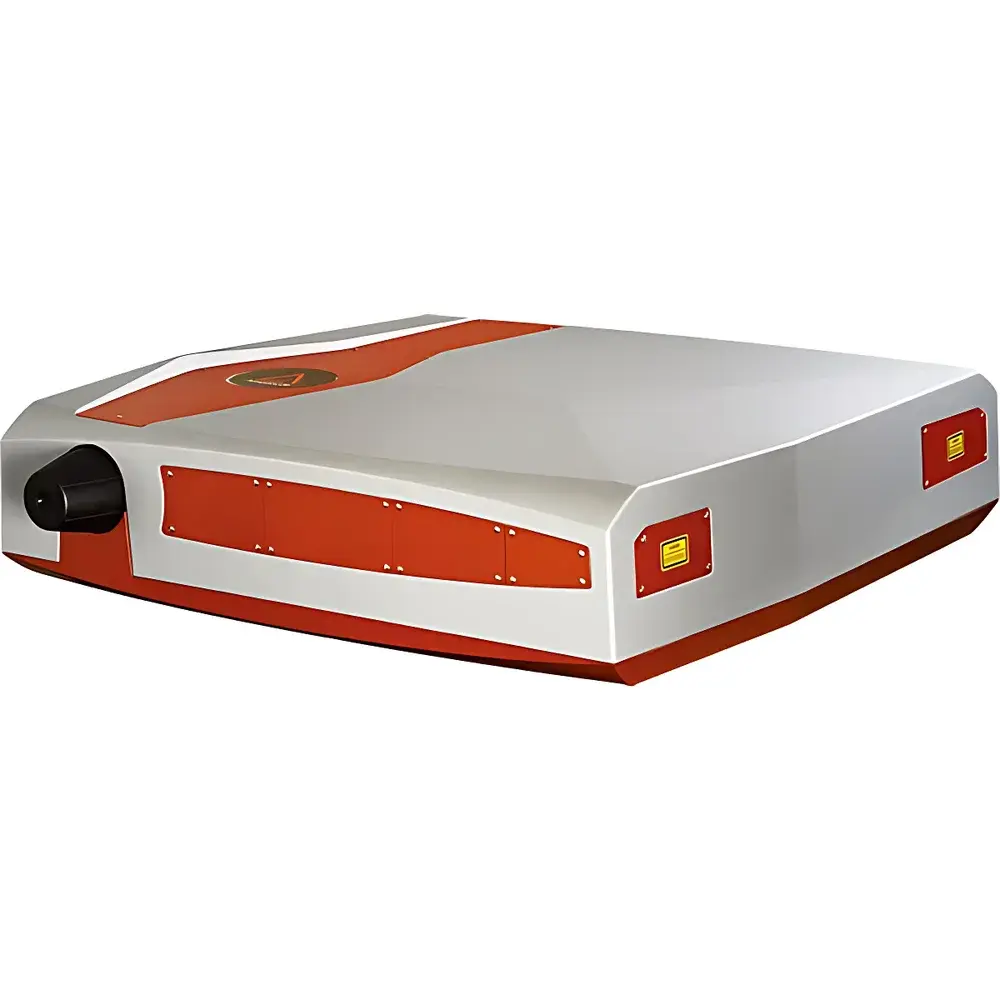
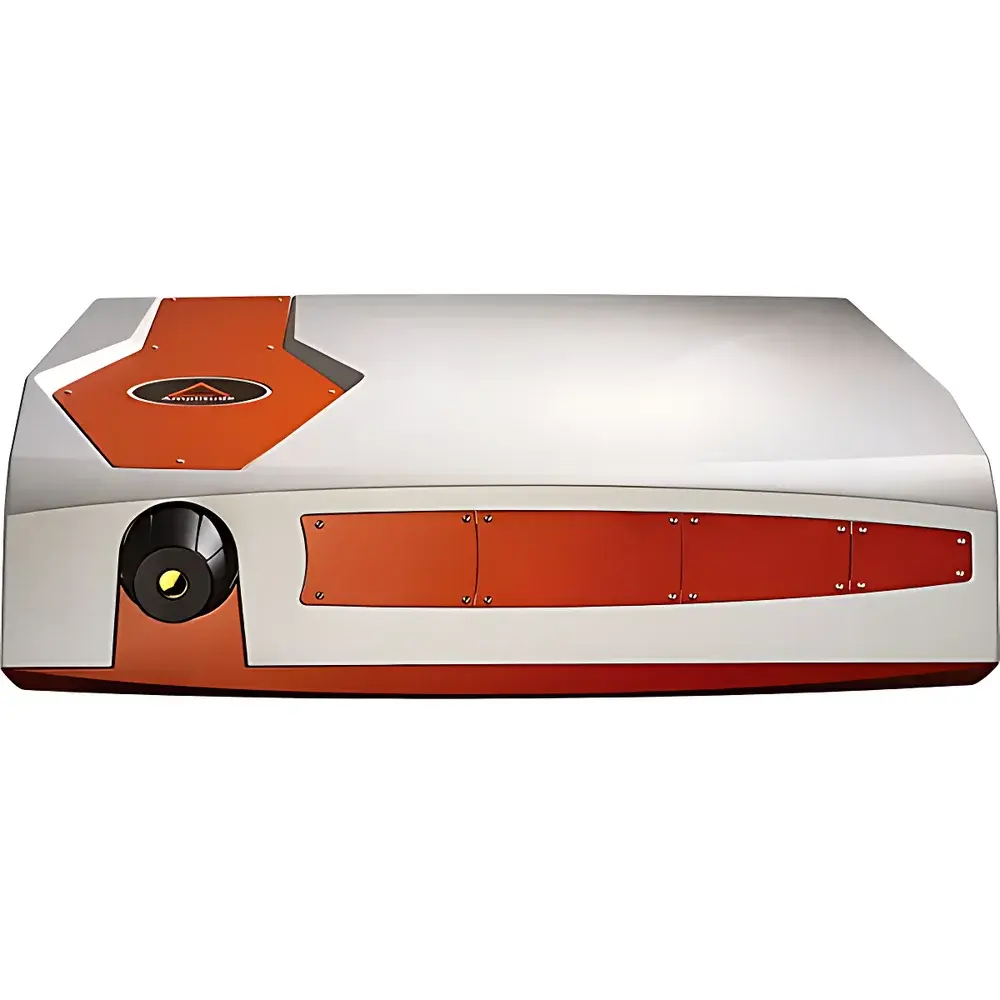
Amplitude Tangor300 High-Power Femtosecond Laser System
| Brand | Amplitude |
|---|---|
| Origin | France |
| Type | Solid-State Femtosecond Laser Oscillator & Amplifier System |
| Model | Tangor300 |
| Average Output Power | 300 W |
| Repetition Rate | Up to 40 MHz (adjustable) |
| Pulse Energy | Up to 3 mJ (configurable via beam splitting) |
| Pulse Duration | <500 fs (typical, sub-100 fs optional with nonlinear compression) |
| Burst Mode | FemtoBurst™ (user-defined pulse count, inter-pulse spacing 25–100 ns) |
| Triggering | FemtoTrig™ (external TTL/trigger-selectable single-pulse emission) |
| Synchronization | SuperSync Control (sub-nanosecond jitter, compatible with high-speed galvo/scanner systems) |
| Optional Wavelength Conversion | UV output up to 100 W (via harmonic generation), Green output available |
Overview
The Amplitude Tangor300 is a turnkey, industrial-grade femtosecond laser system engineered for high-throughput, precision material processing and advanced scientific research. Based on a diode-pumped solid-state (DPSS) architecture with chirped-pulse amplification (CPA), the Tangor300 delivers ultrashort pulses (<500 fs, optionally <100 fs with nonlinear compression) at an unprecedented average power of 300 W. Its core design integrates high-repetition-rate oscillation (up to 40 MHz) with scalable pulse energy (up to 3 mJ per pulse, configurable via internal or external beam splitting), enabling flexible operation across both high-speed microprocessing and high-energy nonlinear optics applications. Unlike conventional ultrafast lasers constrained by thermal management or pulse stability trade-offs, the Tangor300 employs active thermal stabilization, hermetically sealed optical paths, and vibration-damped mechanical architecture—ensuring long-term amplitude and timing stability required for 7×24 industrial deployment and GLP-compliant laboratory environments.
Key Features
- FemtoBurst™ Burst Mode: Programmable pulse trains with user-defined burst count, intra-burst spacing (25–100 ns), and inter-burst repetition—enabling controlled energy deposition for reduced thermal accumulation in transparent or heat-sensitive materials.
- FemtoTrig™ Single-Pulse Selection: Hardware-level TTL-triggered pulse gating allows deterministic selection of individual pulses from the full train, critical for synchronization with motion stages, detectors, or pump-probe experiments.
- SuperSync Control: Sub-500 ps timing jitter interface compatible with high-speed scanning systems (e.g., polygon mirrors, resonant galvanometers), ensuring spatial fidelity in large-area ablation or surface structuring.
- Wavelength Flexibility: Integrated harmonic generation modules support stable UV output up to 100 W (266 nm or 355 nm) and green output (532 nm), eliminating need for external OPA or SHG stages in many spectroscopic or photochemical workflows.
- Industrial Robustness: IP54-rated enclosure, air-cooled thermal management, and redundant monitoring of pump diodes, cavity alignment, and pulse energy ensure >99.5% uptime in factory-floor environments—validated per ISO 13849-1 for functional safety integration.
Sample Compatibility & Compliance
The Tangor300 is compatible with a broad range of optically transparent and opaque substrates—including fused silica, sapphire, LiNbO₃, silicon wafers, polymers (PI, PET, PC), metals (Cu, Al, stainless steel), and biological tissues—without requiring pre-ablation surface treatments. Its sub-500 fs pulse duration minimizes collateral thermal damage (heat-affected zone < 100 nm in dielectrics), satisfying ASTM F3011-15 requirements for precision medical device micromachining. The system complies with IEC 60825-1:2014 (Class 4 laser safety), CE marking for machinery directive 2006/42/EC, and supports audit-ready electronic logbooks meeting FDA 21 CFR Part 11 and EU Annex 11 requirements when integrated with validated LIMS or MES platforms.
Software & Data Management
Control is executed via Amplitude’s proprietary LaserStudio software suite—a Windows-based application supporting real-time parameter monitoring (pulse energy, RMS stability, M², pointing stability), automated calibration routines, and scriptable workflow sequencing (Python API included). All operational data—including timestamped pulse energy logs, thermal sensor readings, and synchronization event triggers—are stored in HDF5 format with SHA-256 checksums, enabling traceability for ISO/IEC 17025-accredited labs. Optional integration with LabVIEW, MATLAB, or TwinCAT enables closed-loop process control in semiconductor packaging or display manufacturing lines.
Applications
- Industrial Manufacturing: High-speed cutting of OLED and micro-LED display panels; drilling of fuel injector nozzles; selective ablation of thin-film solar cells; via formation in advanced packaging (Fan-Out Wafer-Level Packaging).
- Scientific Research: Pump-probe spectroscopy of carrier dynamics in 2D materials; THz generation via optical rectification in DAST or ZnTe crystals; coherent anti-Stokes Raman scattering (CARS) imaging in live tissue; laser wakefield acceleration staging.
- Secondary Light Sources: Driving high-flux optical parametric amplifiers (OPAs) for broadband IR generation; seeding high-harmonic generation (HHG) sources for attosecond science; pumping synchrotron-compatible XUV beamlines.
FAQ
What is the typical pulse duration specification, and how is it verified?
The standard Tangor300 delivers pulses <500 fs FWHM, measured via autocorrelation using a commercial second-harmonic generation (SHG) interferometric correlator traceable to NIST standards. Sub-100 fs operation is achievable with optional nonlinear pulse compression (NLPC) module, with characterization performed using frequency-resolved optical gating (FROG) or spectral phase interferometry for direct electric-field reconstruction (SPIDER).
Can the system be integrated into a Class 100 cleanroom environment?
Yes—the Tangor300 features HEPA-filtered internal airflow, zero-oil vacuum pumps (where applicable), and non-outgassing optical mounts compliant with ISO 14644-1 Class 5 specifications. Full cleanroom qualification documentation (including particle emission testing reports) is provided upon request.
Is remote diagnostics and predictive maintenance supported?
Yes—embedded Ethernet/IP and OPC UA interfaces enable secure remote access to subsystem health metrics (diode current/voltage, coolant flow rate, cavity temperature gradients). Machine learning–based anomaly detection models are deployed via optional Amplitude Predictive Service, delivering failure forecasts with >92% accuracy for critical components (e.g., Yb-doped crystal degradation, grating alignment drift).



