
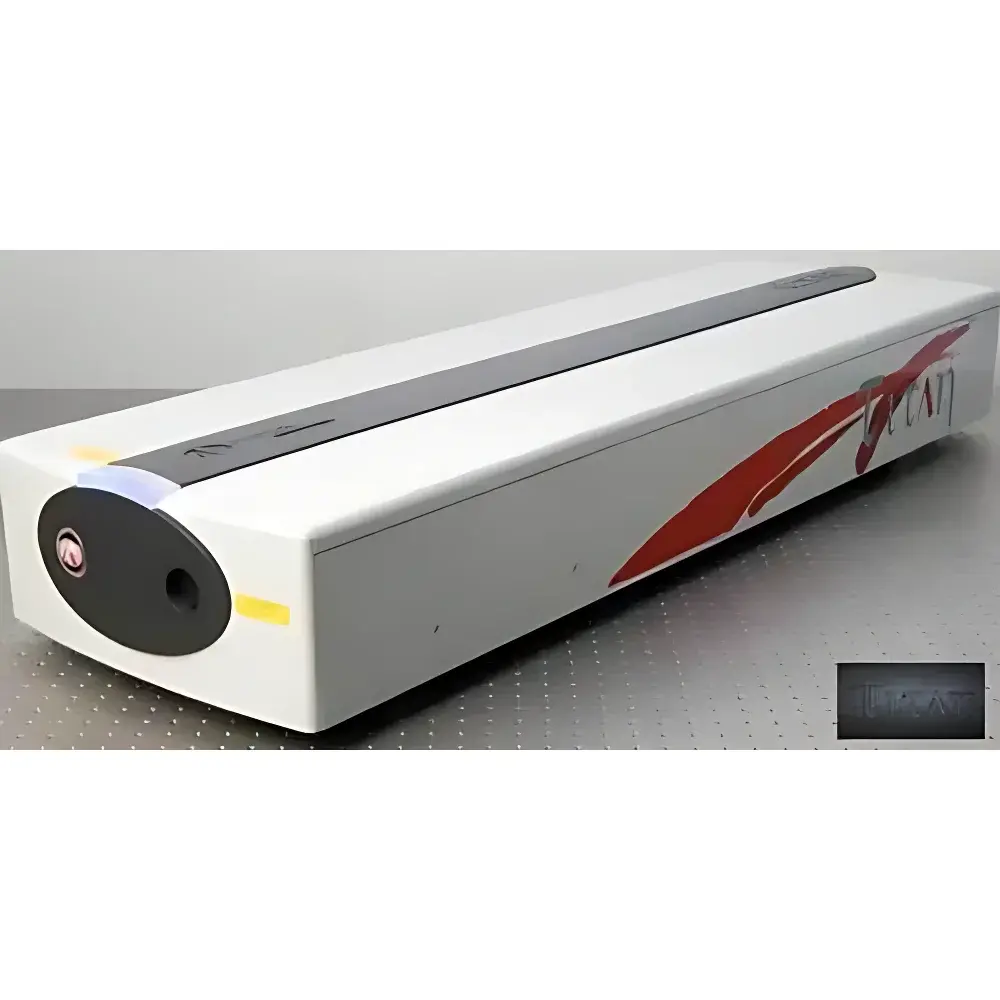
Amplitude Titan Series High-Energy Nanosecond Pulsed Laser
| Brand | Amplitude |
|---|---|
| Origin | France |
| Product Type | Diode-Pumped Nd:Glass Amplifier System |
| Model | Titan Series |
| Wavelength | 532 nm / 1064 nm |
| Pulse Energy | 6 J @ 532 nm, 8 J @ 1064 nm (Single Beam) |
| Repetition Rate | 1 Hz or 5 Hz |
| Pulse Width | ~12 ns |
| Energy Stability | 1.2% RMS (1000 shots), 1.0% RMS (1000 shots) |
| Energy Drift | ≤5% over 8 hours |
| Beam Profile | Top-Hat (Flat-Top) |
| Temporal Jitter | 0.5 ns RMS |
| Polarization | Vertical @ 532 nm |
| Optional Configuration | Dual-Pulse Mode (two 12 ns pulses with adjustable inter-pulse delay) |
Overview
The Amplitude Titan Series is a high-energy, nanosecond-pulsed, diode-pumped Nd:glass laser system engineered for demanding scientific and industrial applications requiring precise temporal control, exceptional pulse-to-pulse stability, and scalable energy output. Designed as a primary pump source for Ti:sapphire chirped-pulse amplification (CPA) systems operating in the terawatt (TW) to petawatt (PW) regime, the Titan leverages a robust master oscillator–power amplifier (MOPA) architecture with flashlamp-pumped Nd:glass preamplifiers and diode-pumped final amplifiers. Its fundamental output at 1064 nm—optionally frequency-doubled to 532 nm—delivers up to 16 J per pulse at 1064 nm and 12 J at 532 nm in dual-beam configuration, with repetition rates selectable between 1 Hz and 5 Hz. The system employs active thermal management and real-time cavity stabilization to maintain beam pointing stability <10 µrad and spatial mode fidelity across extended operation cycles. Unlike conventional Q-switched lasers, the Titan integrates a custom-designed electro-optic switch enabling deterministic dual-pulse generation (two temporally separated ~12 ns pulses with sub-nanosecond jitter), supporting pump-probe experiments and parametric amplification seeding.
Key Features
- High-energy nanosecond pulses: 6 J @ 532 nm / 8 J @ 1064 nm (single beam); scalable to 12 J / 16 J in dual-beam configuration
- Ultra-stable energy delivery: ≤1.0% RMS fluctuation over 1000 shots (Titan HE), with drift <5% over 8 hours under continuous thermal equilibrium
- Engineered top-hat (flat-top) near-field intensity profile—optimized for uniform pumping of Ti:sapphire crystals and minimizing thermal lensing effects
- Precise temporal control: pulse width ~12 ns FWHM; dual-pulse mode with adjustable inter-pulse delay (100 ps–100 ns resolution); timing jitter <0.5 ns RMS
- Polarization management: orthogonal polarization states per wavelength channel (vertical @ 532 nm; horizontal or split 50/50 @ 1064 nm) for compatibility with polarization-sensitive nonlinear optics
- Modular architecture: supports integration with Amplitude’s Synchronizer control platform, external trigger synchronization (TTL/LVDS), and vacuum-compatible beam delivery interfaces
Sample Compatibility & Compliance
The Titan Series is designed for laboratory-scale ultrafast laser infrastructure and conforms to international safety and electromagnetic compatibility standards applicable to Class 4 laser systems. It complies with IEC 60825-1:2014 (Laser Product Safety), EN 61000-6-3:2019 (EMC Emission), and EN 61000-6-2:2019 (EMC Immunity). All optical paths are enclosed within interlocked beam enclosures meeting ANSI Z136.1–2022 requirements. For regulated environments—including academic core facilities, national laboratories, and ISO/IEC 17025-accredited metrology labs—the system supports optional audit-ready logging (timestamped energy, temperature, alignment status) compatible with GLP/GMP documentation workflows. While not FDA-cleared (as it is not a medical device), its operational parameters align with laser safety protocols required for use in USP and ASTM F2793-compliant optical damage threshold testing.
Software & Data Management
Control and monitoring are executed via Amplitude’s proprietary LaserStudio software suite, a Windows-based application offering real-time graphical feedback on pulse energy, shot counter, cavity alignment diagnostics, coolant temperature, and diode current. All operational parameters—including repetition rate, Q-switch delay, harmonic generator angle, and dual-pulse separation—are programmable via intuitive GUI or remote API (TCP/IP and RS-232). Energy measurements are traceably calibrated using NIST-traceable pyroelectric sensors (Ophir PE50-CF), with raw data export in CSV and HDF5 formats. Optional integration with LabVIEW™, MATLAB®, or Python (via RESTful API) enables automated experiment sequencing, closed-loop energy stabilization, and synchronization with external diagnostics (e.g., streak cameras, photodiodes, spectrometers). Audit trails—including user login, parameter changes, and calibration events—are logged with SHA-256 hashing for Part 11 compliance readiness.
Applications
- Pumping Ti:sapphire CPA systems for ultrafast science (TW–PW peak power generation)
- Optical parametric chirped-pulse amplification (OPCPA) front-end seeding and pump sources
- Laser-induced damage threshold (LIDT) testing of coatings, crystals, and thin-film optics per ISO 21254
- Time-resolved spectroscopy and pump–probe studies requiring dual-pulse excitation
- Plasma generation and laser-driven particle acceleration experiments
- Calibration of high-dynamic-range photodetectors and fast photodiodes
FAQ
What is the maximum average power output of the Titan Series?
Average power depends on repetition rate and wavelength: at 5 Hz and 12 J @ 532 nm, average power reaches 60 W; at 5 Hz and 16 J @ 1064 nm, it reaches 80 W. Thermal management limits sustained operation above these thresholds without duty-cycle modulation.
Can the Titan be synchronized with femtosecond oscillator timing signals?
Yes—via low-jitter (<100 ps RMS) TTL or LVDS external trigger input, with programmable delay from −100 ns to +10 µs relative to master clock, enabling precise lock-in to fs oscillator harmonics.
Is harmonic generation (e.g., 266 nm or 355 nm) supported natively?
The Titan provides fundamental (1064 nm) and second-harmonic (532 nm) outputs. Third- and fourth-harmonic modules (355 nm, 266 nm) are available as field-installable add-ons with integrated wavelength separation and beam recombination optics.
What cooling infrastructure is required?
The system requires closed-loop chilled water at 18–22 °C, flow rate ≥20 L/min, pressure drop <2.5 bar. Onboard chillers are optional; integration with facility-grade cooling plants is standard.
How is beam pointing stability maintained during thermal transients?
Active cavity alignment compensation uses piezoelectric mirror mounts guided by real-time wavefront sensor feedback, correcting low-order tilt modes with bandwidth >10 Hz and residual pointing error <5 µrad RMS over 1 hour.





