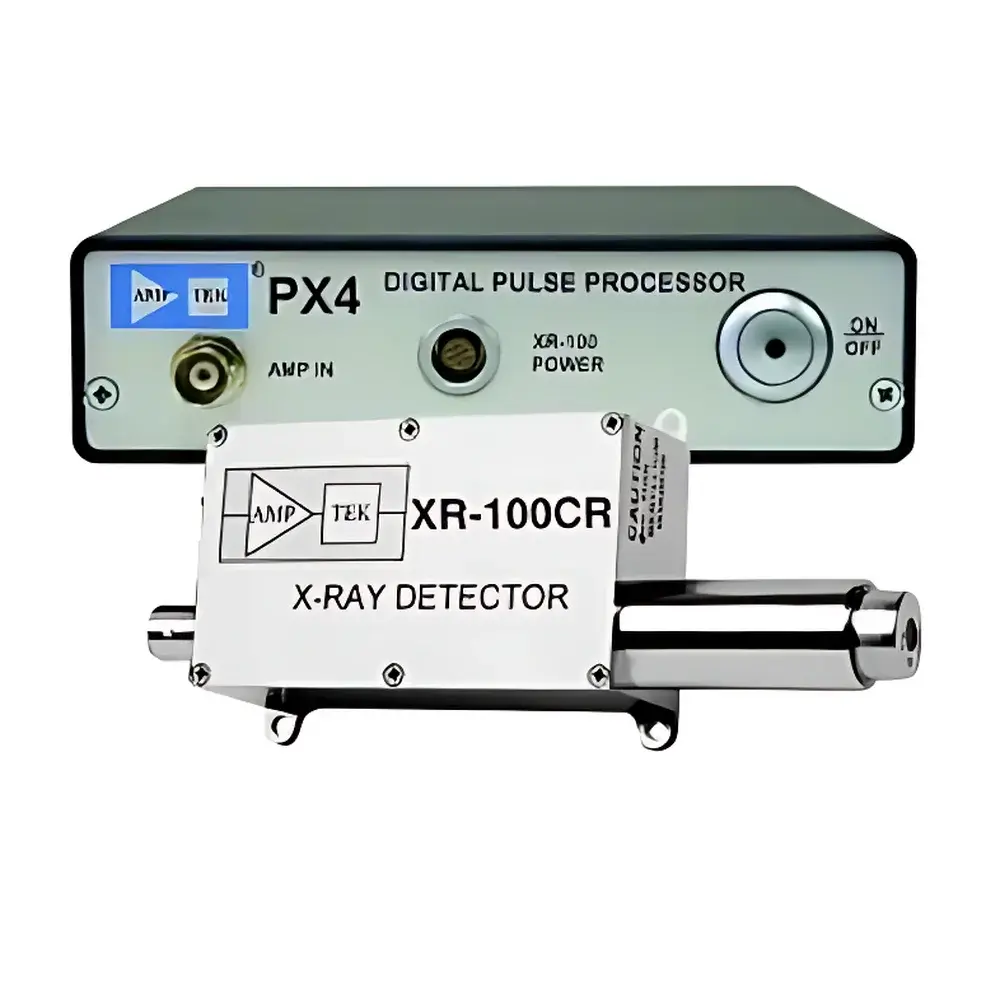
Amptek XR-100CR Si-PIN X-ray Detector with Integrated Thermoelectric Cooling and Digital Temperature Control
| Brand | Amptek |
|---|---|
| Origin | USA |
| Model | XR-100CR |
| Detector Type | Si-PIN |
| Active Area | 6–25 mm² |
| Silicon Thickness | 500 µm |
| Energy Resolution | 145–230 eV FWHM @ 5.9 keV (⁵⁵Fe) |
| Be Window Thickness | 12.5 µm or 25 µm |
| Operating Temperature | ~−55 °C (thermoelectrically stabilized) |
| Power Consumption | <1 W total |
| Package | Hermetic TO-8 with beryllium window |
| Weight | 139 g |
| Certifications | UL 61010-1:2004, CAN/CSA-C22.2 No. 61010-1:2004, TUV CU 72072412 01 |
Overview
The Amptek XR-100CR is a compact, high-performance X-ray spectrometer module engineered for precision energy-dispersive X-ray spectroscopy (EDS) in laboratory, industrial, and field-deployable applications. At its core lies a passivated ion-implanted planar silicon photodiode (Si-PIN), operated at cryogenic temperatures (~−55 °C) via a two-stage thermoelectric cooler (TEC). This active cooling significantly reduces thermal noise and leakage current, enabling superior energy resolution and long-term spectral stability—critical for quantitative elemental analysis and low-flux measurements. Unlike liquid-nitrogen-cooled detectors, the XR-100CR integrates a fully self-contained temperature controller, eliminating external chiller requirements and simplifying system integration. Its hermetically sealed TO-8 package features a thin beryllium entrance window (12.5 µm or 25 µm), optimized for transmission of soft X-rays down to ~1 keV while maintaining mechanical robustness and vacuum compatibility. The detector is designed for direct coupling to Amptek’s digital pulse processors (e.g., DP5, PX5) or third-party spectroscopy electronics supporting charge-sensitive preamplifier input.
Key Features
- High-purity Si-PIN detector with active areas from 6 mm² to 25 mm² and 500 µm thick depletion layer—optimized for efficiency across 1–30 keV
- Two-stage thermoelectric cooling system with integrated PID temperature controller, maintaining stable operation at −55 °C ±0.5 °C
- Custom-designed charge-sensitive preamplifier with HV-reset functionality and gain stability better than 20 ppm/°C
- Hermetic TO-8 metal-can packaging with low-mass beryllium window—enabling reliable performance in ambient air, inert gas, or vacuum environments
- Total power consumption under 1 W—including detector bias, preamp, and cooler—suitable for battery-powered or embedded instrumentation
- Compliance with IEC/EN 61010-1 safety standards (UL 61010-1:2004, CSA C22.2 No. 61010-1:2004) and certified by TÜV (CU 72072412 01)
Sample Compatibility & Compliance
The XR-100CR is compatible with solid, powdered, and thin-film samples requiring non-destructive elemental analysis. Its low-energy response supports detection of light elements including Na (1.04 keV), Mg (1.25 keV), Al (1.49 keV), and Si (1.74 keV), provided appropriate window selection and vacuum/purge conditions are employed. For routine benchtop XRF, handheld analyzers, or portable X-ray fluorescence (pXRF) systems, the detector meets functional requirements aligned with ASTM E1361 (Standard Guide for X-Ray Spectrometry) and ISO 21043 (X-ray fluorescence analysis — General requirements). While not inherently GLP/GMP-certified as a standalone component, the XR-100CR supports audit-ready data acquisition when paired with compliant digital signal processors featuring 21 CFR Part 11–enabled firmware (e.g., Amptek DP5 with secure user authentication and electronic signature logging).
Software & Data Management
The XR-100CR operates as a hardware sensor and does not include embedded firmware or onboard software. It delivers analog pulse output to external spectroscopy electronics, which perform shaping, digitization, and spectral accumulation. When used with Amptek’s DP5 digital pulse processor and associated MCA software (e.g., XPMA or DPPMCA), users gain access to real-time spectrum visualization, peak identification (using library-based fitting), dead-time correction, and export in standard formats (CSV, SPE, TXT). All spectral data files include metadata such as acquisition time, live time, real time, detector temperature, and high-voltage setting—supporting traceability and post-acquisition reprocessing. The module’s analog interface ensures compatibility with legacy and custom DAQ systems, including those based on National Instruments PXI platforms or FPGA-based acquisition cards.
Applications
- Portable and benchtop X-ray fluorescence (XRF) analyzers for alloy verification, mining exploration, and environmental soil screening
- Energy-dispersive X-ray microanalysis (EDS) in scanning electron microscopes (SEM) when configured with appropriate beam current and working distance
- Radioisotope identification and low-activity gamma/X-ray monitoring in nuclear safeguards and health physics instrumentation
- Quality control in electronics manufacturing—e.g., solder composition analysis, plating thickness verification, and RoHS-compliant screening
- Academic research in materials science, archaeometry, and planetary science where compact, low-power, and thermally stable detection is required
FAQ
Does the XR-100CR require external cooling or vacuum housing?
No—the detector incorporates a fully integrated two-stage thermoelectric cooler and closed-loop temperature controller. It operates reliably in ambient air; no liquid nitrogen, vacuum pumps, or external chillers are needed.
What is the typical energy resolution achievable with this detector?
Energy resolution ranges from 145 eV to 230 eV FWHM at 5.9 keV (⁵⁵Fe), depending on selected active area, shaping time constant, and operating temperature stability.
Can the XR-100CR detect elements below sodium (Z = 11)?
Detection of ultra-light elements (e.g., C, N, O) is limited by absorption in the Be window and atmospheric attenuation. With a 12.5 µm Be window and helium purge or vacuum path, carbon Kα (0.28 keV) may be observable under optimized conditions—but sensitivity decreases significantly below 1 keV.
Is the detector suitable for high-count-rate applications?
The XR-100CR is optimized for moderate count rates (<50,000 cps) with minimal pile-up. For higher throughput, users should consider Amptek’s silicon drift detector (SDD) modules such as the X-123 series.
What is the expected operational lifetime under normal laboratory use?
Typical device lifetime is 5–10 years, contingent upon cumulative exposure dose, thermal cycling frequency, and adherence to specified operating temperature and humidity limits.