
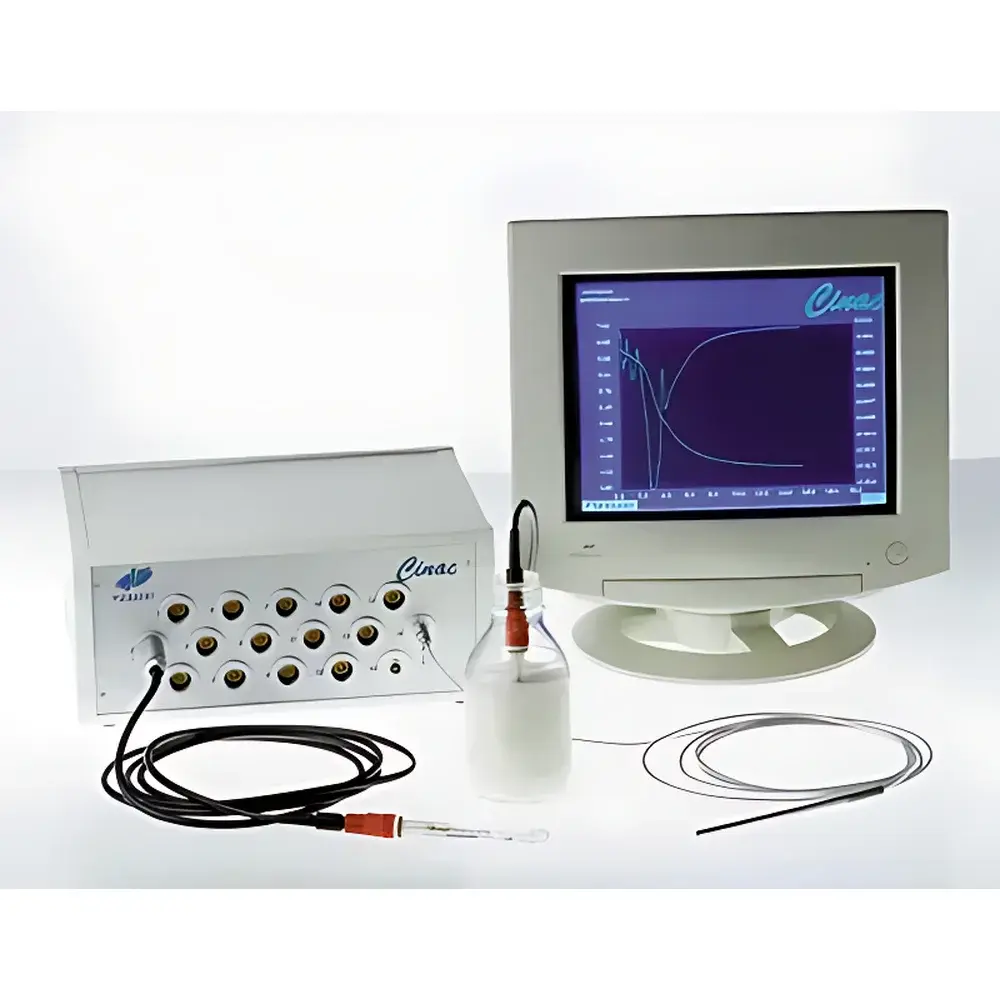
AMS-Alliance CINAC Dairy Fermentation Monitoring System
| Brand | AMS Alliance |
|---|---|
| Origin | France |
| Model | CINAC |
| Automation | Fully Automatic |
| Analysis Speed | 16 samples/min |
| Measurable Parameters | Temperature, pH, Redox Potential |
| Repeatability | <0.5% CV |
| Accuracy | <1.0% |
| Input Voltage | 110–220 V AC ±15%, 50–60 Hz |
| Dimensions (L×W×H) | 35 × 26 × 15 cm |
| Weight | 3.5 kg |
| Channel Configuration | Up to 16 pH electrodes (CINAC16), or mixed configurations (e.g., CINAC12: 12 pH + 4 Pt100 |
| CINAC14 | 14 pH + 2 Pt100) |
| Data Acquisition | Real-time logging of pH, temperature, and redox across 1–16 (expandable to 32 via dual-unit PC integration) channels |
| Calibration Traceability | Factory-calibrated against certified reference standards |
| Compliance | Designed in collaboration with INRA-LGMPA (France) |
Overview
The AMS-Alliance CINAC Dairy Fermentation Monitoring System is a purpose-built, high-precision instrument engineered for the real-time kinetic characterization of lactic acid bacteria (LAB) activity during dairy fermentation processes. Operating on the fundamental principle of continuous electrochemical and thermometric monitoring, the CINAC system simultaneously acquires and logs pH, temperature, and redox potential across up to 16 independent sample channels—scalable to 32 via synchronized dual-unit operation under a single PC interface. Developed in close collaboration with INRA-LGMPA (Laboratoire de Génie Microbien et Procédés Alimentaires), the system meets stringent requirements set by global dairy R&D centers for reproducible, traceable, and process-relevant microbial activity profiling. Its architecture is grounded in validated microbiological assay methodology—not merely endpoint measurement—but dynamic tracking of acidification kinetics, including lag phase duration, maximum acidification rate (Vmax), time to target pH (e.g., pH 5.0), and buffering capacity estimation. This enables rigorous strain comparison, medium optimization, and predictive modeling of fermentation behavior under controlled thermal profiles.
Key Features
- Fully automated, multi-channel acquisition with simultaneous real-time logging of pH, temperature, and redox across 1–16 channels (CINAC12/CINAC14/CINAC16 configurations)
- Integrated temperature-compensated pH measurement using high-stability, food-grade glass electrodes with Pt100 thermal sensors
- Modular hardware design supporting scalable channel expansion and independent per-channel calibration scheduling
- Patented analog output interface (Patent No. FR8804456) enabling direct integration with external water baths, incubators, or PLC-controlled environmental chambers
- Onboard real-time calculation of kinetic descriptors—including ΔpH/Δt, time-to-threshold pH, inflection points, and buffering index—without post-acquisition processing
- Factory pre-calibration verified against NIST-traceable reference buffers and INRA-LGMPA benchmark strains, ensuring inter-laboratory comparability
- Robust mechanical design (3.5 kg, compact 35 × 26 × 15 cm footprint) optimized for benchtop deployment in QC labs and pilot-scale fermentation facilities
Sample Compatibility & Compliance
The CINAC system is validated for use with liquid dairy matrices including raw milk, standardized milk, reconstituted skim milk powder (RSM), whey-based media, and starter culture suspensions. Electrode compatibility extends across pH 2.0–12.0 with autoclavable, sterilizable probe options suitable for aseptic fermentation trials. All hardware and firmware comply with IEC 61000-6-3 (EMC) and IEC 61010-1 (safety) standards. While not a regulated medical device, the system supports GLP and GMP-aligned workflows through audit-trail-enabled software (v4.x), timestamped raw data export (CSV, XML), and user-access controls. It is routinely deployed in laboratories adhering to ISO 17025 (testing competence) and aligned with Codex Alimentarius fermentation validation guidelines.
Software & Data Management
CINAC v4 software provides a deterministic, deterministic data acquisition environment with no background processing delays. It implements automatic temperature compensation per channel using embedded Pt100 readings, real-time drift correction, and configurable alarm thresholds for pH, temperature, and time-based events. All raw sensor values are stored at user-defined intervals (1 s to 5 min) with millisecond-level timestamps. The software generates six primary curve types: pH vs. time, d(pH)/dt vs. time, temperature vs. time, redox vs. time, pH derivative overlay, and comparative strain overlays. Custom descriptor fields (e.g., “pH at 4 h”, “time to pH 5.0”) are defined without scripting and exported alongside metadata. Data files include full calibration history per electrode, operator ID, sample ID, and environmental log—enabling full 21 CFR Part 11 readiness when deployed with validated IT infrastructure.
Applications
- Strain selection and performance benchmarking of lactic acid bacteria (e.g., Lactococcus lactis, Streptococcus thermophilus, Lactobacillus delbrueckii)
- Optimization of starter culture blends and inoculum levels in yogurt, cheese, and fermented dairy beverages
- Thermal profile simulation—e.g., ramped cooling, stepwise heating—to assess strain resilience and acidification kinetics under process-relevant conditions
- Medium formulation studies evaluating impact of calcium, citrate, or whey protein concentration on buffering capacity and acidification lag
- Stability testing of commercial starters across storage conditions and rehydration protocols
- Validation of fermentation process parameters for regulatory submissions (e.g., EFSA QPS dossiers, FDA GRAS notifications)
FAQ
How many samples can be monitored simultaneously?
Up to 16 samples in a single CINAC unit; up to 32 samples when two units are synchronized via one PC.
Is electrode calibration automated?
Calibration is user-initiated but fully guided—software validates slope, offset, and response time per electrode and logs all calibration events with operator signature and buffer lot traceability.
Can CINAC integrate with existing lab automation systems?
Yes—via analog voltage outputs (0–10 V) for temperature/pH control loops and RS-232/USB for bidirectional command-and-control with LIMS or SCADA platforms.
What is the typical service life of pH electrodes in dairy applications?
Under routine cleaning and storage protocols (0.1 M KCl + 0.01% sodium azide), electrodes maintain <0.5% CV performance for ≥12 months of daily use in milk-based media.
Does CINAC support redox measurements for facultative anaerobes?
Yes—integrated platinum redox electrodes enable simultaneous Eh monitoring, critical for studying mixed-culture fermentations involving Propionibacterium or Bifidobacterium.





