
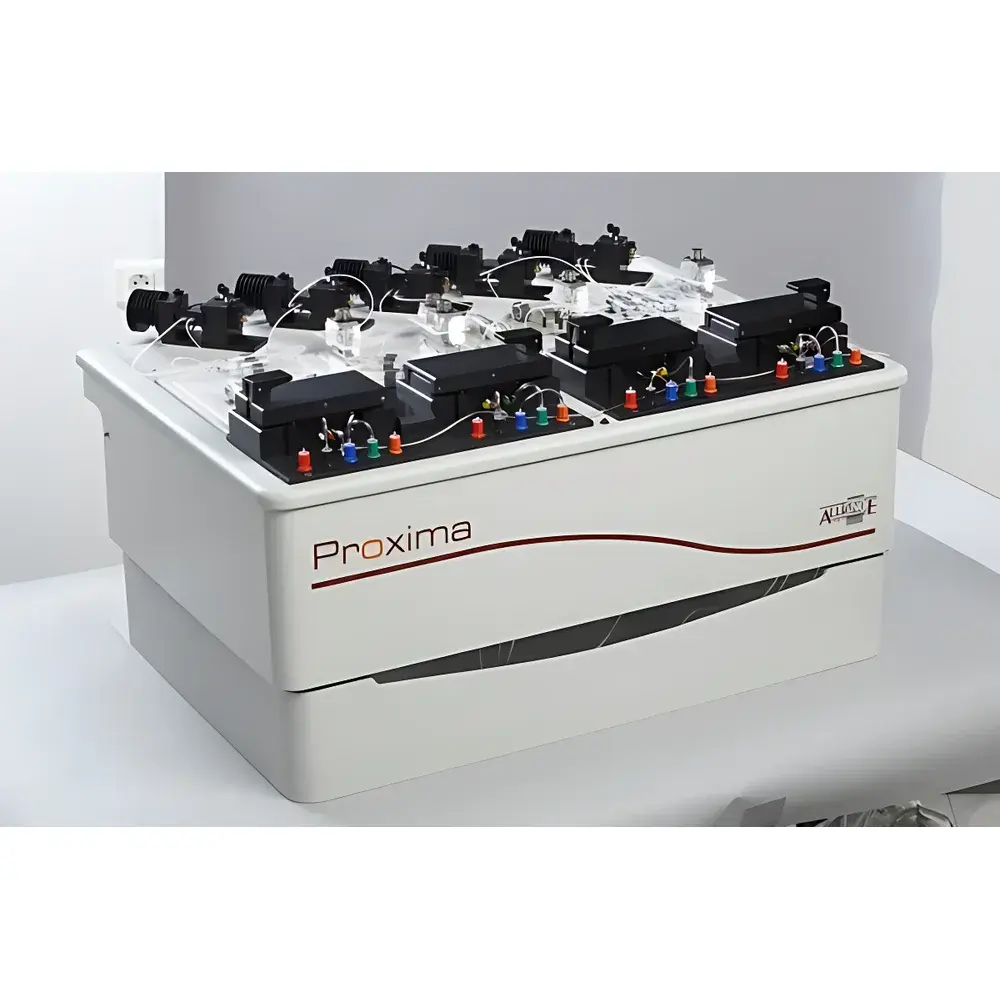
AMS Alliance PROXIMA Continuous Flow Analyzer
| Brand | AMS Alliance |
|---|---|
| Origin | France |
| Model | PROXIMA |
| Product Type | Continuous Flow Analyzer |
| Wavelength Range | 340–1100 nm |
| Sample Capacity | 104-position turntable autosampler (optional 360-position XYZ autosampler) |
| Reagent Positions | 36 |
| Flow Cell Path Length | 50 mm |
| Light Source | Tungsten-Halogen Lamp |
| Detection Limit | Sub-ppb level |
| Throughput | Up to 120 samples/hour |
| Pump Tubing | 52 channels (2 × 26) |
| Flow Rate Range | 50–3000 µL/min |
| A/D Resolution | 24-bit (1.68 × 10⁷) |
| Dimensions (Main Unit) | 75 × 50 × 42 cm |
| Weight (Main Unit) | 45 kg |
Overview
The AMS Alliance PROXIMA Continuous Flow Analyzer is a fully automated, modular wet-chemistry platform engineered for high-throughput, multi-parameter environmental and industrial analysis. Based on segmented continuous flow (SCF) technology—also known as continuous flow analysis (CFA)—the system transports samples and reagents through precisely controlled peristaltic pumping, mixing, reaction, and detection stages in a closed, contamination-free fluidic path. Unlike discrete batch analyzers or flow injection systems, PROXIMA employs true segmental flow with air or inert gas segmentation to eliminate cross-contamination, ensure reproducible reaction kinetics, and support long-term unattended operation. Its optical detection architecture integrates a high-stability tungsten-halogen light source and a 24-bit analog-to-digital converter, delivering exceptional signal-to-noise ratio across the full 340–1100 nm spectral range. Designed for compliance-driven laboratories, PROXIMA supports method validation under ISO/IEC 17025, EPA Methods (e.g., EPA 365.2, 4500-P E, 4500-CN G), AFNOR, and COFRAC-accredited protocols—making it suitable for regulatory reporting in water quality, agricultural testing, food safety, and pharmaceutical QC environments.
Key Features
- Modular 5-channel architecture: Enables simultaneous, independent analysis of up to five parameters without cross-interference; each channel is a self-contained unit comprising peristaltic pump, chemical manifold, detector, and reagent cabinet.
- High-precision 52-tube dual-head peristaltic pump (2 × 26): Delivers stable, pulse-free flow across 50–3000 µL/min with three-speed programmable control and automatic tube compression/decompression.
- XYZ 3-axis programmable autosampler: Supports both 104-position rotary carousels and optional 360-position XYZ configurations; accommodates vial sizes from 10 to 50 mL and enables barcode reading, sample identification by alphanumeric labels, and programmable dilution sequences.
- Sub-ppb detection sensitivity: Achieved via optimized 50 mm path-length flow cells, low-volume (1–150 µL) optical cells, and advanced de-bubbling—using mechanical, photoelectric, or software-controlled bubble suppression—to ensure baseline stability and measurement repeatability.
- Rapid module interchangeability: Chemical manifolds are tool-free, snap-in modules; replacement or method reconfiguration takes ≤5 minutes per channel, minimizing downtime during method switching.
- Flexible sample handling: Supports injection, on-line dilution, dialysis, UV digestion, liquid–liquid extraction, and stop-flow modes—all programmable via PROXIMA software without hardware modification.
- Compact footprint (75 × 50 × 42 cm) and robust construction: Complies with CE, RoHS, and IEC 61000-6-3 electromagnetic compatibility standards; designed for integration into GLP/GMP-compliant laboratory workflows.
Sample Compatibility & Compliance
PROXIMA accommodates aqueous matrices including drinking water, wastewater, seawater, soil extracts, plant digests, fertilizer solutions, wine, beer, dairy products, and pharmaceutical process streams. Sample volumes range from 0.5 mL to 10 mL, with optional auto-dilution extending dynamic range for high-concentration analytes. All fluid-contact materials—including reagent reservoirs (200–1000 mL capacity), tubing, and manifolds—are chemically inert (e.g., PTFE, FEP, borosilicate glass) and certified non-leaching per USP Class VI and FDA 21 CFR Part 11 requirements. The system meets ISO 5725 (accuracy and precision), ISO 8466 (calibration linearity), and EN ISO/IEC 17025:2017 documentation standards. Audit trails, electronic signatures, and data integrity controls are embedded in PROXIMA software to satisfy FDA 21 CFR Part 11 and EU Annex 11 compliance mandates.
Software & Data Management
PROXIMA Control Software provides a unified, intuitive interface for real-time monitoring of all five channels—including flow pressure, temperature, absorbance, and reagent consumption—via color-coded status indicators and dynamic chromatogram overlays. It supports method development using drag-and-drop protocol builders, automatic calibration curve generation (linear, quadratic, or cubic), and QC flagging based on user-defined acceptance criteria (e.g., %RSD < 2%, recovery 95–105%). Raw data are stored in vendor-neutral .csv and .xlsx formats; metadata (operator ID, timestamp, instrument configuration, version history) is embedded and exportable for LIMS integration. The software maintains full audit trail logs compliant with ALCOA+ principles (Attributable, Legible, Contemporaneous, Original, Accurate) and supports role-based access control for multi-user environments.
Applications
PROXIMA is widely deployed in accredited environmental labs for routine analysis of nutrients (total phosphorus, nitrate, nitrite, ammonium, Kjeldahl nitrogen), contaminants (cyanide, phenol, sulfide, Cr(VI), TOC), and physicochemical parameters (conductivity, pH, urea). In agronomy and food science, it quantifies macro/micronutrients (K, Ca, Mg, Fe, Zn, Cu, Mn), anions (Cl⁻, SO₄²⁻, F⁻), and organic compounds (formaldehyde, nicotine, alcohol) in soils, plant tissues, fertilizers, wines, and dairy products. Pharmaceutical applications include excipient assay, residual solvent screening, and dissolution testing. Over 1,000 validated methods—including more than 320 EPA, ISO, and AFNOR standard methods—are preloaded and continuously updated via AMS Alliance’s Method Library Portal.
FAQ
What distinguishes PROXIMA from flow injection analyzers (FIA)?
PROXIMA uses segmented continuous flow (SCF), where discrete air segments separate sample and reagent zones to prevent dispersion and enable precise reaction timing—unlike FIA’s carrier-stream-only approach, which relies on diffusion-controlled mixing and offers lower reproducibility for slow kinetic reactions.
Can PROXIMA perform UV digestion or dialysis inline?
Yes—PROXIMA supports integrated UV photolysis (using optional mercury-vapor lamps) and membrane-based dialysis modules, both controlled programmatically within the same method sequence.
Is remote monitoring and troubleshooting supported?
PROXIMA software includes secure remote desktop capability (via TLS-encrypted VNC) and diagnostic telemetry, enabling AMS Alliance Field Application Scientists to perform real-time health checks and firmware updates without on-site visits.
Does the system comply with FDA 21 CFR Part 11 for electronic records?
Yes—PROXIMA software implements full electronic signature workflows, immutable audit trails, and data encryption at rest and in transit, meeting all technical and procedural requirements of 21 CFR Part 11 and EU Annex 11.
What maintenance intervals are recommended for the peristaltic pump?
Pump tubing should be inspected every 200 hours of operation and replaced every 500–800 hours depending on reagent aggressiveness; AMS Alliance supplies calibrated lifetime-tracking kits and predictive wear diagnostics via software.
Related Products




