
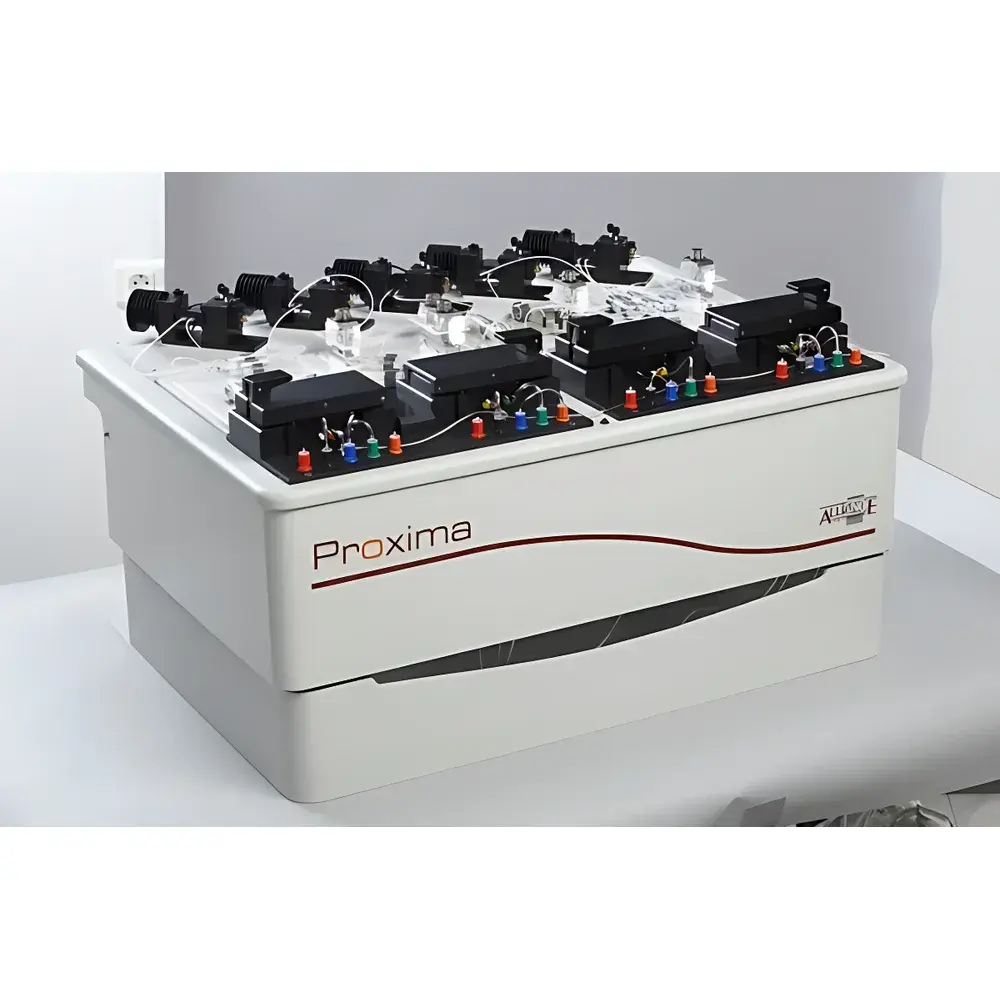
AMS Alliance PROXIMA Continuous Flow Analyzer
| Brand | AMS Alliance |
|---|---|
| Origin | France |
| Model | PROXIMAs |
| Product Type | Continuous Flow Analyzer |
| Wavelength Range | 340–1100 nm |
| Sample Volume | 0.5 mL |
| Reagent Positions | 104 |
| Flow Cell Path Length | 5–50 mm |
| Light Source | Halogen Lamp |
Overview
The AMS Alliance PROXIMA Continuous Flow Analyzer is an advanced, fully automated wet-chemistry platform engineered for high-throughput, multi-parameter environmental and industrial analysis. It operates on the principle of segmented continuous flow analysis (CFA), where discrete sample segments are introduced into a continuously flowing carrier stream, separated by air bubbles to prevent cross-contamination and ensure precise reaction timing. This methodology enables reproducible, kinetically controlled chemical derivatization—such as colorimetric, fluorometric, or ion-selective reactions—prior to detection. Unlike discrete batch analyzers, PROXIMA maintains constant hydrodynamic conditions across all analytical cycles, delivering exceptional inter-run precision and long-term stability. Designed for compliance-driven laboratories, the system supports method validation per ISO 15195, EPA Methods 300.0/353.2/4500 series, AFNOR NF T90-110, and COFRAC-accredited protocols. Its architecture integrates fluidic control, optical detection, and software-defined workflow orchestration into a single cohesive platform—making it suitable for routine QC, regulatory monitoring, and research-grade method development.
Key Features
- Modular 5-channel configuration: Up to five independent analytical modules can be installed simultaneously, each with dedicated pump, chemistry manifold, detector, and reagent cabinet—enabling concurrent measurement of distinct analytes without cross-method interference.
- High-performance dual 26-channel peristaltic pump: Total of 52 pump tubes (2 × 26) provide precise, pulse-free fluid propulsion with adjustable speed (3 settings) and volumetric flow range of 50–3000 µL/min.
- Throughput optimized for regulatory labs: Achieves up to 120 samples/hour per channel, scalable via parallel channel operation; sample volume flexibility from 0.5 mL to 10 mL accommodates both micro-volume and standard protocols.
- Rapid module interchangeability: Chemistry modules—including digestion, distillation, dialysis, UV photolysis, and liquid–liquid extraction units—are tool-free and replaceable in ≤5 minutes, minimizing downtime during method switching.
- Advanced bubble management: Three integrated degassing strategies—mechanical (vibrational), electronic (optical bubble sensing), and software-controlled (adaptive flow interruption)—ensure baseline stability and eliminate false positives in absorbance-based detection.
- XYZ robotic autosampler: Supports 104-position carousel or 360-position Cartesian coordinate sampling; optional barcode reader and dual/multi-probe configuration enable unattended sample identification and heterogeneous matrix handling.
- Compact footprint: Main unit dimensions are 75 × 50 × 42 cm (W × D × H); total system weight is 45 kg—designed for benchtop deployment in ISO 17025-certified laboratories with space constraints.
Sample Compatibility & Compliance
PROXIMA accommodates aqueous and semi-aqueous matrices including drinking water, wastewater, seawater, soil extracts, plant digests, agricultural fertilizers, fermented beverages (beer, wine), dairy products, meat homogenates, pharmaceutical excipients, and industrial process streams. All fluid-contact materials—including tubing, manifolds, and reagent reservoirs—are chemically inert (e.g., PTFE, FEP, polypropylene) and certified non-leaching per USP Class VI and FDA 21 CFR 177. All analytical methods implemented on PROXIMA adhere to internationally recognized standard methods: EPA 365.1 (phosphate), ISO 6878 (phosphorus), ISO 11905-1 (nitrate/nitrite), AOAC 973.42 (cyanide), and ASTM D3869 (chloride). The system architecture supports full GLP/GMP traceability through audit-ready electronic records, user access controls, and instrument calibration logs compliant with 21 CFR Part 11 requirements when paired with validated PROXIMA software.
Software & Data Management
The PROXIMA Control Software provides real-time, multi-channel supervision with intuitive graphical interface (English-language default; localized versions available). It supports method creation via drag-and-drop protocol builder, automatic calibration curve generation (linear, quadratic, spline), and dynamic range extension through on-line dilution. Data acquisition utilizes 24-bit analog-to-digital conversion (1.68 × 10⁷ resolution) synchronized with flow timing events. Raw absorbance, fluorescence, or electrode potential signals are timestamped, stored with full metadata (sample ID, reagent lot, operator, environmental sensor readings), and exportable in CSV, XML, or LIMS-compatible ASTM E1384 format. Optional features include remote diagnostics, predictive maintenance alerts, and integration with enterprise-level ELN/LIMS systems via OPC UA or RESTful API.
Applications
PROXIMA delivers validated performance across regulated and research domains: (1) Environmental monitoring—nutrients (NO₃⁻, NO₂⁻, NH₄⁺, PO₄³⁻, SiO₂), metals (Fe, Mn, Al after chelation), cyanide, phenols, and surfactants in surface water, groundwater, and effluent; (2) Agri-food testing—total Kjeldahl nitrogen (TKN), protein, sulfate, chloride, sulfite, and sugar profiles in soils, grains, fruits, dairy, and alcoholic beverages; (3) Industrial QC—formaldehyde, residual chlorine, COD, BOD surrogates, and catalyst poisons in petrochemical and biopharmaceutical manufacturing; (4) Clinical and life science support—ammonia, creatinine, and uric acid assays in biological fluids using enzymatic CFA adaptations.
FAQ
What regulatory standards does PROXIMA comply with?
PROXIMA conforms to ISO/IEC 17025:2017 general requirements for competence of testing laboratories, and its method implementations align with EPA, ISO, AFNOR, and AOAC official methods. Full 21 CFR Part 11 compliance is achievable with validated software configuration and procedural controls.
Can PROXIMA perform online sample dilution?
Yes—optional integrated auto-dilutor enables programmable 1:2 to 1:1000 dilutions prior to analysis, extending linear dynamic range without manual intervention.
Is UV digestion supported for total phosphorus or nitrogen determination?
Yes—dedicated UV photolysis modules with 185/254 nm mercury lamps are available for complete oxidation of organic-bound nutrients, meeting ISO 11905-1 and EPA 365.3 requirements.
How is method validation documented?
Each PROXIMA method includes built-in validation tools: spike recovery calculation, limit of detection (LOD) estimation per IUPAC guidelines, precision profiling (within-run and between-run RSD), and linearity assessment over ≥5 concentration levels.
What maintenance intervals are recommended?
Peristaltic pump tubing should be replaced every 3–6 months depending on usage intensity; optical components require quarterly cleaning; full system performance verification is advised every 6 months using NIST-traceable reference standards.




