
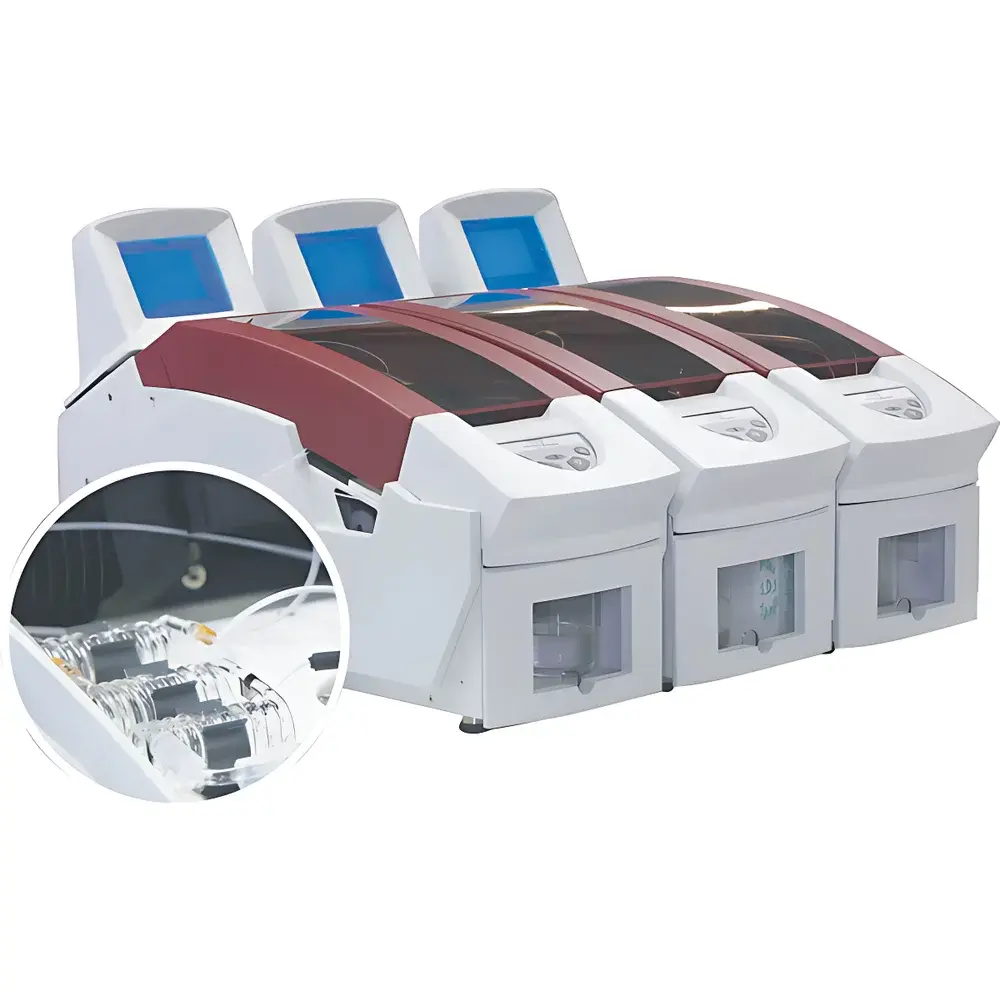
AMS FUTURA Segmented Continuous Flow Analyzer
| Brand | AMS |
|---|---|
| Origin | France |
| Manufacturer Type | Authorized Distributor |
| Product Category | Imported Instrument |
| Model | FUTURA Segmented Continuous Flow Analyzer |
| Wavelength Range | 340–1100 nm |
| Sample Capacity | 240–720 positions |
| Reagent Positions | 5–30 |
| Flow Cell Path Length | 5–500 mm |
| Light Source | Tungsten-Halogen Lamp |
Overview
The AMS FUTURA Segmented Continuous Flow Analyzer (SFA) is a high-precision, multi-channel wet-chemistry automation platform engineered for reproducible, regulatory-compliant colorimetric and photometric analysis. Based on segmented flow analysis (SFA) principles, the system introduces discrete air segments between sequential liquid streams—sample, reagent, and standard—to physically isolate reaction zones within transparent PTFE or chemically inert tubing. This segmentation eliminates axial dispersion, minimizes carryover, enhances reaction kinetics through controlled mixing and residence time, and ensures consistent bubble-driven cleaning of tube walls—thereby preserving sample integrity and improving analytical precision. Designed and manufactured in France by Alliance (a member of the AMS Group), the FUTURA complies with ISO 9001 quality management standards and delivers data traceable to internationally recognized protocols including AOAC International, US EPA Methods (e.g., 353.2, 354.1), AFNOR NF X 20-700, and COFRAC-accredited reference procedures. Its architecture supports full end-to-end automation—from programmable XYZ autosampling to integrated dilution, heating, distillation, UV digestion, dialysis, and liquid–liquid extraction—enabling robust, unattended batch processing across environmental, food, agricultural, and pharmaceutical laboratories.
Key Features
- True 100% independent channel design: Each of up to 12 parallel channels operates with dedicated fluidic paths, pumps, valves, detectors, and thermal control—eliminating cross-talk and enabling simultaneous, heterogeneous assay configurations (e.g., macro-flow phosphate + micro-flow nitrate on the same run).
- Hybrid flow architecture: Seamlessly integrates macro-flow (50–3000 µL/min) and micro-flow (sub-100 µL/min) modes on a single platform, optimizing reagent consumption without compromising sensitivity or dynamic range.
- High-throughput autosampling: Configurable XYZ robotic sampler accommodates up to 720 sample positions; optional dual-needle configuration enables simultaneous sampling from primary and secondary racks with barcode or alphanumeric identification support.
- Intelligent bubble management: Integrated electronic degassing module and software-controlled bubble detection/compensation algorithms reduce manual intervention and ensure stable baseline conditions during extended runs.
- Modular expandability: Additional modules—including automatic dilutors, wash valves, peristaltic pump controllers, and auxiliary reagent switching valves—can be added without hardware modification or firmware reflash.
- Regulatory-ready operation: Built-in audit trail logging, user access levels, electronic signatures, and data export compliance with FDA 21 CFR Part 11 and GLP/GMP documentation requirements.
Sample Compatibility & Compliance
The FUTURA accepts aqueous, semi-aqueous, and low-viscosity organic matrices—including raw wastewater, seawater, wine must, dairy extracts, soil leachates, plant digests, tobacco homogenates, and pharmaceutical intermediates—without pre-filtration in most applications. Sample volumes range from 0.5 mL to 10 mL; viscosity tolerance extends to ≤5 cP. All fluid-contact materials (tubing, manifolds, flow cells) are constructed from chemically resistant polymers (e.g., PTFE, ETFE, polypropylene) certified for USP Class VI and ISO 10993 biocompatibility where applicable. The system meets CE marking requirements for electromagnetic compatibility (EN 61326-1) and safety (EN 61010-1). Method validation documentation aligns with ISO/IEC 17025:2017 and supports accreditation under national metrology frameworks (e.g., UKAS, DAkkS, ANAB).
Software & Data Management
CFMV2 software provides full instrument control, method development, real-time signal monitoring, peak integration, calibration curve generation (linear, quadratic, spline), and QC reporting (Levey-Jennings, Westgard rules). It supports Windows 10/11 and Linux-based deployment, networked multi-user environments, and direct integration with LIMS via ASTM E1384 or HL7 interfaces. Raw absorbance data is acquired using a 24-bit ADC (1.68 × 10⁷ resolution) and stored in vendor-neutral formats (CSV, XML, PDF). Audit trails record all parameter changes, user logins, calibration events, and result modifications with timestamps and operator IDs. Software validation packages—including IQ/OQ/PQ protocols and UAT test scripts—are available for regulated laboratories.
Applications
The FUTURA delivers validated, standardized determinations across diverse sectors:
- Water & Wastewater: Ammonia-N, nitrate-N, nitrite-N, total Kjeldahl nitrogen (TKN), total phosphorus, orthophosphate, silica, sulfate, chloride, iron, manganese, calcium, magnesium, zinc, cyanide, phenols, surfactants (MBAS), urea, and UV-absorbing organics.
- Food & Beverage: Titration acidity, volatile acidity, L-lactic acid, L-malic acid, tartaric acid, citric acid, reducing sugars, sucrose, glucose, fructose, alcohol, SO₂ (free/total), pH, color (APHA/Hazen), turbidity, protein (Kjeldahl), starch, and enzymatic activity (α-amylase, β-glucanase).
- Agriculture & Soil Science: Available nutrients (P, K, Mg, Ca, B, Mo), exchangeable cations, carbonate alkalinity, organic carbon, electrical conductivity, and extractable metals (Cu, Zn, Fe, Mn).
- Tobacco & Fertilizers: Nicotine, total alkaloids, chloride, nitrate, sulfate, urea, potassium, and heavy metals.
- Clinical & Life Sciences: Creatinine, glutamic acid, lactate, glucose, and ethanol in serum, urine, and fermentation broths.
FAQ
What distinguishes segmented flow analysis (SFA) from flow injection analysis (FIA)?
SFA uses discrete air bubbles to segment continuous liquid streams, enabling longer reaction times, precise thermal control, and post-reaction manipulations (e.g., distillation, dialysis). FIA relies on turbulent dispersion and shorter residence times, limiting its applicability to rapid, single-step reactions.
Can the FUTURA perform both macro- and micro-flow assays in one run?
Yes—the system’s independently controlled peristaltic pumps and modular flow cells allow concurrent macro-flow (e.g., phosphate at 1.2 mL/min) and micro-flow (e.g., nitrate at 80 µL/min) methods without cross-contamination or recalibration.
Is method transfer from legacy CFA systems supported?
CFMV2 includes backward-compatible method import tools and configurable timing parameters (segment volume, dwell time, mixing coil length) to replicate published SFA protocols from Alliance, Technicon, or Skalar platforms.
How does the system handle particulate-laden samples?
A 0.45 µm inline filter is recommended upstream of the autosampler; for high-solids matrices (e.g., sludge digests), optional centrifugation or filtration modules integrate seamlessly via auxiliary valve control.
What maintenance intervals are recommended for routine operation?
Peristaltic pump tubing should be replaced every 3–6 months depending on usage; flow cell windows require cleaning after 200–500 injections; annual calibration verification against NIST-traceable standards is advised for ISO 17025 compliance.





