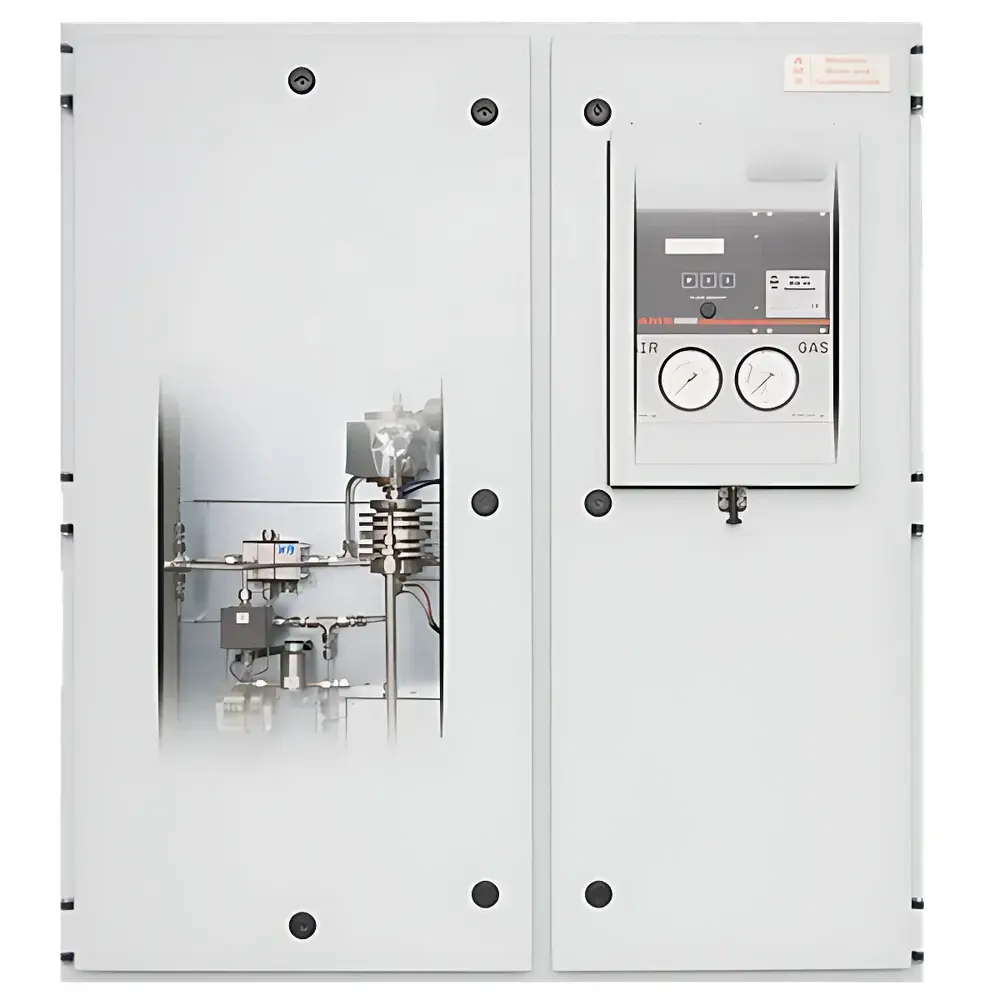
AMS RHADOX 7100/7100EX/7300/7300EX Wobbe Index & Combustion Air Requirement Index (CARI) Analyzer
| Brand | AMS |
|---|---|
| Origin | Germany |
| Model | RHADOX 7100/7100EX/7300/7300EX |
| Repeatability | CARI & Wi ≤ 1.0% of reading |
| Drift | ≤ 2% of reading/month |
| Response Time (T90) | 10–30 s (gas viscosity-dependent) |
| Explosion Protection | ATEX II 2G Ex pxb IIB+H2 T4 Gb X (Zone 1) |
| Operating Temperature | +5 °C to +60 °C |
| Sample Flow Rate | 20–100 NL/h (gas), 50–500 NL/h (instrument air) |
| Gas Inlet Pressure | ≥ 0.1 bar(g) (7100 series), ≥ 0.5 bar(g) (7300 series), max 17 bar(g) |
| Instrument Air Pressure | ≥ 2 bar(g), max 8 bar(g) |
| Analog Outputs | 2 × 4–20 mA (7100), 4 × 4–20 mA (7300), galvanically isolated |
| Digital Interface | RS232 (standard), optional RS485 or Ethernet |
| Measurement Parameters | Wobbe Index (Wi), Combustion Air Requirement Index (CARI), Specific Gravity (SG), Lower Calorific Value (LCV) |
Overview
The AMS RHADOX 7100/7100EX/7300/7300EX is a certified online gas analyzer engineered for continuous, real-time determination of combustion-relevant gas properties in industrial process environments. It operates on the principle of catalytic oxidation calorimetry: sample gas and conditioned instrument air are precisely metered, thermally equilibrated, and mixed at controlled pressure and temperature before entering a heated catalytic reactor. Within this reactor, complete oxidation of combustible components occurs under stoichiometric conditions. Oxygen concentration is monitored continuously via an electrochemical or paramagnetic sensor upstream and downstream of the catalyst bed. The differential oxygen consumption—correlated with pre-established calibration curves—directly yields the Combustion Air Requirement Index (CARI), defined as the volumetric air-to-gas ratio required for stoichiometric combustion. The Wobbe Index (Wi) is derived from CARI and measured specific gravity (SG) using the standardized relationship Wi = LCV / √SG, where LCV (Lower Calorific Value) is calculated concurrently. This first-principles approach ensures traceable, physics-based measurement without reliance on empirical correlations or multi-sensor fusion algorithms.
Key Features
- True catalytic oxidation-based measurement architecture—no interference from inert gases (N₂, CO₂, H₂O vapor) or non-combustibles within operational limits
- Dual-range calibration capability: independent low- and high-range reference points established per process gas composition, enabling accurate quantification across wide dynamic ranges
- Robust IP65-rated stainless-steel enclosure with integrated thermal management; no active cooling required under ambient conditions between +5 °C and +60 °C
- ATEX-certified variants (7100EX and 7300EX) compliant with Zone 1 (Ex pxb IIB+H2 T4 Gb X) and Zone 2 (Ex IIB+H2 T3 Gc) hazardous area classifications
- Modular flow path design with dedicated mixing chamber, ensuring laminar, repeatable gas–air homogenization prior to reaction
- Galvanically isolated analog outputs (2 or 4 channels, 4–20 mA) supporting integration into DCS, PLC, or SCADA systems with SIL2-compatible signal integrity
- Optional built-in bypass catalytic converter for pre-treatment of complex or sulfur-laden streams, extending sensor life and maintaining measurement fidelity
Sample Compatibility & Compliance
The RHADOX series accommodates a broad spectrum of industrial fuel gases—including blast furnace gas, coke oven gas, syngas, biogas, landfill gas, refinery off-gas, and blended natural gas substitutes—provided they meet mechanical and chemical compatibility requirements. Sample gas must be free of particulates (>5 µm filtration recommended), condensables (dew point maintained at least 10 K below operating temperature), and catalytic poisons (e.g., >1 ppm H₂S or halogens require optional guard beds). All models comply with EN 61000-6-2 (EMC immunity) and EN 61000-6-4 (EMC emissions). ATEX certification documentation includes full EU Type Examination Certificates (Notified Body 0082) and installation guidance aligned with IEC 60079-14. For regulated industries, the system supports audit-ready operation under GLP and GMP frameworks when paired with AMS-certified data logging firmware (optional 21 CFR Part 11-compliant electronic signatures and audit trails available).
Software & Data Management
Local operation is supported via a backlit 2×16 character LCD display showing real-time Wi, CARI, SG, and LCV values alongside status indicators (calibration due, fault codes, service mode). Configuration, diagnostics, and manual calibration are accessible through a hierarchical menu structure navigated via membrane keypad. Remote control and monitoring are enabled via RS232 (standard), with RS485 Modbus RTU or TCP/IP Ethernet options facilitating integration into enterprise-level MES or historian platforms. Firmware supports configurable alarm thresholds, event logging (timestamped measurement deviations, calibration events, power cycles), and periodic automatic zero/span verification routines. Data export formats include CSV and XML; historical records are retained onboard for ≥30 days (configurable) with battery-backed memory.
Applications
This analyzer is deployed primarily in energy-intensive industrial settings where precise combustion optimization is critical to efficiency, emissions compliance, and fuel cost control. Typical use cases include: continuous feed-forward control of air–fuel ratios in reheating furnaces and glass melting tanks using waste gases; dynamic blending of biogas with natural gas to maintain constant Wi for grid injection; real-time LCV monitoring in municipal solid waste incineration plants for steam generation scheduling; and quality assurance in hydrogen-enriched synthetic fuel production lines. Its ability to deliver <1.0% repeatability on CARI and Wi—validated per ISO 6974-2 and ASTM D4891—makes it suitable for custody transfer applications where contractual heating value specifications must be enforced.
FAQ
What standards govern the Wobbe Index calculation methodology used by the RHADOX system?
The system implements the fundamental definition per ISO 6976 and EN 15403: Wi = LCV / √SG, where LCV is determined experimentally via catalytic oxidation enthalpy and SG is measured gravimetrically using calibrated flow and pressure differentials.
Can the RHADOX operate without external air supply?
No. Instrument-grade dry air (oil-free, dew point ≤ –40 °C) is mandatory for both oxidation reaction and pneumatic actuation of internal valves; flow rate is dynamically adjusted based on CARI output.
Is field recalibration possible without manufacturer tools?
Yes. Two-point manual calibration (low/high) can be performed using certified reference gases traceable to NIST or PTB standards; no proprietary hardware or software dongles are required.
How does the system handle gas streams containing hydrogen sulfide?
H₂S concentrations exceeding 0.5 ppm require installation of an optional sulfur scrubber module upstream of the analyzer inlet; the standard catalytic reactor is not resistant to irreversible sulfidation.
What is the maximum allowable pressure drop across the sample conditioning system?
Total system pressure loss (inlet to exhaust) remains below 0.3 bar at nominal flow rates; detailed pressure drop curves are provided in the Installation & Commissioning Manual (Ref. AMS-RHADOX-IM-7300-EN).
Related Products