
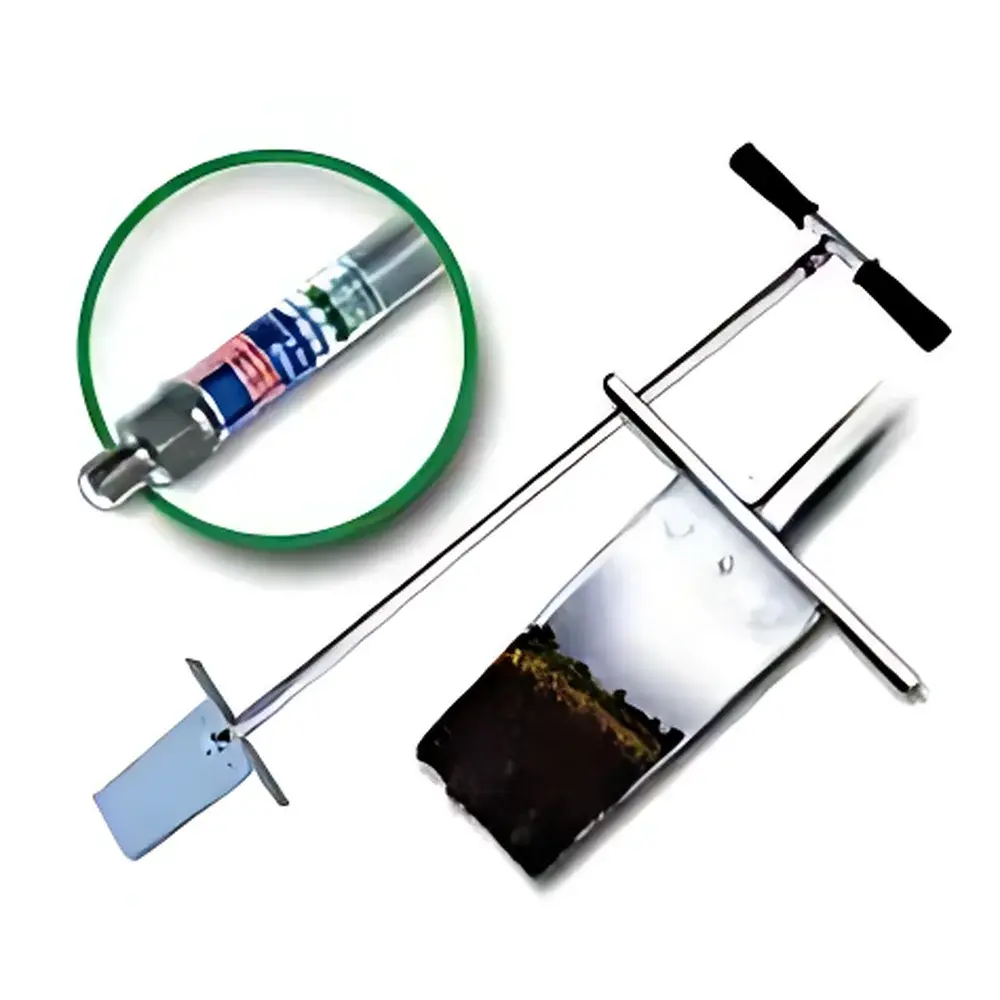
AMS Small-Diameter Cylindrical Soil Auger
| Origin | USA |
|---|---|
| Manufacturer Type | Authorized Distributor |
| Origin Category | Imported |
| Model | Small-Diameter Cylindrical Soil Auger |
| Pricing | Available Upon Request |
Overview
The AMS Small-Diameter Cylindrical Soil Auger is a precision-engineered manual soil sampling tool designed for high-fidelity, minimally disturbed collection of intact soil cores across diverse field conditions. Based on the principle of rotary penetration with controlled wall clearance and optional liner containment, it enables reproducible sampling from surface layers to depths exceeding 3.6 meters—depending on configuration and auxiliary tools (e.g., slide hammers or extension rods). Constructed to meet ASTM D1586 (Standard Test Method for Penetration Resistance and Classification of Soils) and ISO 22027 (Soil quality — Sampling — Guidance on sampling strategies), this auger system supports both routine agronomic monitoring and regulatory-compliant environmental site assessments. Its modular architecture—comprising interchangeable bits, liners, handles, and depth-marked variants—ensures adaptability to heterogeneous substrates including compacted clay, gravelly loam, sod-covered turf, and root-dense forest floor.
Key Features
- Multiple material options: 4130 chromoly steel (heat-treated and nickel-plated) or 304/316 stainless steel for corrosion resistance, mechanical durability, and compliance with USDA-NRCS and EPA SW-846 sampling protocols.
- Standardized diameters: 2.22 cm (7/8″) and 2.86 cm (1 1/8″) core extraction profiles, optimized for minimal bulk density alteration and compatibility with standard laboratory sample tubes (e.g., 50 mL centrifuge tubes or 100 mm × 100 mm PVC liners).
- Configurable lengths: 15.24 cm to 91.44 cm (6″ to 36″), enabling stratified sampling at discrete horizons without cross-contamination between layers.
- Integrated design elements: Longitudinal slots (for direct-extraction augers), recessed liner retention systems (for undisturbed sampling), and hardened tip geometries (Rockwell C52–58) to maintain edge integrity in coarse or rocky soils.
- Universal interface: All models accept AMS-standard cross-handle grips, slide hammers (model SH-10), and telescoping extension rods (ER-30, ER-60), supporting both hand-driven and percussion-assisted operation.
Sample Compatibility & Compliance
This auger series accommodates a full spectrum of soil types—from saturated clays and silty sands to highly organic topsoil and calcareous subsoils—without compromising structural integrity of the core. The “recovery-type” configuration (with inner liner protruding 3.2 mm beyond the outer barrel) conforms to USP and FDA 21 CFR Part 11 requirements for traceable, non-contaminating sample acquisition in GLP/GMP-aligned environmental testing labs. Liners are available in autoclavable polypropylene or electropolished stainless steel, ensuring compatibility with volatile organic compound (VOC) analysis per EPA Method 5035A and heavy metal digestion per EPA Method 3050B. All components are certified free of lead, cadmium, and phthalates per RoHS Directive 2011/65/EU.
Software & Data Management
While the auger itself is a mechanical instrument, its integration into digital field workflows is supported via AMS FieldLog™ mobile application (iOS/Android), which enables geotagged logging of sampling coordinates, depth intervals, soil horizon notes, and photo documentation. Exported CSV files include metadata fields compliant with ISO 11464 (Soil quality — Sampling — Vocabulary) and are directly importable into LIMS platforms such as LabWare LIMS and Thermo Fisher SampleManager. Audit trails—including user ID, timestamp, GPS accuracy, and device calibration status—are retained for regulatory review under ISO/IEC 17025:2017 Clause 7.7.
Applications
- Agronomic nutrient profiling: Depth-resolved sampling for nitrate, phosphorus, and potassium mapping in precision farming operations.
- Environmental site characterization: Screening for petroleum hydrocarbons (TPH), PAHs, and chlorinated solvents in Phase I/II ESA investigations.
- Turfgrass and landscape management: Root-zone assessment for golf course maintenance, parkland rehabilitation, and urban green infrastructure projects.
- Hydrological studies: Moisture profile delineation using depth-calibrated augers (e.g., Brown Moisture Auger with 0.3 m / 1 ft increments).
- Ecological research: Undisturbed monolith recovery for rhizosphere microbiome analysis and soil aggregate stability testing per ASTM D6913.
FAQ
What standards does this auger comply with for environmental sampling?
It meets ASTM D1586, ISO 22027, and EPA SW-846 Chapter One guidelines for representative soil core collection, including provisions for liner use, depth marking, and operator training documentation.
Can the auger be used for VOC analysis without contamination risk?
Yes—when paired with electropolished stainless steel liners or certified VOC-free polypropylene sleeves, and following EPA Method 5035A field preservation protocols (e.g., immediate chilling and headspace-free sealing).
Is calibration required before field deployment?
No calibration is needed for mechanical operation; however, users must verify liner protrusion tolerance (±0.1 mm) and depth scale accuracy annually using NIST-traceable calipers per ISO/IEC 17025 Section 6.5.
How deep can samples be collected without extension rods?
Maximum hand-driven depth is ~60.96 cm (24″) in loamy soils; use of the SH-10 slide hammer extends effective penetration to 91.44 cm (36″), while ER-60 extension rods enable sampling to 366 cm (12 ft) in cohesive materials.
Are replacement tips available for different soil hardness levels?
Yes—AMS offers interchangeable bit assemblies: standard recovery bits (for soft-to-medium soils), rock-tipped bits (tungsten-carbide embedded), and turf-specific chisel points—all threaded to 3/4″-16 UNC for rapid field exchange.







