
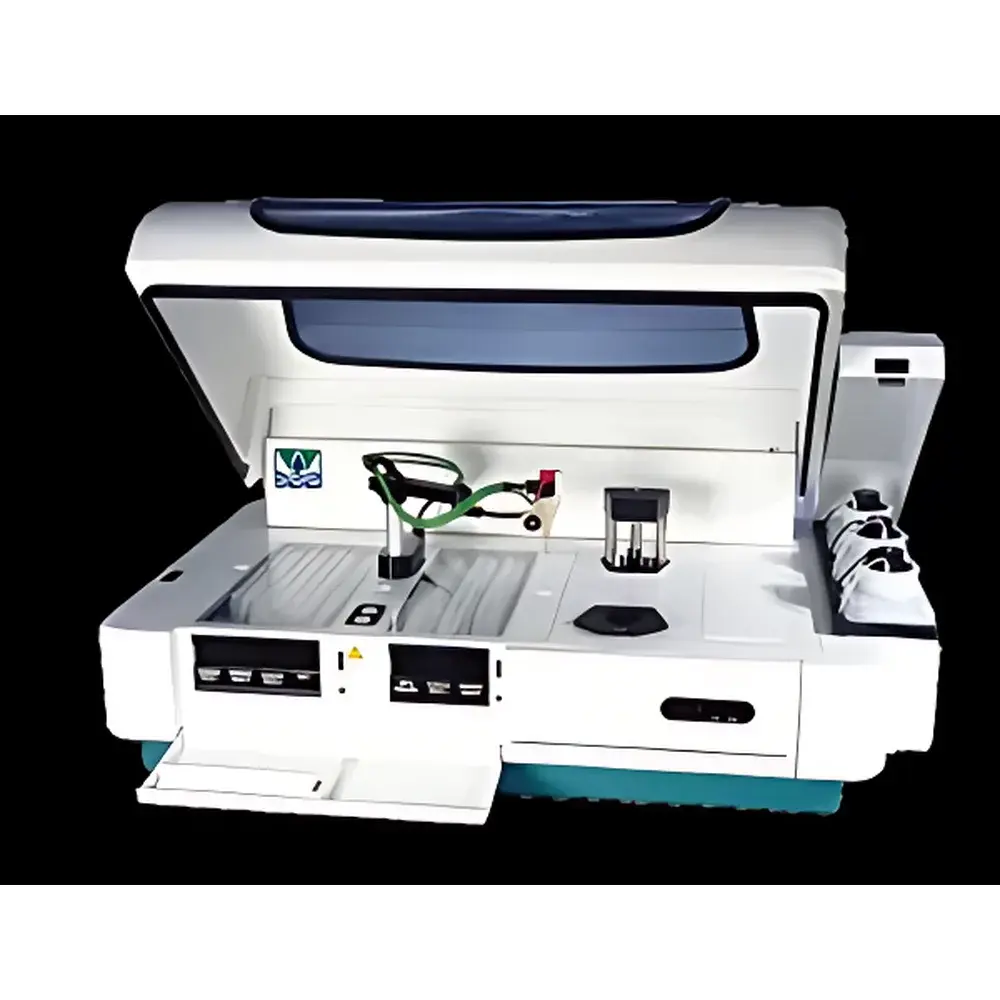
AMS SmartChem 200 Fully Automated Discrete Analyser for Wine and Beverage Analysis
| Origin | France |
|---|---|
| Manufacturer Type | Authorized Distributor |
| Origin Category | Imported |
| Model | SmartChem 200 |
| Price | €60,000 |
| Power Requirement | 90–250 VAC, 47–63 Hz, 300 W |
| Water Consumption | 2 mL per test |
| Operating Temperature | 18–30 °C |
| Relative Humidity | 20–85 % RH |
| Dimensions (H×W×D) | 42 × 65 × 100 cm |
| Weight | 65 kg |
| Sample Capacity | 126 positions across 5 racks |
| Sample Tube Size | up to 16 mm × 100 mm |
| Minimum Sample Volume | 3.0 µL (1 µL increment) |
| Reagent Volume | 3.0–300 µL (1 µL increment) |
| Dilution Factor | up to 100× |
| Reaction Cuvettes | 60-position rotating reusable disc, temperature-controlled at 37.0 ± 0.1 °C |
| Optical System | Dual-beam photometer with 8 narrow-band interference filters (420–880 nm), 6 V/10 W halogen lamp, 10 mm pathlength, linear range 0.001–2.500 Abs, resolution 0.0001 Abs |
| Throughput | up to 200 tests/hour |
| Detection Principle | Direct spectrophotometric measurement in discrete reaction cuvettes |
Overview
The AMS SmartChem 200 is a fully automated discrete analyser engineered for high-precision, low-volume chemical analysis in wine, grape must, and beverage quality control laboratories. Unlike continuous-flow or segmented-flow systems, the SmartChem 200 employs true discrete analysis: each sample reacts in an individual, thermally regulated cuvette, eliminating carryover and cross-contamination. Its core architecture integrates robotic liquid handling, real-time cuvette integrity monitoring, and multi-wavelength dual-beam photometry—enabling simultaneous quantification of multiple analytes from a single 3–300 µL sample aliquot. The system operates on endpoint, kinetic, differential, two-point, and turbidimetric assay principles, supporting regulatory-compliant methods including EPA-approved cadmium-column reduction for nitrate/nitrite and AOAC- and OIV-endorsed protocols for wine-specific parameters. Designed for GLP/GMP-aligned environments, it meets essential requirements for auditability, method traceability, and data integrity under FDA 21 CFR Part 11 when deployed with validated software configurations.
Key Features
- Discrete cuvette-based architecture with 60-position rotating disc—each cuvette automatically cleaned, optically verified, and temperature-stabilised at 37.0 ± 0.1 °C prior to use
- Dual-beam photometer with eight user-selectable narrow-band optical filters (420, 480, 510, 540, 570, 600, 660, 880 nm) plus one blank filter; extended dynamic range (0.001–2.500 Abs) minimises re-runs due to absorbance saturation
- Integrated micro-pipetting system with contact-sensing probes, post-aspiration automatic tip wash, and real-time liquid level detection—ensuring volumetric accuracy within ±1 µL
- Two reagent carousels: one Peltier-cooled (10 positions, 4–10 °C), one ambient (6 reagents + 10 standards + 2 controls)
- No pumps, no tubing, no baseline drift—eliminates maintenance associated with peristaltic or syringe-based fluidics
- On-demand urgent sampling: any position in the 126-sample rack can be prioritised without interrupting batch processing
- Reagent-free dilution: digital volume control enables precise 2× to 100× on-board dilution without mechanical dilutors or additional hardware
Sample Compatibility & Compliance
The SmartChem 200 accepts standard 16 mm × 100 mm borosilicate or polypropylene tubes, compatible with both routine and emergency sample workflows. It supports OIV (International Organisation of Vine and Wine) Method 2021-A11 for total and free SO₂, AOAC 985.23 for titratable acidity, and EPA Method 353.2 for nitrate/nitrite via integrated cadmium-reduction module. All assay protocols are pre-validated for matrix-matched calibration using wine, must, and juice reference materials. Instrument compliance includes CE marking per Directive 2014/30/EU (EMC) and 2014/35/EU (LVD); software configuration supports 21 CFR Part 11 electronic signatures and audit trail generation when paired with AMS-certified LIMS integration modules.
Software & Data Management
Controlled via AMS SmartSoft v5.x, the system provides role-based user access, method versioning, electronic lab notebook (ELN)-style annotation, and automated report generation in PDF/CSV/XLSX formats. Raw absorbance traces, cuvette health logs, reagent lot tracking, and calibration history are timestamped and cryptographically hashed. Data export conforms to ASTM E1384 and ISO/IEC 17025:2017 documentation requirements. Optional API integration enables bidirectional communication with enterprise LIMS platforms—including LabWare, STARLIMS, and Thermo Fisher SampleManager—via secure RESTful endpoints with OAuth 2.0 authentication.
Applications
Primary deployment domains include enological QC labs, contract testing facilities, and university viticulture research units. Validated assays cover 18 wine-relevant parameters: glucose, fructose, sucrose, tartaric acid, malic acid, acetic acid, gluconic acid, iron, copper, total acidity, pH, total SO₂, free SO₂, ammonia nitrogen, PANOPA (polyphenol index), nitrate, nitrite, and phosphoric acid. Additional application kits support cider, beer, fruit juice, and vinegar matrices. The system’s low reagent consumption (≤2 mL/test) and minimal hazardous waste output (<5 mL/day at 100 tests) align with ISO 14001 environmental management objectives.
FAQ
Is the SmartChem 200 compliant with OIV and EU wine regulation Annex I.B methodologies?
Yes—pre-installed methods conform to OIV Resolution OENO 563/2021 and EU Commission Regulation (EU) No 2019/934 for mandatory wine parameter verification.
Can existing wet chemistry methods be migrated to the SmartChem 200 platform?
Yes—AMS provides method adaptation services including linearity verification, spike recovery validation, and LOQ/LOD determination per ISO 5725-2.
What maintenance intervals are recommended for routine operation?
Optical alignment verification every 6 months; cuvette disc replacement every 12 months or after 10,000 cycles; probe tip wear inspection quarterly.
Does the system support remote diagnostics and firmware updates?
Yes—secure TLS 1.2-enabled remote access allows AMS-certified engineers to perform diagnostics, log review, and controlled firmware upgrades without on-site visits.
How is reagent stability managed during long unattended runs?
The Peltier-cooled reagent carousel maintains temperature between 4–10 °C; all reagents are monitored via integrated RFID tags logging lot number, expiry date, and first-opening timestamp.







