
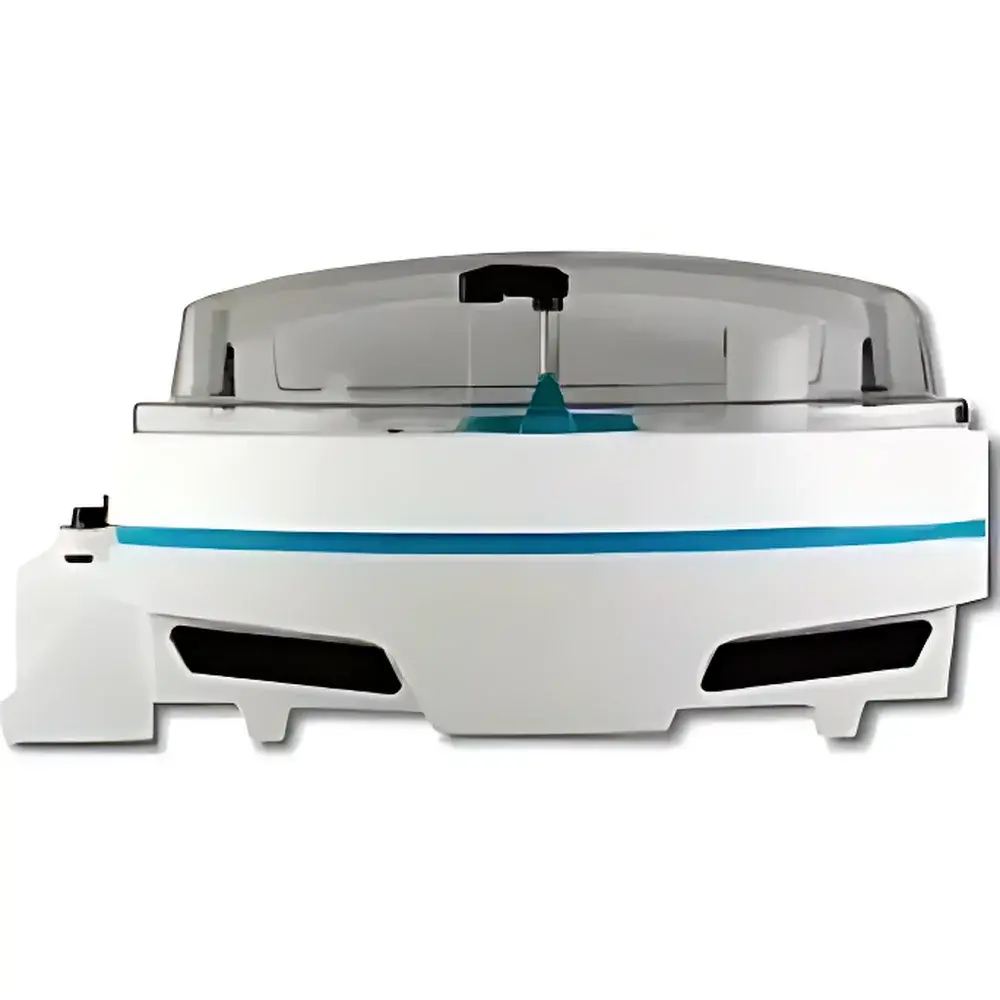
AMS Smartchem 300 Fully Automated Discrete Analyzer
| Origin | Italy |
|---|---|
| Manufacturer Type | Authorized Distributor |
| Origin Category | Imported |
| Model | Smartchem 300 |
| Pricing | Upon Request |
Overview
The AMS Smartchem 300 is a fully automated discrete chemical analyzer engineered for high-precision, high-throughput wet-chemistry analysis in regulated laboratory environments. Unlike continuous-flow or flow-injection systems, the Smartchem 300 employs a true discrete (segmented) analysis principle: each sample and reagent is handled individually in dedicated cuvettes, eliminating cross-contamination and enabling rigorous control over reaction timing, temperature, and stoichiometry. This architecture ensures compliance with method-defined kinetics—critical for endpoint, kinetic, differential, dual-wavelength, and fixed-time assays. Designed for routine QC/QA, environmental monitoring, food & beverage testing, and agricultural laboratories, the system delivers traceable, auditable results aligned with ISO/IEC 17025, AOAC INTERNATIONAL, US EPA Methods (including Method 353.2 for nitrate/nitrite), AFNOR, COFRAC, and BATF validation frameworks.
Key Features
- Modular three-zone carousel design: physically separated sample, reagent, and cuvette handling zones reduce robotic arm travel distance and increase cycle efficiency.
- Dual-channel photometer with high-stability 6 V/10 W halogen source, 6 mm optical path, and auto-selected narrow-band interference filters (340–880 nm); linear absorbance range: 0.001–4.200 Abs; resolution: 0.0001 Abs.
- Refrigerated reagent storage: 72 total positions—including four movable racks (16 × 25 mL each) plus eight auxiliary 25 mL slots—with onboard cooling maintained at 8–12 °C.
- Sample handling flexibility: four universal sample carousels accommodate both disposable cups and tubes (10–16 mm diameter, 40–100 mm height); up to 15 samples per rack with real-time emergency sample injection capability.
- Precision liquid handling: capacitive microdispensing system with adjustable volume range from 3.0 µL to 330 µL (1 µL increments); integrated probe washing, on-board 37 °C reagent preheating, and optional on-line dilution.
- Reaction cuvette management: 80 reusable quartz/glass cuvettes distributed across four independent rotating carousels (20 per carousel); automated cleaning with user-selectable acidic, alkaline, or neutral wash solutions; cuvette integrity monitored optically.
- Integrated ISE module (optional): direct potentiometric measurement of Na⁺, K⁺, Cl⁻, and Li⁺ at up to 140 samples/hour; maintenance-free solid-state electrodes with no liquid junction or refilling required.
Sample Compatibility & Compliance
The Smartchem 300 supports diverse matrix types without modification: aqueous environmental samples (drinking water, wastewater, seawater), alcoholic beverages (wine, beer, spirits), soil and plant digests, animal feed extracts, fertilizer solutions, and tobacco homogenates. All assay protocols are implemented as user-defined methods conforming to published regulatory standards—including US EPA 353.2 (nitrate/nitrite), ASTM D129, ISO 6775, and AOAC 982.02 (phosphate). The system’s hardware architecture and software audit trail meet GLP and GMP requirements, with full support for 21 CFR Part 11-compliant electronic signatures, user access tiers, and immutable method/version history.
Software & Data Management
AMS ChemStation software provides complete method development, execution, and data governance. Users can define up to 999 stored analytical methods with customizable parameters—including reaction delay times, mixing sequences, wavelength selection, calibration curve types (linear, quadratic, spline), and pass/fail criteria. All instrument actions—including pipetting volumes, photometer readings, cuvette status, and reagent lot tracking—are time-stamped and logged in a tamper-evident database. Export formats include CSV, PDF reports, and LIMS-compatible XML. Optional barcode scanning enables automatic sample and reagent identification, reducing manual entry errors and supporting chain-of-custody documentation.
Applications
The Smartchem 300 performs standardized colorimetric, enzymatic, and ion-selective analyses across multiple sectors:
- Environmental: Acidity, alkalinity, Al, NH₃-N, COD, Cl₂, CN⁻, Cl⁻, hardness, Cr, Mn, F⁻, NO₃⁻, NO₂⁻, phenol, PO₄³⁻, SiO₃²⁻, SO₄²⁻, TKN, TKP, Fe, urea.
- Wine & Beverage: Glucose, fructose, sucrose, malic acid, tartaric acid, acetic acid, gluconic acid, Fe, Cu, total acidity, pH, total/free SO₂, PANOPA, NH₃-N, alcohol (TVA), OD₄₂₀/OD₅₂₀/OD₆₂₀, ascorbic acid, sorbic acid.
- Agriculture & Food: NH₃-N, NO₃⁻, NO₂⁻, B, Ca, PO₄³⁻, Cl⁻, total N/P, Mg, lysine, urea in soils, plants, feeds, and fertilizers.
- Tobacco: NH₃-N, Cl⁻, nicotine, NO₃⁻, PO₄³⁻, cyanide, formaldehyde.
FAQ
What regulatory standards does the Smartchem 300 comply with?
The system supports method execution and data reporting compliant with ISO/IEC 17025, AOAC INTERNATIONAL, US EPA (e.g., Method 353.2), AFNOR, COFRAC, and BATF. Its software architecture supports 21 CFR Part 11 and GLP/GMP audit requirements.
Can the instrument handle viscous or particulate-laden samples?
Yes—sample introduction is compatible with clarified or filtered suspensions; optional centrifugation or filtration modules may be integrated upstream for high-solids matrices.
Is remote monitoring or LIMS integration supported?
ChemStation includes native LIMS connectivity via ASTM E1384 and HL7 protocols; secure remote access is enabled through TLS-encrypted web interface and API-based method scheduling.
How is reagent stability ensured during extended runs?
All onboard reagents are refrigerated at 8–12 °C; temperature is continuously monitored and logged. Optional barcode tracking links reagent lots to individual assay results for full traceability.
What maintenance is required for the photometer and fluidics system?
The dual-beam photometer requires no routine calibration; fluidic components undergo automated cleaning after each run. Preventive maintenance intervals are scheduled every 6 months based on usage logs and are fully documented within the service module.





