
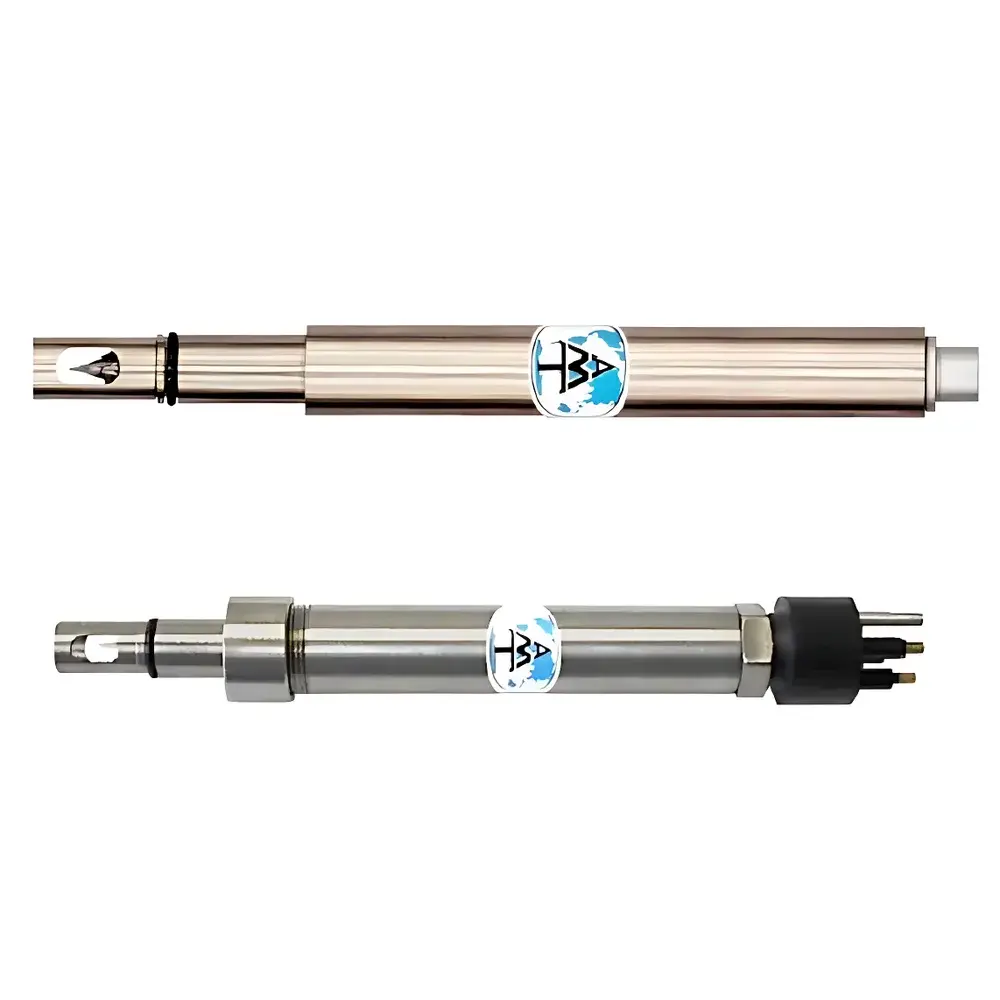
AMT AMT-O2 Underwater Oxygen Microsensor
| Brand | AMT |
|---|---|
| Origin | Germany |
| Manufacturer Status | Authorized Distributor |
| Origin Category | Imported |
| Model | AMT-O2 |
| Pricing | Upon Request |
Overview
The AMT AMT-O2 Underwater Oxygen Microsensor is an electrochemical, self-polarizing, membrane-covered Clark-type microsensor engineered for high-resolution, in situ measurement of dissolved oxygen (DO) in aquatic environments. It operates on amperometric (galvanic) principle: molecular oxygen diffuses selectively through a gas-permeable polytetrafluoroethylene (PTFE) or silicone membrane, undergoes reduction at a cathode (typically platinum or gold), and generates a current proportional to the partial pressure of O2. This current is linearly correlated with dissolved oxygen concentration across the full 0–200% air saturation range under standard conditions (0–30 °C). Designed for minimal perturbation of the measured system, the sensor features an ultra-fine electrode tip (<25 µm diameter) and sub-millimeter membrane area—enabling diffusion-limited response times as fast as t90% = 200 ms. Its self-polarizing architecture eliminates the need for external polarization voltage, reducing power requirements and enhancing long-term stability in field-deployed or incubation-based setups.
Key Features
- Microscale geometry: Working electrode diameter <25 µm; membrane diameter optimized for rapid O2 diffusion and minimal boundary layer disturbance
- Ultra-fast response: t90% ≤ 200 ms at 25 °C, enabling real-time profiling of dynamic oxygen gradients in sediments, biofilms, and microbial mats
- High-pressure tolerance: Stable operation up to >10 bar (equivalent to >100 m water depth) with titanium-housed variants and BH-4-MP underwater connectors
- Modular probe design: Interchangeable sensor heads—including O2 (0–200% air saturation), H2S (0.01–50 mg/L, three sensitivity ranges), and custom configurations—facilitate multi-analyte studies without instrument replacement
- Robust mechanical construction: IP68-rated titanium housing; removable protective sleeve; field-replaceable probe tips with strict dry-connection protocol during exchange
- Integrated temperature compensation: Built-in thermistor enables automatic correction per ISO 5814 and ASTM D888 standards
Sample Compatibility & Compliance
The AMT-O2 is validated for use in freshwater, seawater, porewater, sediment cores, benthic chambers, bioreactors, and microcosms. Its micro-dimensioned probe minimizes physical disruption to delicate stratified systems—critical for accurate quantification of oxygen penetration depth (OPD), nitrification zones, and anaerobic/aerobic interfaces. The sensor complies with ISO 5814:2012 (Water quality — Determination of dissolved oxygen — Electrochemical probe method) and supports GLP/GMP-aligned data integrity when paired with compliant data loggers. For regulated environmental monitoring or research subject to EPA Method 360.1 or USP , the sensor’s traceable calibration protocol (using air-saturated water and zero-oxygen sodium sulfite solution) meets documentation requirements for audit readiness.
Software & Data Management
The sensor interfaces via analog voltage output (0–5 V or 0–10 V) or digital RS-232/RS-485 outputs compatible with industry-standard DAQ systems (e.g., LabVIEW, MATLAB, Python-based acquisition platforms). AMT provides optional calibration and configuration software supporting two-point calibration, temperature compensation coefficient adjustment, and real-time gradient visualization. All raw signal timestamps, temperature readings, and user-defined metadata are exportable in CSV or HDF5 format. When integrated into networked environmental monitoring stations, the sensor supports time-synchronized logging aligned with FDA 21 CFR Part 11-compliant electronic records—provided the host system implements audit trails, electronic signatures, and secure data storage.
Applications
- In situ sediment oxygen profiling for biogeochemical modeling of redox zonation and organic matter mineralization
- Real-time DO mapping in wastewater biofilm reactors and membrane bioreactors (MBRs)
- Oxygen flux quantification across benthic-pelagic interfaces using eddy covariance or chamber-based approaches
- Microscale respiration assays in single-cell or microcolony studies (e.g., sulfate-reducing bacteria, methanogens)
- Calibration and validation of optical oxygen sensors (e.g., luminescent lifetime probes) in turbid or high-H2S environments
- Long-term deployment in coastal observatories, lake buoys, and deep-sea moorings (with appropriate pressure-rated housings)
FAQ
What is the recommended calibration frequency for continuous field deployment?
For high-accuracy applications, daily two-point calibration (air-saturated water and chemical zero) is advised. In stable laboratory incubations, recalibration every 48–72 hours suffices if temperature and salinity remain constant.
Can the sensor be used in hydrogen sulfide-rich environments?
Yes—when equipped with the dedicated H2S probe variant (0.01–3 mg/L, 0.05–10 mg/L, or 0.5–50 mg/L ranges); however, simultaneous O2/H2S measurement requires sequential probing due to cross-sensitivity and membrane selectivity constraints.
Is the probe suitable for sterilization prior to microbiological experiments?
Ethanol wiping and UV exposure are acceptable; autoclaving or chemical sterilants (e.g., glutaraldehyde) will degrade the membrane and electrolyte—probe replacement is required post-sterilization.
How does pressure affect measurement accuracy at depth?
The sensor’s sealed, pressure-balanced design maintains accuracy up to 10 bar; no correction factor is needed within its rated depth range (≤100 m), provided the membrane remains intact and free of micro-bubbles.
What is the expected service life under typical freshwater sediment conditions?
At 100% air saturation and 20 °C, functional lifespan is 9–18 months; in low-O2 sediments (<5% saturation), longevity extends significantly due to reduced cathodic consumption rate.







