
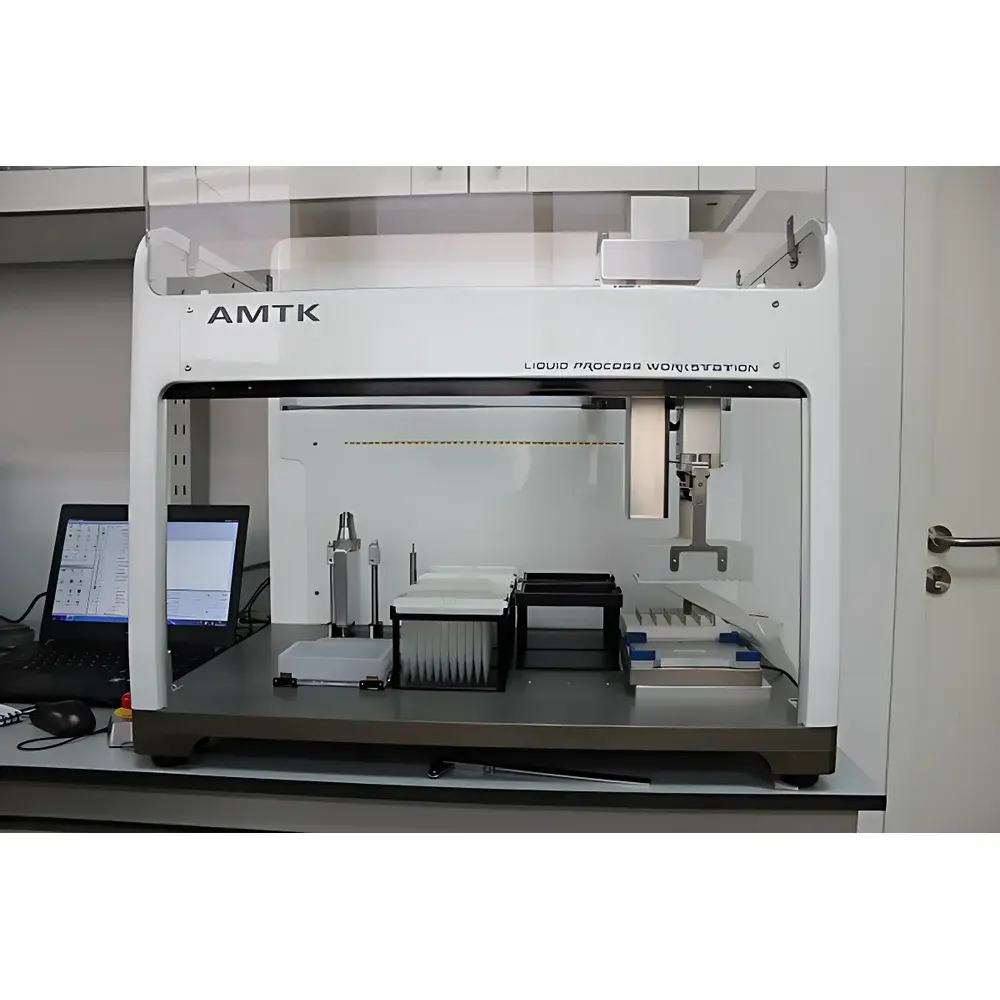
AMTK LH1406 Automated Magnetic Bead-Based Nucleic Acid Purification Workstation
| Brand | AMTK |
|---|---|
| Origin | Beijing, China |
| Manufacturer Type | Authorized Distributor |
| Country of Origin | China |
| Model | LH1406 |
| Instrument Type | Magnetic Bead-Based Purification System |
| Automation Level | Dedicated Fully Automated Platform |
| Throughput | 1–96 samples per run |
| Sample Volume Range | 0.5–200 µL |
| Processing Time per Batch | ~40 minutes |
| Elution Volume | Adjustable (typically 30–100 µL) |
| Ambient Operating Temperature | 23 °C ± 5 °C |
| Power Supply | 110/220 VAC, 50/60 Hz |
| Relative Humidity | 10–90% RH (non-condensing) |
| Deck Capacity | 12 deck positions |
| Extracted Yield (Human Whole Blood, 100–300 µL) | 4–8 µg total nucleic acid |
Overview
The AMTK LH1406 Automated Magnetic Bead-Based Nucleic Acid Purification Workstation is an integrated, benchtop platform engineered for high-fidelity, walk-away isolation of genomic DNA, plasmid DNA, viral RNA, and total RNA from diverse biological matrices—including whole blood, serum, plasma, saliva, buccal swabs, cultured cells, and tissue lysates. Leveraging proven magnetic bead separation chemistry under programmable liquid handling control, the system executes all core purification steps—lysis, binding, washing, elution, and optional on-deck heating—without manual intervention. Its architecture adheres to fundamental principles of solid-phase extraction: nucleic acids bind selectively to carboxyl- or silica-coated magnetic beads in high-salt chaotropic conditions, followed by sequential ethanol-based washes and low-salt elution. Designed for reproducible performance across variable input volumes (0.5–200 µL), the LH1406 delivers consistent yield and purity (A260/A280 ≥ 1.7–1.9, A260/A230 ≥ 1.8) suitable for downstream applications including qPCR, digital PCR, Sanger sequencing, NGS library preparation, and CRISPR-based assays.
Key Features
- Fully automated, dedicated workflow: No pipetting, no reagent transfer, no centrifugation—entire process executed via preloaded protocols.
- Modular functional architecture: Independent precision liquid handling module, temperature-controlled magnetic separation station (4–85 °C), adjustable heating block (for lysis and elution enhancement), and multi-position deck (12 slots) supporting standard SBS-format plates, tubes, and reservoirs.
- Flexible throughput: Configurable for 1–96 samples per run using 96-well plates or individual tubes; accommodates both low-volume research runs and mid-throughput screening.
- Optimized binding kinetics: Integrated mixing and incubation routines ensure uniform bead–nucleic acid interaction, minimizing loss during binding and improving recovery from low-abundance or inhibitor-rich samples.
- Robust contamination control: Positive-pressure air filtration, UV sterilization lamp (optional), and disposable tip usage per sample prevent cross-contamination and carryover.
- Intuitive touchscreen interface with protocol library: Pre-validated methods for blood, saliva, FFPE, bacteria, and viral templates; user-customizable step parameters (incubation time, mixing speed, aspiration height).
Sample Compatibility & Compliance
The LH1406 supports a broad spectrum of primary and processed sample types without requiring method re-optimization. Validated inputs include anticoagulated whole blood (EDTA/K2EDTA), dried blood spots, serum/plasma, nasopharyngeal swab transport media, bacterial cultures (Gram-positive/negative), yeast lysates, and homogenized tissue suspensions. All purification chemistries are compatible with ISO 18385-compliant consumables and third-party magnetic bead kits meeting ASTM D7924 standards for residual metal content. The system’s operational logs, protocol execution records, and error timestamps comply with GLP documentation requirements. While not inherently 21 CFR Part 11–certified, its audit trail functionality—including user login tracking, protocol versioning, and electronic signature support—enables integration into GMP-aligned workflows when deployed with validated software extensions and networked LIMS interfaces.
Software & Data Management
Control software runs on an embedded Linux OS with a 10.1-inch capacitive touchscreen display. Protocols are stored locally and exportable via USB or Ethernet as XML-based method files. Each run generates a timestamped CSV report containing sample IDs, start/end times, module status codes, thermal profiles, and liquid handling event logs. Raw data can be archived to external NAS or synced to cloud-based instrument management platforms (e.g., LabVantage, Thermo Fisher SampleManager). Software updates are delivered via secure HTTPS channel with SHA-256 checksum verification. Optional remote monitoring enables real-time status dashboards accessible via browser-based client—supporting multi-site lab coordination without exposing internal network infrastructure.
Applications
- Clinical molecular diagnostics: High-volume extraction for infectious disease testing (e.g., SARS-CoV-2, HPV, HBV) in CAP/CLIA-certified labs.
- Biobanking: Standardized processing of longitudinal biospecimens with traceable chain-of-custody metadata.
- Academic genomics: Scalable prep for WGS, exome capture, and methylation analysis where input consistency directly impacts library complexity.
- Vaccine development: Rapid isolation of pathogen RNA/DNA from cell culture supernatants and animal challenge studies.
- Quality control in biomanufacturing: Release testing of plasmid DNA vectors and mRNA intermediates per ICH Q5A/Q5D guidelines.
FAQ
What types of nucleic acids can the LH1406 isolate?
Genomic DNA, mitochondrial DNA, plasmid DNA, total RNA, viral RNA (including ssRNA and dsRNA), and miRNA—depending on selected chemistry and protocol configuration.
Is the system compatible with third-party magnetic bead kits?
Yes—provided bead size distribution (1–5 µm), surface chemistry, and binding buffer composition align with standard magnetic separation parameters; validation is recommended prior to routine use.
Can the workstation integrate with laboratory information management systems (LIMS)?
Yes—via HL7 or RESTful API interfaces; custom middleware development is supported through AMTK’s OEM partnership program.
What maintenance is required for long-term reliability?
Quarterly calibration of liquid handling accuracy (per ISO 8655-6), annual magnetic field strength verification, and routine cleaning of the magnet array and pipette carriage with 70% ethanol.
Does the system support dual elution or split eluate collection?
Not natively—but users may configure two sequential elution steps into separate wells using custom protocols, enabling parallel downstream assay setup.



