
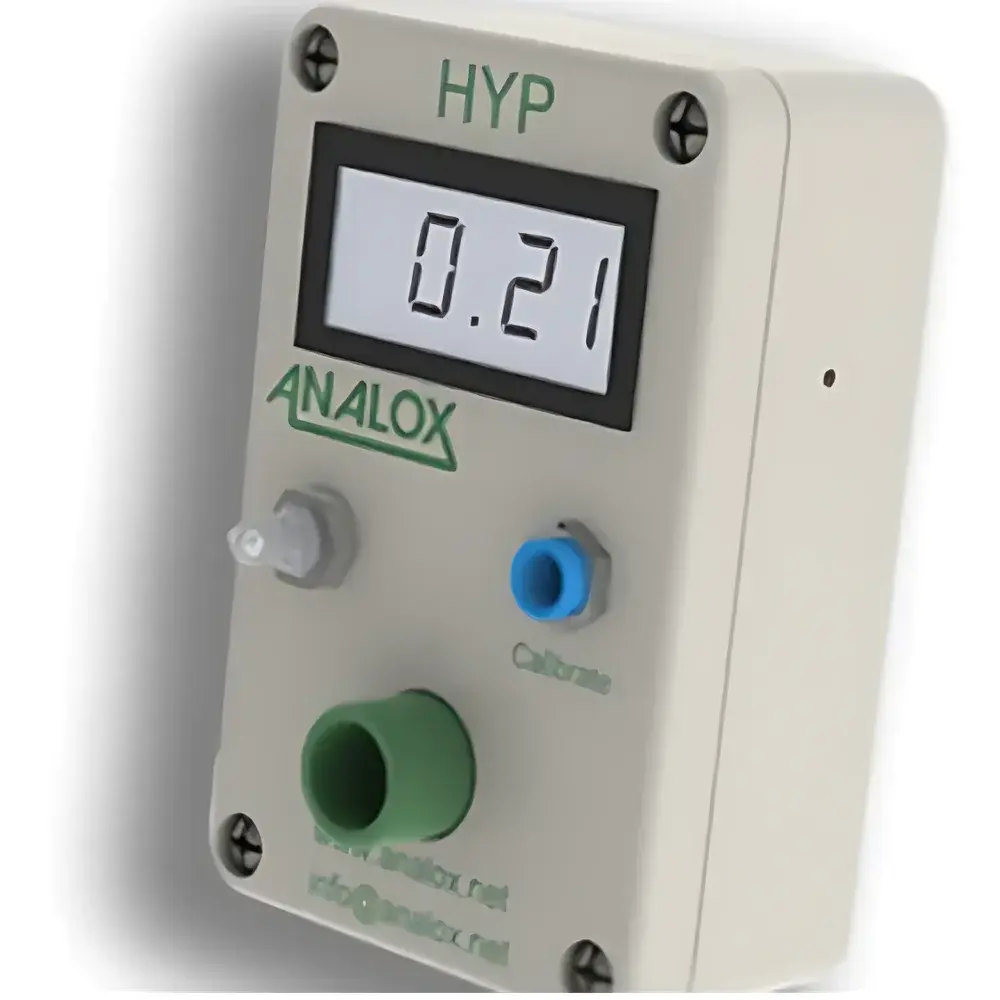
ANALOX HYP-MO2HBYY03 Portable Partial Pressure Oxygen (pO₂) Analyzer
| Brand | ANALOX |
|---|---|
| Origin | United Kingdom |
| Model | HYP-MO2HBYY03 |
| Instrument Type | Portable |
| Measurement Principle | Electrochemical (Clark-type pO₂ sensor) |
| Range | 0–2 bar ppO₂ |
| Accuracy | ±1% of reading ±1 LSD |
| Temperature Effect | ±0.2% of reading / °C |
| Long-term Drift | ≤5% of reading per year |
| Zero Drift | <1% FS/year |
| Span Drift | <1% FS/year |
| Linearity Error | ±1% FS |
| Resolution | 0.01 bar ppO₂ |
| Repeatability | ±1% FS |
| Operating Temperature | 0–40 °C |
| Operating Pressure | 0.8–60 bar absolute (≈600 msw / 2000 fsw) |
| Compression/Decompression Rate Limit | <2 bar/min |
| Power Supply | 9 V PP3 battery |
| Battery Life | 800 h continuous operation |
| Dimensions | 64 × 98 × 36 mm |
| Weight | 0.200 kg |
| Sensor Module | Analox 9100-9212-5H |
| Optional Probe | 9100-9212-2 |
Overview
The ANALOX HYP-MO2HBYY03 is a certified portable partial pressure oxygen (pO₂) analyzer engineered for high-integrity monitoring in hyperbaric and subsea life-support environments. Unlike concentration-based O₂ analyzers, the HYP-MO2HBYY03 measures *absolute partial pressure*—a critical parameter for human physiological safety under elevated ambient pressure. Its electrochemical sensing architecture employs a temperature-compensated Clark-type galvanic cell (Analox 9100-9212-5H), delivering direct, drift-stable pO₂ output in bar (or kPa) without requiring gas dilution or pressure correction algorithms. Designed to meet stringent operational demands of commercial diving, saturation systems, submarine escape training, and hyperbaric medical chambers, the instrument operates reliably across a full absolute pressure range from 0.8 to 60 bar—equivalent to depths up to 600 meters seawater (msw) or 2000 feet seawater (fsw). Its compact form factor (64 × 98 × 36 mm), IP65-rated enclosure, and robust mechanical design ensure survivability in vibration-prone, humid, and saline-exposed deployment zones.
Key Features
- True partial pressure measurement (0–2 bar ppO₂), traceable to NIST-calibrated reference standards
- Integrated temperature compensation with ±0.2% / °C stability—critical for accurate pO₂ interpretation during thermal transients in pressurized habitats
- Galvanic oxygen sensor with low-power consumption and no external polarization voltage required
- High-contrast backlit LCD display with large numeric readout optimized for gloved operation and low-light conditions
- Compliance with ISO 8573-1 Class 1 compressed air quality verification requirements for breathing gas analysis
- Self-diagnostics including sensor health status, battery voltage indicator, and pressure transducer validation
- Configurable alarm thresholds (audible + visual) with latching capability for critical O₂ excursions
- Pressure-compensated zeroing function enabling field recalibration at any operating depth within spec
Sample Compatibility & Compliance
The HYP-MO2HBYY03 is validated for use with breathable gas mixtures—including air, nitrox, heliox, and trimix—in closed-loop and open-circuit hyperbaric systems. It does not require sample extraction or flow control; measurements are performed in situ via diffusion-limited membrane contact. The device conforms to key international standards governing life-critical gas monitoring: EN 137-2019 (respiratory protective devices), DNV-RP-F115 (subsea hyperbaric system safety), and IMO MSC/Circ.1201 (submarine escape training facility requirements). It supports GLP-compliant recordkeeping when paired with optional data logging accessories and satisfies audit-ready traceability per ISO/IEC 17025 calibration management frameworks. Regulatory documentation includes UKCA marking and CE certification under the EU PPE Regulation (EU) 2016/425.
Software & Data Management
While the HYP-MO2HBYY03 operates as a standalone analog/digital instrument, its RS-232 serial interface (optional cable kit) enables integration with third-party SCADA or chamber control systems for real-time telemetry and alarm forwarding. Firmware supports Modbus RTU protocol for interoperability with industrial PLCs. Calibration logs—including date, operator ID, reference gas value, and deviation report—are stored internally (non-volatile memory) and exportable via ASCII dump. All firmware updates and configuration changes are logged with timestamp and user authentication (where enabled), supporting 21 CFR Part 11–compliant electronic records when deployed in regulated medical hyperbaric facilities.
Applications
- Redundant pO₂ monitoring in manned hyperbaric chambers (e.g., decompression, therapeutic, and research applications)
- O₂ surveillance in diving bells, personnel transfer capsules, and deep-sea rescue vehicles
- Pre-dive and post-dive breathing gas verification in saturation diving spreads
- Submarine crew compartment environmental monitoring during emergency surfacing drills
- Validation of O₂ delivery integrity in rebreather loop testing and closed-circuit life support R&D
- Field verification of gas blending accuracy prior to compression in offshore saturation systems
FAQ
Does the HYP-MO2HBYY03 measure %O₂ or partial pressure?
It measures absolute partial pressure of oxygen (ppO₂) in bar or kPa—essential for physiological safety assessment at depth. Conversion to %O₂ requires simultaneous ambient pressure input.
Can it be used inside a 50-bar hyperbaric chamber?
Yes. Its 0.8–60 bar absolute pressure rating covers all standard commercial and military hyperbaric applications, including multi-atmosphere medical treatment and saturation diving.
How often does the sensor require calibration?
Annual calibration is recommended per ISO/IEC 17025 guidelines; however, functional checks using certified span gas (e.g., 1.00 bar ppO₂ in N₂ balance) should be performed before each mission-critical deployment.
Is the unit suitable for underwater housing or submersion?
No. It is rated IP65 (dust-tight and water-jet resistant) but not submersible. It must be mounted in dry, ventilated compartments within pressure vessels.
What is the expected service life of the electrochemical sensor?
Typical functional lifespan is 24–36 months under continuous operation at 20–25 °C; performance degrades predictably and is monitored via built-in diagnostics.
Related Products







