
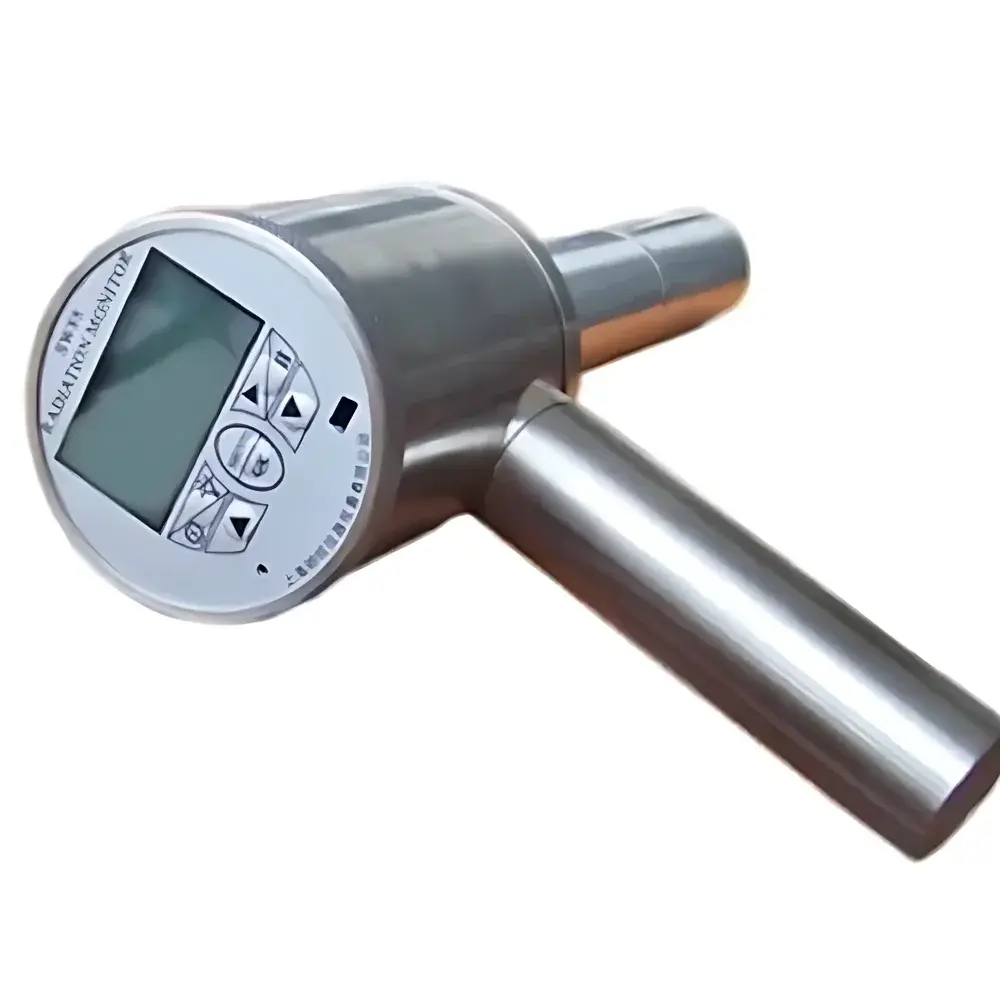
Analysis PM1121 Beta-Gamma Personal Dose Rate Alarm Meter
| Brand | Analysis |
|---|---|
| Model | PM1121 |
| Detection Principle | Geiger-Müller (GM) Tube-Based Ionizing Radiation Monitoring |
| Measurement Range | 0.01–10,000 µSv/h (Dose Rate), 0.01 µSv–9999 mSv (Cumulative Dose) |
| Energy Response | 40 keV–3 MeV |
| Sensitivity | >6000 CPM per µSv/h (relative to ¹³⁷Cs) |
| Alarm Response Time | ≤5 s |
| Operating Temperature | −15°C to +50°C |
| Power Supply | 2×AA batteries (alkaline or rechargeable) |
| Weight | 0.3 kg |
| Dimensions | 135 × 70 × 25 mm |
| Compliance | Designed for IEC 60846-1:2014 (Radiation Protection Instruments – Dose Rate and Dose Meters for Photon Radiation) and compatible with GLP/GMP field-use requirements |
Overview
The Analysis PM1121 Beta-Gamma Personal Dose Rate Alarm Meter is a compact, battery-powered radiation safety instrument engineered for real-time monitoring of photon (X and γ) and high-energy beta (β⁻) radiation fields in occupational environments. It employs a compensated, energy-sensitive Geiger-Müller (GM) tube detector operating in window-mode configuration—optimized for enhanced detection efficiency across a broad energy spectrum (40 keV to 3 MeV). Unlike scintillation-based or semiconductor detectors, the GM tube architecture delivers robust, low-cost, high-reliability performance ideal for routine personal dosimetry and area surveillance. The device measures ambient dose equivalent rate H’(10) in µSv/h and cumulative dose in µSv/mSv, conforming to ICRP-defined operational quantities for radiation protection. Its embedded 16-bit ultra-low-power microcontroller enables extended field operation (>1000 hours on standard AA cells), while non-volatile memory preserves time-stamped dose logs, calendar settings, and alarm thresholds—even during battery replacement. Designed for continuous wear or belt-mount deployment, the PM1121 serves as both a primary personal alarm dosimeter and a secondary verification tool in regulated nuclear, medical, and industrial radiography settings.
Key Features
- High-sensitivity compensated GM tube with window-type geometry for simultaneous β/γ detection
- Dual-parameter display: real-time dose rate (µSv/h, µR/h, CPS, CPM) and accumulated dose (µSv/mSv)
- Configurable dual-threshold alarms: independent dose rate and cumulative dose alarm setpoints
- Acoustic feedback proportional to count rate—audible pulse frequency increases linearly with radiation intensity
- Tri-language UI support (English, Chinese, Japanese) with intuitive menu navigation and backlight-enabled LCD
- Low-power architecture: typical current draw ≤4 mA; average power consumption ≈8 mW
- Environmental resilience: operational from −15°C to +50°C and up to 90% RH at 40°C
- Non-volatile memory retention for time/date, calibration history, and dose records during battery change
Sample Compatibility & Compliance
The PM1121 is intended for use in heterogeneous radiation fields encountered in nuclear power plants, radiotherapy clinics, industrial radiography bays, cobalt-60 irradiation facilities, and research laboratories handling sealed or unsealed radioactive sources. Its energy response (±25% deviation relative to ¹³⁷Cs reference) meets the Class II accuracy criteria defined in IEC 60846-1:2014 for portable dose rate meters. While not a Type-Approved legal metrology instrument per ISO/IEC 17025, it satisfies functional verification requirements under ANSI N42.33 (Personal Radiation Detectors) and supports ALARA (As Low As Reasonably Achievable) compliance workflows. Device firmware maintains audit-ready event logs—including alarm triggers, threshold modifications, and battery status changes—facilitating traceability in GLP and GMP-regulated operations where electronic record integrity is required per FDA 21 CFR Part 11 guidelines.
Software & Data Management
The PM1121 operates autonomously without external software dependency. All configuration, calibration, and alarm parameters are managed via front-panel controls and stored in onboard EEPROM. No proprietary drivers or cloud connectivity are implemented—ensuring electromagnetic compatibility (EMC) stability in high-interference environments such as accelerator vaults or MRI-adjacent zones. Optional PC interface (via UART-to-USB adapter, sold separately) enables manual export of timestamped dose history in CSV format for integration into enterprise radiation safety management systems (e.g., RadWorker, RAMP). Firmware updates—when released—are distributed as signed binary files accompanied by SHA-256 checksums and revision-controlled release notes, supporting version governance in regulated QA/QC programs.
Applications
- Real-time personal exposure monitoring for radiographers, NDT technicians, and nuclear medicine staff
- Secondary verification of fixed-area monitors during maintenance or source handling procedures
- Field screening in decommissioning projects, environmental remediation sites, and border radiation detection checkpoints
- Education and training: demonstration of inverse-square law, shielding effectiveness, and background variability
- Support for ISO 4037-3 compliant radiation field characterization in calibration laboratories
- Emergency response triage—rapid identification of elevated dose rate zones during radiological incidents
FAQ
Does the PM1121 require periodic factory recalibration?
Yes. Annual calibration against traceable ¹³⁷Cs and ⁶⁰Co sources is recommended per IEC 62387-1:2012 to maintain stated accuracy (≤±10% basic error). Calibration certificates include energy-response verification data.
Can the device detect alpha radiation?
No. The GM tube’s mica end-window is not optimized for alpha particles, which are fully attenuated by air and the detector housing. Alpha detection requires ZnS(Ag) scintillators or PIPS detectors.
Is the PM1121 suitable for neutron field monitoring?
No. It lacks neutron-sensitive converter materials (e.g., ³He, ¹⁰B, or LiF) and exhibits negligible response to fast or thermal neutrons.
What is the minimum detectable dose rate above background?
With a typical background of ≤30 CPM, the lower limit of reliable detection is approximately 0.01 µSv/h—achievable through 60-second averaging and digital noise filtering.
How is data integrity ensured during long-term deployment?
All critical parameters—including cumulative dose, alarm timestamps, and battery voltage history—are written to write-protected EEPROM sectors with CRC-16 validation, preventing corruption from power interruption or ESD events.



