
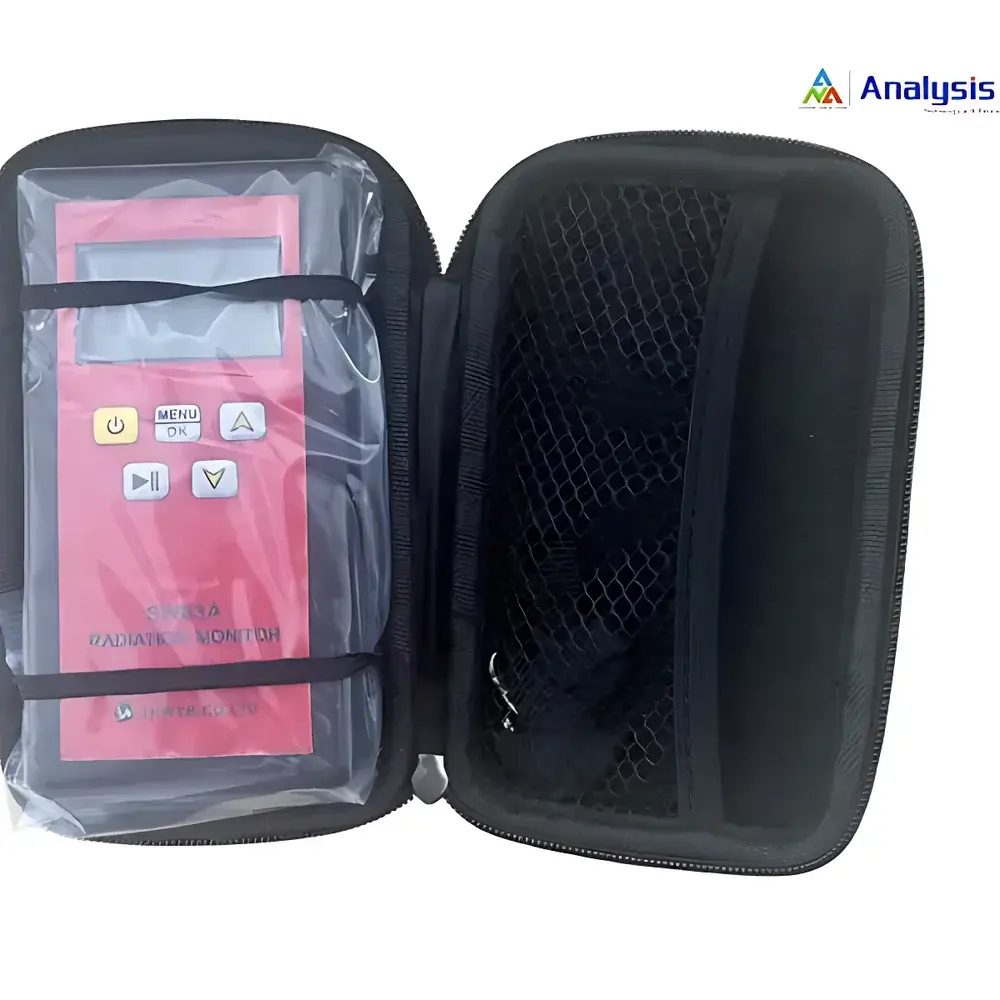
Analysis PM1121 Personal Radiation Dosimeter and Alarm
| Brand | Analysis |
|---|---|
| Model | PM1121 |
| Detector Type | Compensated Geiger-Müller (GM) Tube |
| Measurement Range | 0.01–10,000 µSv/h (dose rate), 0.01 µSv–9999 mSv (cumulative dose) |
| Energy Response | 40 keV–3 MeV |
| Sensitivity | >6000 cps per µSv/h (relative to ¹³⁷Cs) |
| Alarm Response Time | ≤5 s |
| Operating Temperature | −15°C to +50°C |
| Dimensions | 135 × 70 × 25 mm |
| Weight | 0.3 kg |
| Power Supply | Two AA batteries (alkaline or rechargeable) |
| Typical Current Draw | ≤4 mA |
| Display | Dot-matrix LCD with backlight |
| Language Options | English, Chinese, Japanese |
| Compliance | Designed for IEC 61526:2010 (Radiation protection instrumentation — Measurement of personal dose equivalents Hp(10) and Hp(0.07)) and compatible with national occupational radiation safety standards |
Overview
The Analysis PM1121 Personal Radiation Dosimeter and Alarm is a compact, battery-powered, real-time radiation monitoring instrument engineered for continuous personal dose assessment in occupational environments. It employs a compensated Geiger-Müller (GM) tube detector optimized for detection of beta (β⁻) and gamma (γ) radiation across an energy range of 40 keV to 3 MeV. Unlike passive dosimeters (e.g., TLD or OSL badges), the PM1121 delivers active, instantaneous readouts of ambient dose equivalent rate Hp(10) and cumulative Hp(10), enabling immediate hazard recognition and procedural intervention. Its measurement principle relies on ionization-induced pulse counting in the GM tube, with digital signal processing performed by a 16-bit ultra-low-power embedded microcontroller. The device satisfies fundamental requirements for operational radiation protection as defined in IEC 61526:2010 and supports alignment with ALARA (As Low As Reasonably Achievable) implementation frameworks in regulated nuclear, medical, and industrial settings.
Key Features
- High-sensitivity compensated GM tube detector with verified response to β and γ radiation—capable of detecting environmental background levels (≤30 CPM)
- Dual-parameter real-time display: simultaneous dose rate (µSv/h, µR/h, CPS, CPM) and accumulated dose (µSv/mSv) on backlit dot-matrix LCD
- Configurable dual-threshold alarm system: independent user-settable limits for dose rate (0.5–100 µSv/h) and cumulative dose (0.05–100 mSv)
- Ultra-low-power architecture: average current draw ≤4 mA; typical battery life exceeds 1,200 hours on two AA alkaline cells
- Non-volatile memory retention: calendar, clock, and all accumulated dose data preserved during battery replacement
- Tri-lingual interface (English, Chinese, Japanese) supporting international deployment and multilingual workforce integration
- Ruggedized ergonomic housing (135 × 70 × 25 mm, 0.3 kg) with IP54-rated ingress protection against dust and water splashes
- Acoustic intensity feedback: audible click rate proportional to incident radiation flux, providing intuitive situational awareness without visual attention
Sample Compatibility & Compliance
The PM1121 is not a sample-analysis instrument but a personnel-worn radiation safety device intended for direct use on individuals operating in controlled or supervised radiation areas. It does not require sample preparation, calibration sources, or consumables during routine operation. Its performance characteristics—including energy response deviation ≤±25% (referenced to ¹³⁷Cs), relative basic error ≤±10%, and alarm response time ≤5 s at ≥2× threshold—are validated per IEC 61526:2010 Annex B test protocols. While not certified to ISO/IEC 17025 for calibration laboratory use, the instrument is supplied with factory calibration traceable to national primary standards (CNIM, Beijing). It supports compliance with national regulatory frameworks governing occupational exposure limits (e.g., NRC 10 CFR 20, IAEA Safety Standards Series No. GSR Part 3) and integrates into broader radiation protection programs requiring documented individual monitoring records.
Software & Data Management
The PM1121 operates as a standalone field instrument with no proprietary software dependency or wired connectivity. All configuration, alarm setup, and unit selection are performed via tactile keypad navigation. Dose history is retained in non-volatile memory but is not exportable—consistent with its role as an immediate-warning tool rather than a data-logging dosimeter. For organizations requiring audit-ready records, the PM1121 is designed to complement centralized radiation safety management systems (e.g., RadWorker, DOSI, or custom LIMS integrations) where manual entry or barcode-assisted logging of end-of-shift readings is standard practice. The device meets functional prerequisites for GLP-aligned usage: time-stamped cumulative dose values, tamper-resistant memory, and unambiguous unit labeling (µSv/h, mSv) ensure traceability in inspection scenarios.
Applications
- Nuclear power plant operations: monitoring personnel during refueling outages, maintenance in containment zones, or waste handling
- Industrial radiography: real-time oversight during X/γ non-destructive testing (NDT) of welds, castings, or pipelines
- Radiopharmaceutical production and nuclear medicine departments: staff screening near PET cyclotrons, hot labs, or radiotherapy suites
- Decommissioning and remediation sites: dynamic assessment of residual contamination in legacy facilities
- Research laboratories using sealed or unsealed radioactive sources (e.g., ⁹⁰Sr, ¹³⁷Cs, ⁶⁰Co)
- Border security and customs inspection points deploying radiation portal monitors (RPMs)
- Emergency response teams conducting radiological survey operations under variable field conditions
FAQ
What radiation types does the PM1121 detect?
It detects beta (β⁻) and gamma (γ) radiation using a compensated GM tube. It is not sensitive to alpha particles or neutrons.
Is the PM1121 suitable for use in high-humidity environments?
Yes—its IP54-rated enclosure ensures reliable operation at relative humidity up to 90% at 40°C.
Does the device meet international calibration traceability requirements?
Factory calibration is traceable to China National Institute of Metrology (CNIM); users may perform periodic verification using accredited check sources per IEC 62387 procedures.
Can the alarm thresholds be modified in the field?
Yes—users can configure both dose rate and cumulative dose alarms through the onboard menu without external tools or software.
How is battery life affected by continuous alarm activation?
Audible and visual alarms increase current draw marginally (1,000 hours under typical intermittent-use conditions.



