
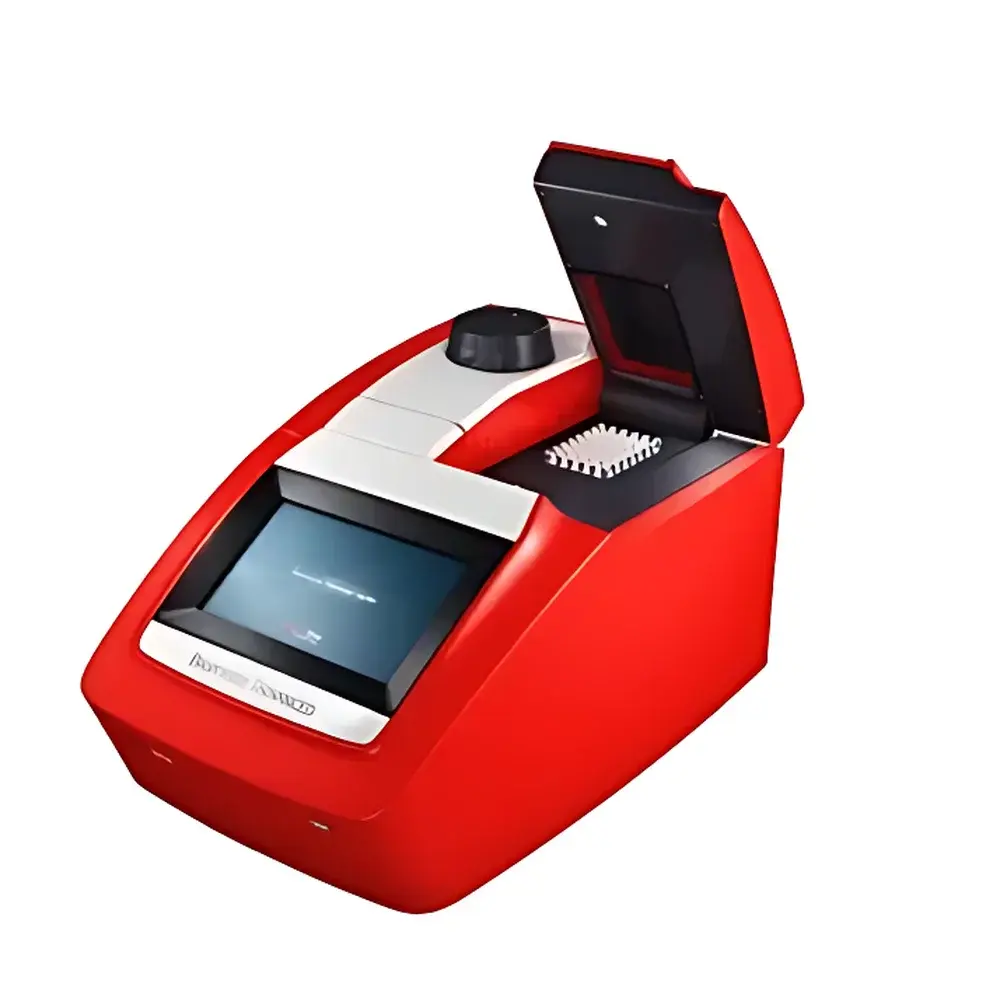
Analytik Jena Biometra TAdvanced Twin Dual-Block PCR Thermocycler
| Brand | Analytik Jena |
|---|---|
| Origin | Germany |
| Model | Biometra TAdvanced Twin |
| Block Configuration | Dual independent 48-well (0.2 mL) blocks or configurable dual-slot modules (e.g., 48×2 standard, 48×2 gradient, 30×2 for 0.5 mL tubes, hybrid 0.2 mL + 0.5 mL) |
| Control | Fully independent thermal control per block |
| Module Recognition | Automatic detection via embedded ID chip |
| Programming Modes | Standard, Gradient, Touchdown, Hot Start, Long PCR |
| Interface | 7-inch full-color capacitive touchscreen (glove-compatible) |
| Safety & Compliance | CE, IEC 61010-1, ISO 13485 (for IVD-relevant configurations), GLP/GMP-ready audit trail support in software |
| Cooling System | Passive base conduction + rear exhaust fan |
| Acoustic Noise Level | <35 dB(A) at 1 m |
Overview
The Analytik Jena Biometra TAdvanced Twin is a high-precision, dual-block thermal cycler engineered for laboratories requiring parallel, independent PCR amplification under rigorously controlled conditions. Unlike conventional single-block instruments, the TAdvanced Twin integrates two physically and thermally isolated reaction blocks—each with fully decoupled Peltier-based heating and cooling systems—enabling simultaneous execution of distinct thermal protocols without cross-interference. Its core architecture adheres to the fundamental principles of polymerase chain reaction kinetics: precise ramp rate control (0.1–5.0 °C/s), uniform block temperature distribution (±0.25 °C across all wells), and minimal thermal overshoot during transition phases. Designed and manufactured in Jena, Germany, the system meets stringent European engineering standards for laboratory instrumentation and supports mission-critical applications in molecular diagnostics, translational research, and quality-controlled nucleic acid testing workflows.
Key Features
- Dual-Independent Block Architecture: Two thermally isolated aluminum blocks operate with separate PID controllers, allowing concurrent runs with different ramp rates, hold times, cycle counts, and endpoint temperatures—effectively delivering the throughput of two instruments in one footprint.
- Intelligent Modular Design: Interchangeable block modules—including 48×2 standard, 48×2 gradient (max ΔT = 24 °C), 30×2 for 0.5 mL tubes, and hybrid 0.2 mL + 0.5 mL configurations—are auto-recognized via integrated RFID chips, ensuring firmware-validated thermal calibration and protocol validation per module type.
- Advanced Thermal Programming: Supports Touchdown PCR (with programmable decrement steps), Hot Start activation profiles, Long PCR optimization (up to 120 min extension), and user-defined gradient slope mapping—enhancing specificity and yield for challenging templates such as GC-rich or repetitive sequences.
- Human-Centric Interface: A 7-inch glove-compatible capacitive touchscreen provides real-time graphical display of thermal profiles, active alarms, and block status. All critical functions—including program editing, file import/export (via USB 2.0), and remote monitoring—can be executed without stylus or mouse input.
- Robust Operational Integrity: Built-in power-fail recovery resumes interrupted runs from the last completed cycle; automatic self-diagnostic routines verify block calibration, sensor integrity, and fan performance at startup; hierarchical user management (admin/operator/guest) enforces role-based access to method editing and instrument settings.
Sample Compatibility & Compliance
The TAdvanced Twin accommodates standard 0.2 mL PCR tubes, 0.5 mL tubes (in dedicated modules), 8-strip tubes, and 96-well plates (with appropriate adapter). All thermal profiles are traceable to NIST-traceable reference standards, and block uniformity is verified per ISO/IEC 17025 requirements for accredited testing laboratories. For regulated environments, the instrument’s firmware and PC-based software (Biometra Thermal Cycler Suite) support 21 CFR Part 11-compliant electronic signatures, audit trails, and secure data archiving—fully aligned with GLP and GMP documentation frameworks. CE marking confirms compliance with Directive 2014/30/EU (EMC) and 2014/35/EU (LVD).
Software & Data Management
The Biometra Thermal Cycler Suite (Windows-based, v5.x) provides full instrument control, protocol library management, and export of raw thermal data (CSV, XML) with timestamps and metadata tags (user ID, block ID, module serial number). Software features include protocol cloning with delta-parameter adjustment, multi-run comparison overlays, and automated report generation compliant with ISO 15189 Annex A. Data integrity safeguards include write-protected method folders, encrypted local storage, and optional integration with LIMS via HL7 or RESTful API endpoints.
Applications
The TAdvanced Twin is routinely deployed in clinical microbiology labs for multiplex pathogen detection (e.g., respiratory virus panels), academic genomics cores for CRISPR guide validation and amplicon sequencing library prep, biopharma QC units performing identity testing of cell line banks, and forensic labs executing STR amplification under ISO 18385-compliant chain-of-custody protocols. Its dual-block capability significantly reduces turnaround time in high-volume screening scenarios—such as prenatal cfDNA enrichment or viral load quantification—where matched control and test reactions must be run under identical thermal history.
FAQ
Does the TAdvanced Twin support gradient PCR on both blocks simultaneously?
Yes—each block can be independently configured for gradient mode, with user-selectable temperature spans and orientation (across rows or columns).
Can I validate the thermal performance of each block separately?
Yes—the included Biometra Validation Kit (traceable to PTB-certified reference sensors) enables per-block calibration verification per ISO/IEC 17025 Clause 6.5.
Is the instrument compatible with third-party consumables?
It accepts all standard 0.2 mL and 0.5 mL thin-wall PCR tubes and strips meeting ANSI/SBS dimensional specifications; however, optimal thermal transfer is guaranteed only with Biometra-qualified consumables.
How is data security maintained during remote operation?
All network communications use TLS 1.2 encryption; local data storage employs AES-256 encryption; and audit logs record every parameter change with user ID, timestamp, and pre/post values.
What maintenance is required beyond routine cleaning?
No scheduled preventive maintenance is mandated; annual verification using the factory calibration certificate and optional service contract (including firmware updates and on-site calibration) is recommended for GLP/GMP environments.




