
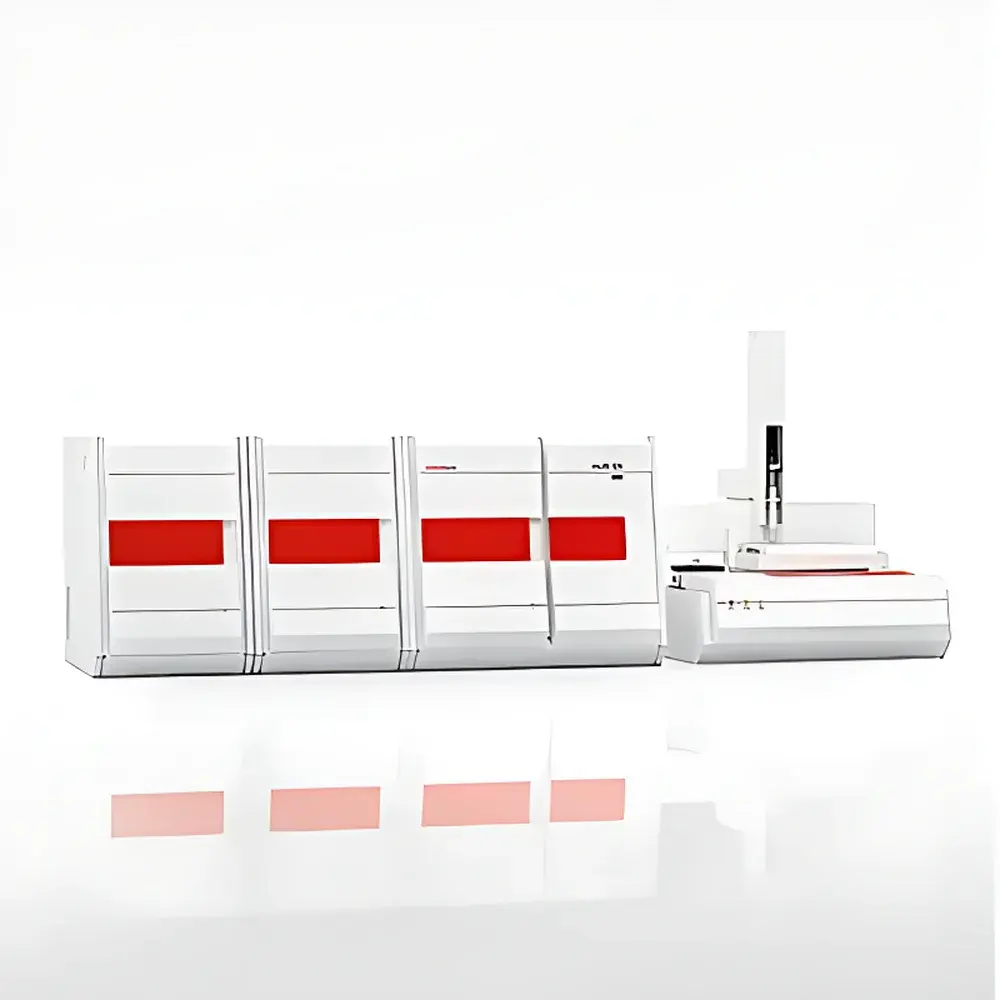
Analytik Jena multi EA® 5000 Multi-Element Analyzer for Total Carbon, Nitrogen, Sulfur, and Chlorine
| Brand | Analytik Jena |
|---|---|
| Origin | Germany |
| Manufacturer | Analytik Jena GmbH & Co. KG |
| Type | Imported Instrument |
| Model | multi EA® 5000 |
| Detection Principles | Chemiluminescence (N), UV Fluorescence or Microcoulometry (S), Microcoulometry (Cl), NDIR (C) |
| Furnace Configuration | Dual-mode vertical/horizontal high-temperature combustion furnace (up to 1100 °C) |
| Sample Forms | Liquid (1–100 µL), Gas (up to 100 mL), LPG (1–50 µL), Solid (up to 100 mg) |
| Detection Range | 0.0x ppm to % level |
| Automatic Mode Recognition | Yes |
| Flame Monitoring Sensor | Integrated real-time combustion state feedback |
| Gas Pressure Tolerance | 0.2–0.6 MPa (O₂), with under/over-pressure alarm |
| Calibration | Single calibration curve applicable across full dynamic range |
| Compliance | Designed for GLP/GMP environments |
Overview
The Analytik Jena multi EA® 5000 is a high-precision, multi-element combustion analyzer engineered for the quantitative determination of total carbon (C), nitrogen (N), sulfur (S), and chlorine (Cl) in diverse sample matrices—including liquids, gases, liquefied petroleum gas (LPG), and solids. Its core analytical principle relies on high-temperature catalytic combustion (up to 1100 °C) followed by selective, element-specific detection: nitrogen is quantified via chemiluminescence detection (CLD), sulfur via ultraviolet fluorescence (UVF) or microcoulometric titration, chlorine exclusively via microcoulometry, and carbon via non-dispersive infrared (NDIR) spectroscopy. The instrument’s defining innovation is its patented dual-mode furnace architecture—operating either as a vertical or horizontal combustion unit within the same platform—enabling method-optimized thermal decomposition without hardware reconfiguration. This eliminates manual combustion tube replacement and enables automatic recognition of furnace orientation, triggering real-time adjustment of gas flow, temperature ramping, and oxygen dosing profiles. Integrated flame monitoring provides closed-loop control of sample introduction rate, preventing flash combustion, carbon deposition, and incomplete oxidation—critical for achieving stoichiometric conversion and minimizing matrix interference.
Key Features
- Dual-mode furnace system (vertical/horizontal) with automatic mode identification and parameter adaptation
- Real-time flame sensor feedback loop for dynamic control of injection speed and combustion stability
- Modular detector configuration: interchangeable CLD (N), UVF/microcoulometric (S), microcoulometric (Cl), and NDIR (C) modules—software-selectable without mechanical intervention
- Universal autosampler supporting liquid, solid, gas, and LPG samples; single hardware platform accommodates all forms with minimal reconfiguration
- Temperature-stabilized gas injection system for LPG and vapor-phase samples, ensuring <±0.5% RSD in volumetric delivery regardless of ambient fluctuations
- Heated membrane dryer and integrated particulate filtration—eliminating moisture-related drift and extending detector lifetime without routine maintenance
- Pressure-regulated gas supply with auto-compensation between 0.2–0.6 MPa O₂ input; out-of-range conditions trigger audible/visual alarms and halt analysis
- Single-point calibration curve valid across the entire measurement range (0.0x ppm to percent-level), reducing standardization workload and inter-batch variability
Sample Compatibility & Compliance
The multi EA® 5000 is validated for use with regulatory-compliant workflows across environmental, petrochemical, pharmaceutical, and materials testing laboratories. It meets fundamental requirements for trace elemental analysis under ISO 14852 (determination of CO₂ evolution in aqueous media), ASTM D5291 (carbon/hydrogen/nitrogen in petroleum products), ASTM D7183 (sulfur in aromatic hydrocarbons), and USP / for elemental impurities in drug substances. Its hardware architecture supports full audit trail generation, electronic signature enforcement, and data integrity controls aligned with FDA 21 CFR Part 11 when deployed with compliant laboratory information management systems (LIMS). All pneumatic and thermal subsystems undergo factory-certified leak testing, and the sealed optical path of UVF and NDIR detectors ensures long-term photometric stability under continuous operation.
Software & Data Management
Control and data acquisition are managed through the EA Control Software v4.x—a Windows-based application designed for multi-user network deployment. The interface provides intuitive method building with stepwise furnace profile definition, detector selection, gas flow sequencing, and calibration curve management. Raw signal integration, baseline correction, and peak deconvolution algorithms are embedded for each detector type. All analytical events—including instrument status, calibration history, user logins, parameter changes, and result exports—are timestamped and stored in an encrypted SQLite database. Export formats include CSV, PDF analytical reports, and XML for LIMS integration. Optional software modules enable automated report generation compliant with ISO/IEC 17025 documentation standards and support for electronic signatures meeting ALCOA+ principles (Attributable, Legible, Contemporaneous, Original, Accurate).
Applications
This analyzer serves critical quality control and research functions in multiple sectors: in petroleum refining, it quantifies total sulfur and chlorine in fuels per EN 20846 and ASTM D4294; in polymer manufacturing, it verifies catalyst residue (e.g., Ti, Cl) and nitrogen-based stabilizers; in environmental labs, it measures TOC and TN in wastewater digester sludge and soil extracts; in pharmaceutical development, it supports ICH Q3D-compliant elemental impurity screening of excipients and active ingredients. Its ability to handle volatile LPG samples without cryogenic trapping—coupled with sub-ppm detection limits for Cl and S—makes it uniquely suited for LNG quality assurance and semiconductor-grade solvent certification.
FAQ
Can the same autosampler handle both liquid and solid samples without hardware modification?
Yes—the universal autosampler uses a programmable syringe drive and heated sample probe compatible with liquid injection and solid pellet insertion via optional crucible adapter.
Is method validation support available for regulatory submissions?
Analytik Jena provides IQ/OQ documentation templates, system suitability test protocols, and detector linearity verification procedures aligned with USP and EP guidelines.
How does the dual-furnace design improve accuracy for heterogeneous solids?
Vertical mode enhances ash-free combustion of refractory organics via gravity-assisted sample drop and uniform oxygen access; horizontal mode improves thermal homogeneity for viscous oils and polymers.
What maintenance intervals are recommended for the microcoulometric cells?
Under normal operation (≤100 injections/day), electrolyte replenishment is required every 6 months; cell electrodes are platinum-coated and require no polishing or replacement for ≥2 years.
Does the system support unattended overnight operation?
Yes—full sequence scheduling, automatic standby-to-run transition, and error-recovery protocols allow 24/7 batch processing with email/SNMP alerts upon completion or fault condition.





