
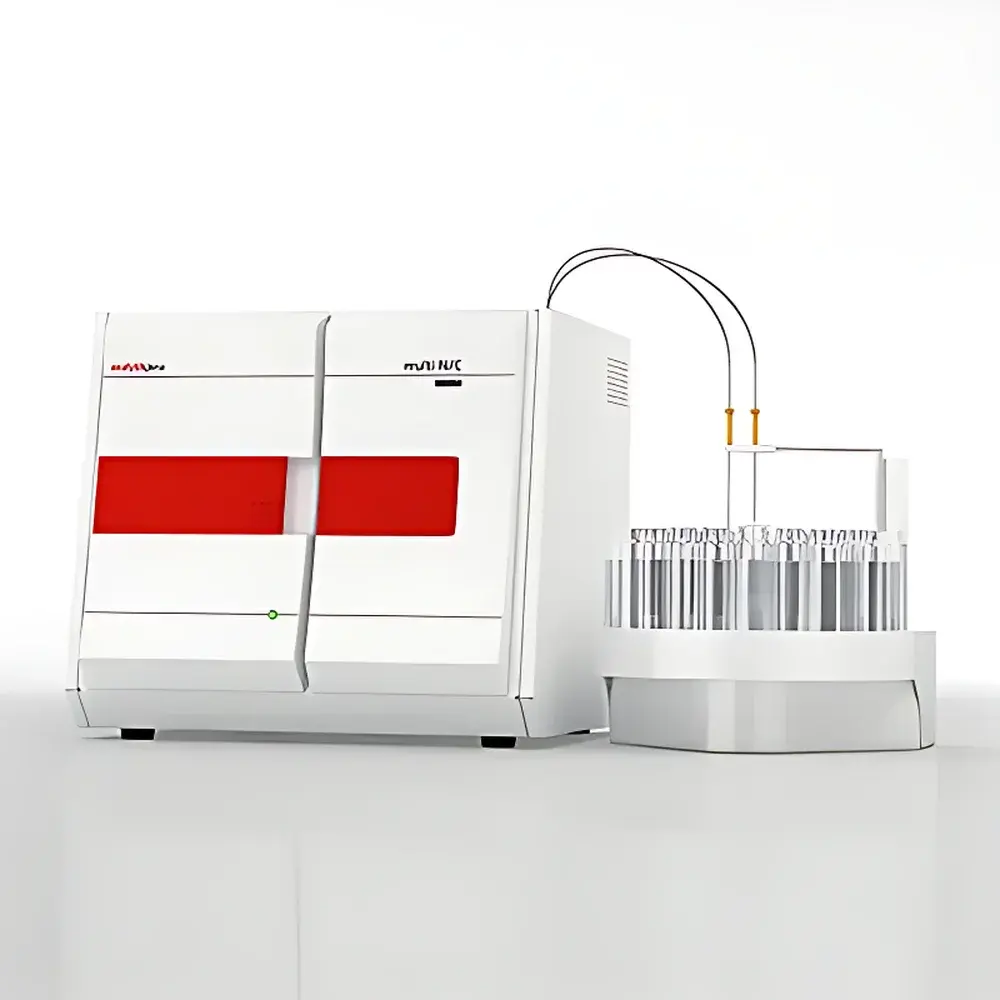
analytik jena multi N/C UV HS Total Organic Carbon and Total Nitrogen Analyzer
| Brand | analytik jena |
|---|---|
| Origin | Germany |
| Manufacturer | analytik jena GmbH & Co. KG |
| Product Type | Laboratory TOC/TN Analyzer |
| Detection Principle | Non-Dispersive Infrared (NDIR) Absorption |
| Oxidation Method | UV/Persulfate Wet Oxidation |
| Measurement Range | 0–10,000 ppm C or N |
| Accuracy | ±2% of reading |
| Resolution | 0.001 ppb C |
| Detection Limit | 0.03 ppb – 10,000 ppm C |
| Repeatability | <1% RSD |
| Compliance | ASTM D5905, ISO 8245, USP <643>, EP 2.2.44, DIN 38409-H41 |
| Software | TOC-Control v4.x with 21 CFR Part 11 compliance options |
Overview
The analytik jena multi N/C UV HS is a high-performance laboratory total organic carbon (TOC) and total nitrogen (TN) analyzer engineered for precision, regulatory compliance, and operational robustness in environmental, pharmaceutical, and industrial water quality laboratories. It employs a dual-channel, wet-chemical oxidation architecture combining high-intensity dual-wavelength ultraviolet (UV) irradiation with persulfate catalysis to achieve complete mineralization of refractory organic compounds and nitrogenous species—including proteins, humic substances, and nitrate/nitrite—into CO₂ and N₂/NH₄⁺. Quantification is performed via highly stable, temperature-compensated non-dispersive infrared (NDIR) detection, eliminating spectral interference and enabling direct measurement across the full 0–10,000 ppm dynamic range without manual dilution. The system’s core optical path utilizes patented high-focusing NDIR optics, delivering exceptional signal-to-noise ratio and long-term baseline stability critical for low-level trace analysis and method validation.
Key Features
- Patented VITA Flow Control Technology: A proprietary real-time flow-signal synchronization algorithm that dynamically adjusts carrier gas flow and detector integration time to compensate for sample matrix viscosity, bubble formation, and oxidation kinetics—ensuring consistent peak shape and quantitative fidelity across heterogeneous aqueous matrices (e.g., wastewater, seawater, pharmaceutical process water).
- Easy Cal Single-Point Calibration: Eliminates multi-point calibration drift through an embedded reference standard protocol; one certified potassium hydrogen phthalate (KHP) or ammonium sulfate solution validates both TOC and TN channels simultaneously, with automatic slope/intercept retention and audit-trail logging compliant with GLP/GMP requirements.
- Dual-Wavelength UV Digestion Module: Two independently controlled 185 nm / 254 nm UV lamps operate in parallel within a quartz reaction coil, enabling synergistic photolysis and radical generation (•OH, SO₄•⁻) for >98% oxidation efficiency on recalcitrant compounds such as pyridine, benzene, and glycine—validated per ISO 8245 Annex B.
- Integrated SCS Safety Self-Check System: Continuously monitors UV lamp status, reagent levels, pressure differentials, temperature gradients, and NDIR cell integrity; halts analysis and triggers alarm if any parameter exceeds IEC 61010-1 safety thresholds—fully documented in the instrument’s electronic logbook.
- Automated System Conditioning & Cleaning: Post-run acid rinse, base neutralization, and high-purity air purge cycles prevent carryover and carbon memory effects; programmable cleaning frequency supports unattended overnight operation for high-throughput labs.
Sample Compatibility & Compliance
The multi N/C UV HS accepts liquid samples ranging from ultrapure water (UPW) to raw wastewater, saline matrices (up to 3.5% NaCl), and aggressive industrial effluents. Integrated filtration and optional inline particulate removal ensure protection against clogging in the UV reactor and NDIR cell. All analytical protocols adhere to internationally recognized standards: ASTM D5905 (TOC in water), ISO 8245 (determination of TOC in aqueous media), USP (pharmaceutical water testing), European Pharmacopoeia 2.2.44, and DIN 38409-H41. Data integrity is maintained through optional 21 CFR Part 11-compliant software modules featuring electronic signatures, role-based access control, and immutable audit trails.
Software & Data Management
TOC-Control v4.x provides intuitive method setup, real-time chromatogram visualization, and automated calculation of TC, TOC, NPOC, TIC, POC, and TN—each reported with uncertainty propagation based on calibration curve statistics and instrument noise metrics. Raw data files (.raw) are stored in vendor-neutral HDF5 format, supporting third-party integration via OPC UA or CSV export. Audit logs record every user action, parameter change, and calibration event with timestamp, operator ID, and reason-for-change fields—fully traceable during FDA or EMA inspections.
Applications
This analyzer serves critical roles in drinking water treatment plant compliance monitoring, semiconductor UPW certification (SEMI F63), biopharmaceutical clean-in-place (CIP) validation, environmental remediation site assessment, and academic research on carbon/nitrogen biogeochemical cycling. Its ability to resolve sub-ppb TOC in high-purity water while simultaneously quantifying TN in nutrient-rich wastewater makes it uniquely suited for integrated nutrient management studies and regulatory reporting under EPA Clean Water Act Section 304(h).
FAQ
Does the multi N/C UV HS require daily recalibration?
No—Easy Cal enables stable calibration over 72 hours under routine use; weekly verification with a mid-range standard is recommended per ISO/IEC 17025.
Can it measure TOC and TN in the same injection cycle?
Yes—dual-channel NDIR detection with synchronized oxidation allows simultaneous quantification without hardware switching or method reconfiguration.
Is the system compatible with existing LIMS platforms?
Yes—via configurable ODBC drivers and HL7-compliant data export; validated interfaces include Thermo Fisher SampleManager, LabVantage, and STARLIMS.
What maintenance intervals are required for the UV lamps and NDIR cell?
UV lamps are rated for 12,000 hours; NDIR cell requires no consumables and is validated annually using certified span gases (CO₂ in N₂).
How does the system handle chloride interference in saline samples?
The persulfate/UV oxidation pathway minimizes chloride-derived CO₂ artifacts; optional chloride scrubber module available for samples >1000 mg/L Cl⁻.
Related Products







