
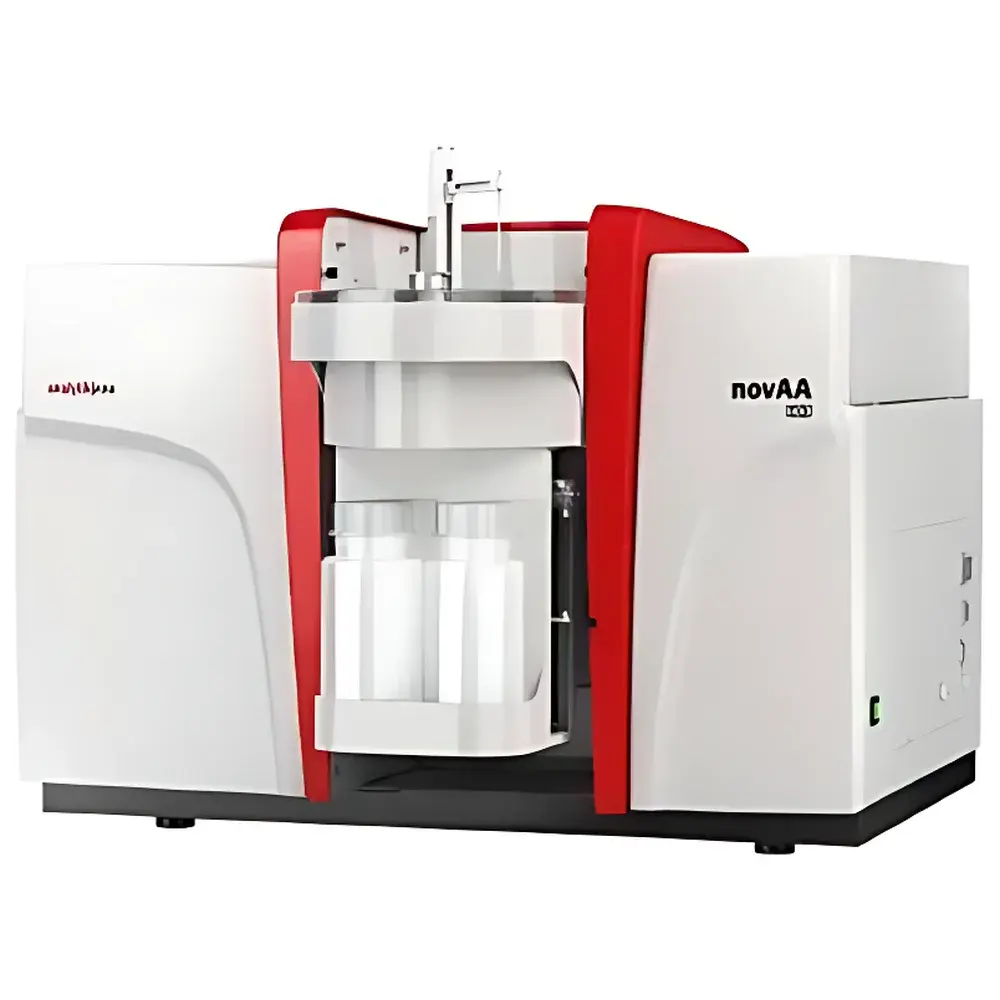
Analytik Jena novAA 800 Atomic Absorption Spectrometer
| Brand | Analytik Jena |
|---|---|
| Origin | Germany |
| Manufacturer Type | Original Equipment Manufacturer (OEM) |
| Instrument Type | Flame and Graphite Furnace AAS |
| Monochromator | Plane Grating |
| Optical System | Dual-Beam with Automatic Switching to Single-Beam |
| Detector | CCD Array (185–900 nm) |
| Background Correction | Automatic Deuterium/Halogen Lamp or Zeeman (software-selectable) |
| Spectral Resolution | ≤ 0.1 nm |
| Sensitivity | ≥ 0.9 A for 5 mg/L Cu solution (279.5 nm, air-acetylene flame) |
| Precision (RSD) | < 0.5% (n = 10, typical aqueous standards) |
| Detection Limit (Flame Mode) | < 0.005 mg/L Cu |
| Detection Limit (Graphite Furnace Mode) | Sub-pg range for Cd/Pb (e.g., < 3 pg for Cd) |
| Baseline Stability | < 0.002 A/h (typical, 24 h drift monitoring) |
Overview
The Analytik Jena novAA 800 is a high-performance, dual-mode atomic absorption spectrometer engineered for precision elemental quantification in environmental, clinical, pharmaceutical, food safety, and industrial quality control laboratories. It operates on the fundamental principle of atomic absorption spectroscopy—measuring the attenuation of characteristic hollow cathode lamp (HCL) radiation as ground-state atoms in a flame or graphite furnace absorb photons at element-specific wavelengths. The instrument integrates Zeiss-designed optical architecture with advanced thermal and electronic control systems to deliver exceptional sensitivity, long-term stability, and analytical robustness across both flame and electrothermal atomization modes.
Key Features
- Zeiss optical system featuring aspheric reflective optics, minimizing aberrations and maximizing image fidelity across the UV–NIR spectrum (185–900 nm)
- Optimized light path with minimal optical elements and quartz-coated components housed in a sealed, optionally purged optical chamber—ensuring immunity to ambient humidity, dust, and temperature fluctuations
- Automatically switchable single/dual-beam optical configuration: single-beam mode maximizes photon throughput and signal-to-noise ratio; dual-beam mode compensates for source intensity drift and lamp aging, ensuring baseline stability during extended analyses
- Transversely heated graphite furnace (THGA) with integrated L’vov platform and real-time temperature feedback—enabling uniform axial heating, suppression of matrix interferences, elimination of memory effects, and extended graphite tube lifetime (up to 500+ firings under optimized conditions)
- Rapid thermal ramping capability: up to 3000 °C/s heating rate with programmable multi-step temperature profiles (drying, pyrolysis, atomization, cleaning)
- Intelligent AS-85 automatic sampler with adaptive functions: auto-dilution upon signal saturation, on-board residue removal via high-temperature ashing cycles, and online pre-concentration for sub-pptr detection
Sample Compatibility & Compliance
The novAA 800 supports aqueous, organic, and digested solid samples (e.g., soils, tissues, polymers) across a wide concentration range—from mg/L (flame AAS) to low-pg absolute mass levels (graphite furnace AAS). Its design conforms to international standard methodologies including ASTM D1688 (copper in water), ISO 11171 (metal impurities in fuels), USP (heavy metals in pharmaceuticals), and EN 14802 (trace metals in foodstuffs). All operational parameters—including lamp current, slit width, gas flow rates, and furnace temperature programs—are logged with time stamps and user IDs, supporting GLP/GMP compliance and FDA 21 CFR Part 11–ready audit trails when deployed with validated software configurations.
Software & Data Management
The instrument is controlled by the jAAS software suite—a modular, Windows-based platform offering method development wizards, automated parameter optimization (e.g., lamp alignment, burner head positioning, furnace ramp profiling), and unattended batch analysis with intelligent error recovery. Built-in spectral library includes >70 element-specific methods with recommended HCL currents, wavelength settings, and matrix modifiers. Real-time spectral visualization, peak integration with multiple background correction algorithms (D₂, Zeeman, or hybrid), and customizable report templates facilitate rapid data interpretation and regulatory submission. Data export complies with ASTM E1382 and ISO/IEC 17025 traceability requirements.
Applications
- Environmental monitoring: quantification of Pb, Cd, As, Cr, Ni, and Zn in drinking water, wastewater, and leachates per EPA Method 7000B and ISO 17294-2
- Clinical toxicology: trace-level Cu, Fe, Zn, and Mn in serum and whole blood using graphite furnace protocols
- Pharmaceutical QC: residual catalyst metals (Pd, Pt, Rh) in active pharmaceutical ingredients (APIs) per ICH Q2(R2) validation guidelines
- Food and beverage testing: Na, K, Ca, Mg in dairy products; Al in acidic beverages; and heavy metal contaminants in infant formula per EU Commission Regulation (EC) No 1881/2006
- Geological and metallurgical analysis: base and precious metals in ores, slags, and alloys following ISO 11885 digestion protocols
FAQ
Does the novAA 800 support both flame and graphite furnace analysis in a single instrument configuration?
Yes—the novAA 800 is a fully integrated flame/graphite furnace AAS platform with automatic hardware recognition and mode-switching logic embedded in the jAAS software.
What background correction technologies are available?
The system offers selectable deuterium arc lamp (D₂) and longitudinal Zeeman-effect background correction, both implemented in real time with no mechanical movement or optical reconfiguration required.
Is the optical system purge-compatible?
Yes—optional nitrogen or argon purge lines can be connected to the sealed optical housing to eliminate ozone formation and enhance UV transmission below 200 nm.
Can the AS-85 autosampler perform online standard additions?
Yes—jAAS supports programmable standard addition sequences with variable injection volumes and integrated calibration curve recalculation.
How is instrument performance verified during routine operation?
Built-in performance checks include wavelength accuracy verification (using Hg/Ne emission lines), photometric linearity assessment (neutral density filters), and long-term stability monitoring (baseline drift over 24 h), all documented in the system log file.





