
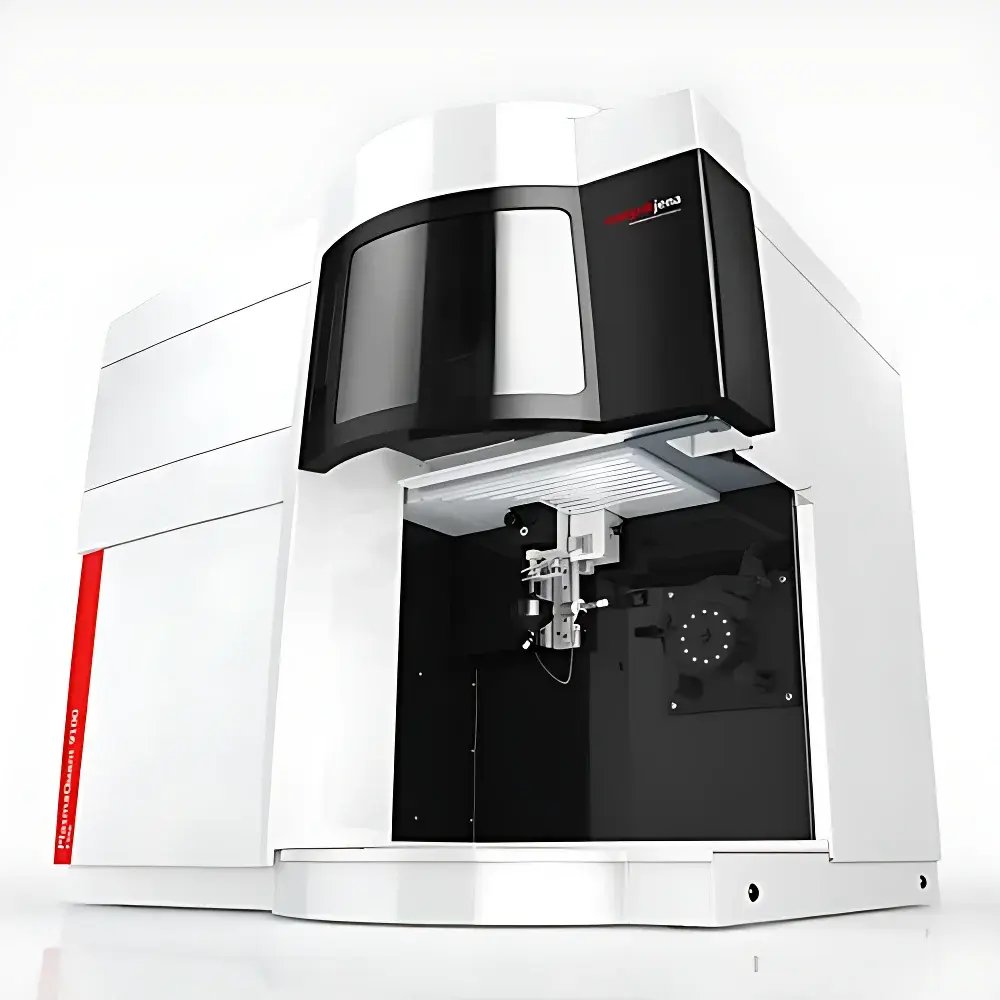
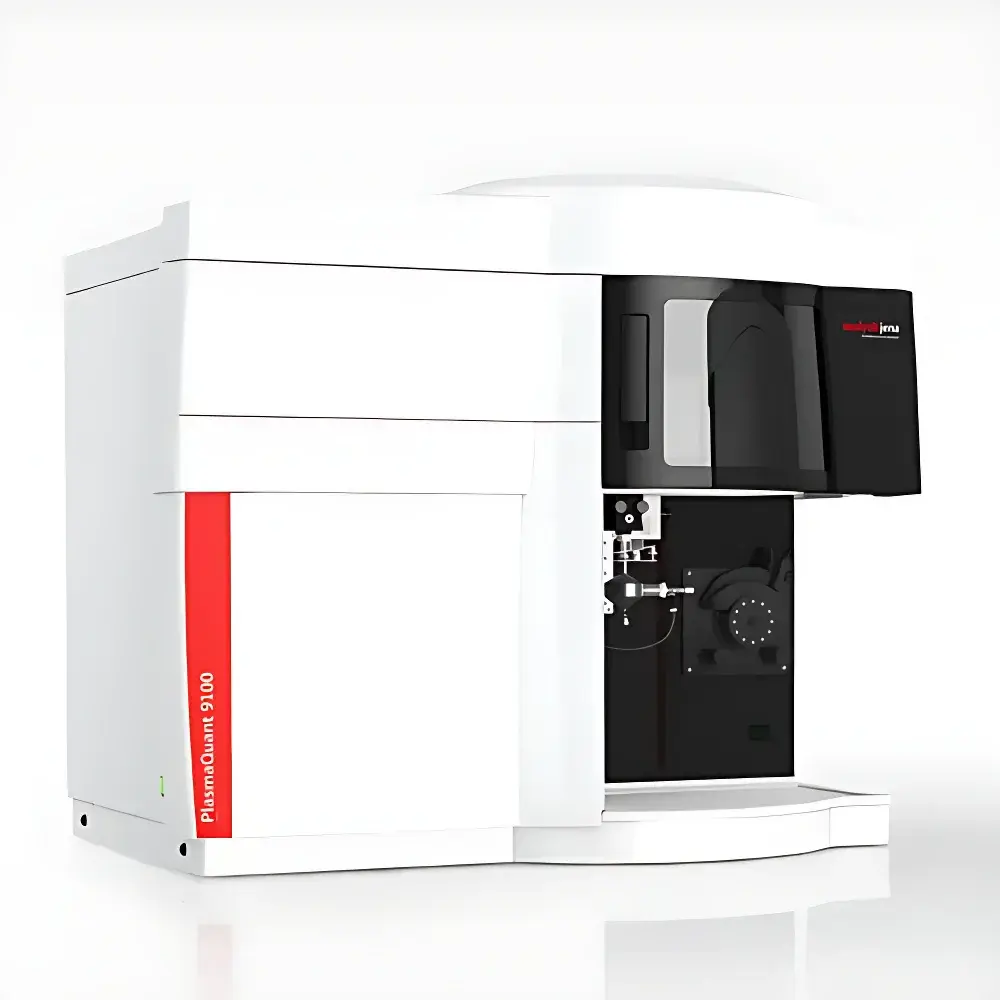
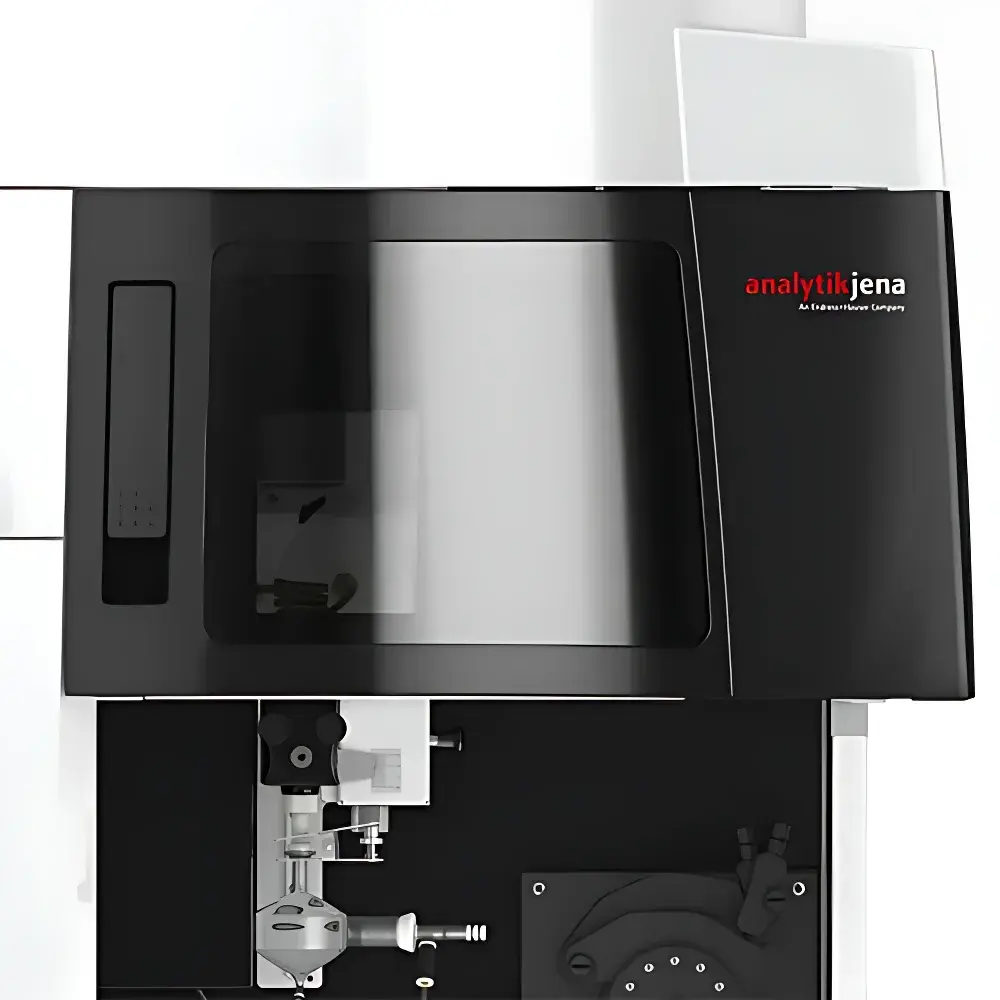
Analytik Jena PlasmaQuant 9100 High-Resolution Inductively Coupled Plasma Optical Emission Spectrometer
| Brand | Analytik Jena |
|---|---|
| Origin | Germany |
| Manufacturer | Analytik Jena AG |
| Type | Full-Spectrum Simultaneous ICP-OES |
| Detection Limit (Zn at 213.856 nm) | 0.06 ppb |
| Precision (RSD) | ≤0.5% |
| Long-Term Stability (RSD, 4h) | ≤1.5% |
| Wavelength Range | 160–900 nm |
| Optical Resolution | 0.003 nm (at 200 nm) |
Overview
The Analytik Jena PlasmaQuant 9100 is a high-resolution, full-spectrum simultaneous inductively coupled plasma optical emission spectrometer (ICP-OES) engineered for trace elemental analysis with uncompromising spectral fidelity and operational robustness. It operates on the fundamental principle of atomization and excitation of analytes in a high-temperature argon plasma (~6,000–10,000 K), followed by detection of element-specific atomic emission lines across the ultraviolet–visible–near-infrared spectrum (160–900 nm). Its defining capability—0.003 nm optical resolution at 200 nm—is achieved through a monolithic, aberration-corrected optical bench incorporating a proprietary Carl Zeiss echelle spectrometer with cross-dispersion and thermally stabilized vacuum optics. This resolution enables superior spectral deconvolution, significantly improving signal-to-background ratio (S/B) and background-equivalent concentration (BEC), particularly critical for complex matrices where adjacent emission lines (e.g., As 193.696 nm / Al 193.696 nm; V 292.402 nm / Fe 292.402 nm) would otherwise co-emit and bias quantification.
Key Features
- Ultra-High-Resolution Optics: Carl Zeiss echelle optical system with vacuum-sealed path and thermal stabilization ensures continuous spectral coverage from 160 nm to 900 nm and wavelength accuracy better than ±0.0004 nm—essential for long-term calibration stability and inter-laboratory comparability.
- Next-Generation Back-Illuminated CCD Detector: Features >95% quantum efficiency in UV, pixel resolution <0.002 nm, and ≥6 orders of magnitude linear dynamic range. Enables simultaneous acquisition of analyte peaks and their immediate spectral environment for real-time background correction and interference identification.
- Vertical Torch with Dual-View Observation: Patented vertical torch orientation eliminates salt deposition, carbon buildup, and condensate formation common in horizontal configurations—enhancing reliability for high-salt (e.g., seawater, brines) and organic solvents (e.g., kerosene, diesel). Dual-view (axial + radial) observation is implemented via a single, motorized optical path—no mechanical repositioning required—allowing concurrent measurement under axial (high sensitivity), radial (high matrix tolerance), axial-plus (enhanced UV transmission), and radial-plus (optimized for volatile elements) modes within one sequence.
- High-Stability RF Generator: Self-oscillating 40.68 MHz solid-state RF source with four-turn load coil delivers up to 1700 W forward power and short-term stability <0.1% RSD. Integrated mass-flow-controlled gas delivery ensures reproducible plasma ignition and sustained thermal equilibrium.
- Integrated Cold Cone & Argon Purge Architecture: Axial view utilizes a water-cooled cold cone with counter-flow argon to suppress tail-flame emission and reduce continuum background. Continuous argon purging of the optical chamber and detector housing eliminates O2 and H2O absorption below 190 nm—enabling reliable detection of key elements including P, S, and Cl.
Sample Compatibility & Compliance
The PlasmaQuant 9100 accommodates aqueous solutions, digested environmental solids (EPA Method 200.7/6020B), petroleum distillates (ASTM D5185), biological tissues (USP /), and high-dissolved-solid matrices (up to 25% w/v TDS) without dilution or offline fractionation. Its dual-view capability satisfies ISO 17294-2:2016 requirements for multi-concentration range validation and supports GLP/GMP workflows through audit-trail-enabled software. The system meets electromagnetic compatibility (EMC) per EN 61326-1 and safety standards per EN 61010-1, and its hardware design aligns with FDA 21 CFR Part 11 readiness for electronic records and signatures when deployed with validated software configuration.
Software & Data Management
PlasmaQuant Software v4.x provides fully integrated instrument control, method development, and quantitative reporting. It includes intelligent spectral line selection algorithms, automated background correction models (multi-point polynomial and interpolated), and interference correction libraries compliant with ASTM D1976 and ISO 11885. All data—including raw spectra, integration parameters, calibration history, and QC metrics—are stored in an encrypted, timestamped database with full user-access logging. Export formats include CSV, PDF analytical reports, and XML for LIMS integration. Software validation packages (IQ/OQ/PQ documentation) and 21 CFR Part 11 add-ons are available for regulated environments.
Applications
The PlasmaQuant 9100 is deployed across laboratories requiring regulatory-grade multi-element analysis: environmental monitoring (EPA 200.7, ISO 17294), metallurgical process control (ASTM E1479), pharmaceutical elemental impurities testing (ICH Q3D), food safety screening (EU 2023/1374), clinical toxicology (blood/urine metals), and geological exploration (ISO 13877). Its ability to resolve overlapping lines (e.g., Ba II 455.403 nm / Ca II 455.403 nm) and quantify ultra-trace Zn (0.06 ppb) makes it especially suited for semiconductor-grade water analysis, nuclear fuel cycle monitoring, and high-purity chemical certification.
FAQ
What is the minimum pre-warm time required before analysis?
The system achieves thermal and plasma stability within five minutes after ignition—enabling true “start-and-measure” operation without extended standby periods.
Does the PQ 9100 support automated background correction during acquisition?
Yes—background positions are dynamically selected and interpolated in real time using adjacent pixel data; users may define fixed or adaptive background windows per element.
Can the instrument analyze samples with high total dissolved solids (TDS)?
Yes—vertical torch geometry and optimized nebulizer gas flow allow direct analysis of samples containing up to 25% w/v TDS without clogging or signal drift.
Is vacuum pumping required for UV spectral access?
No—the optical chamber is continuously purged with high-purity argon, eliminating the need for mechanical vacuum pumps while maintaining transmission down to 160 nm.
How is compliance with ISO/IEC 17025 ensured during routine operation?
Built-in performance verification checks (e.g., wavelength calibration with Hg/Ar lamp, sensitivity monitoring via Mg II 280.270 nm), combined with documented preventive maintenance logs and traceable reference material protocols, support ongoing accreditation requirements.






