
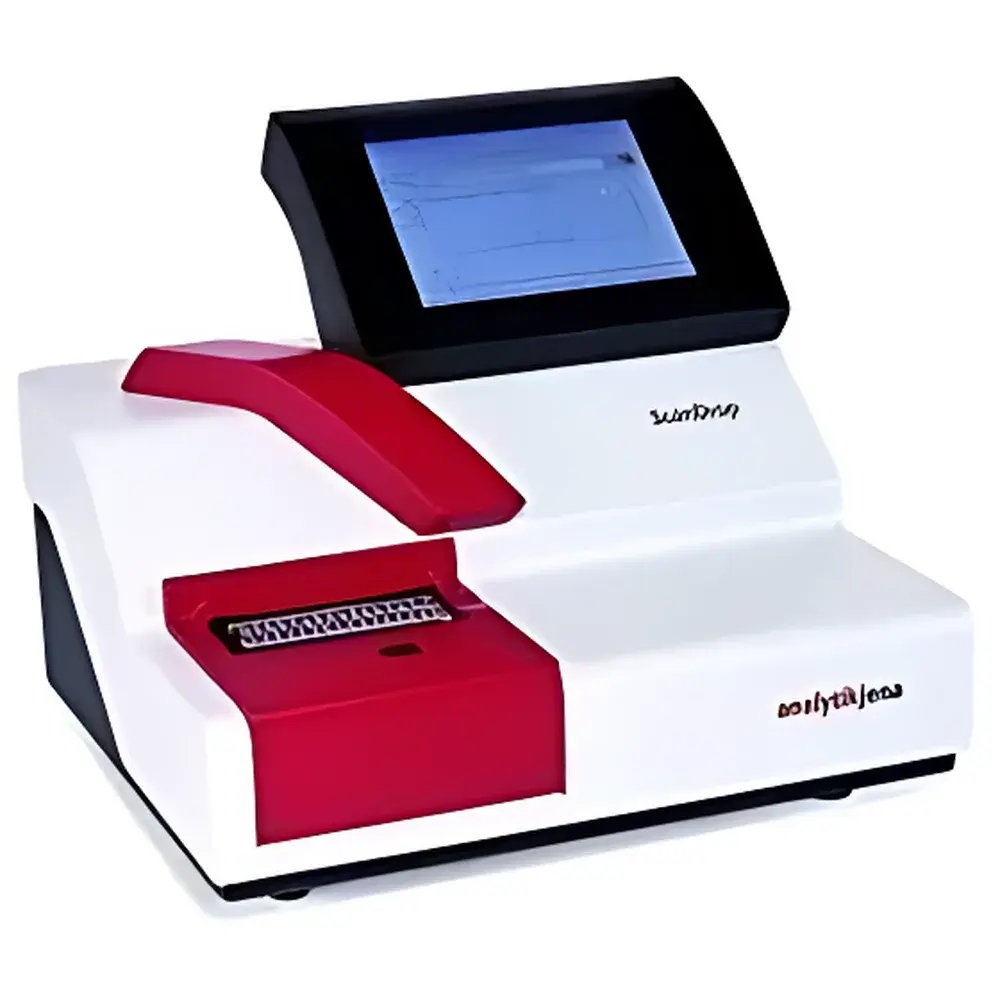
Analytik Jena ScanDrop 250 Microvolume UV/VIS Spectrophotometer for Nucleic Acid and Protein Quantification
| Brand | Analytik Jena |
|---|---|
| Origin | Germany |
| Model | ScanDrop 250 |
| Wavelength Range | 190–720 nm (0.5 nm step) |
| Wavelength Accuracy | ±1 nm |
| Wavelength Repeatability | ±0.05 nm |
| Absorbance Range | −3 to +3 A |
| Absorbance Linearity | 0.2–200 A (equivalent to 10 mm pathlength, measured via CHIPCUVETTE at 350 mm) |
| Absorbance Accuracy | ±0.04 A (UV), ±0.02 A (VIS) |
| Stray Light | ≤0.5% T |
| Absorbance Drift | ≤0.003 A/h at 500 nm |
| Full Spectrum Acquisition Time | 1 s |
| Sample Volume (CHIPCUVETTE) | 0.3–4 µL |
| Pathlength Options (CHIPCUVETTE) | 0.1 mm or 1.0 mm |
| Cuvette Compatibility | Standard 10 mm pathlength cuvettes (1.7–2.0 mL) |
| Detector | Diode Array |
| Light Source | Xenon Flash Lamp |
| Optical System | Monochromator-based with DAD |
| Dimensions | 24 × 17 × 20 cm (D×W×H) |
| Weight | ~5 kg |
| Interface | USB, RS-232 |
| Optional Controller | HID-Pro 320 (5.7″ color touchscreen, Windows CE, 1 GB SD card) |
Overview
The Analytik Jena ScanDrop 250 is a high-performance microvolume UV/VIS spectrophotometer engineered for precise, rapid quantification and quality assessment of nucleic acids, proteins, and other biomolecules in life science laboratories. It integrates dual-sample-path architecture—supporting both conventional 10 mm pathlength cuvettes and proprietary CHIPCUVETTE microfluidic chips—within a single compact platform. Its optical core employs a high-stability xenon flash lamp coupled with a diode array detector (DAD) and a precision monochromator system, enabling full-spectrum acquisition from 190 nm to 720 nm in just 1 second. This architecture ensures exceptional wavelength fidelity (±1 nm accuracy), low photometric drift (<0.003 A/h), and robust linearity across an extended absorbance range (0.2–200 A, normalized to 10 mm). Designed for routine QC in molecular biology, biopharma upstream/downstream processing, and academic core facilities, the ScanDrop 250 delivers traceable, reproducible measurements compliant with fundamental principles outlined in ISO 8576 (spectrophotometer performance verification) and aligned with laboratory practices supporting GLP and GMP environments.
Key Features
- Dual-mode sample handling: Simultaneous support for standard quartz/glass cuvettes (1.7–2.0 mL, 10 mm pathlength) and microfluidic CHIPCUVETTE chips (0.3–4 µL, switchable 0.1 mm or 1.0 mm pathlength)
- High-speed spectral acquisition: Full 190–720 nm scan completed in ≤1 second—enabling throughput of up to 60 spectra per minute without thermal or mechanical compromise
- Patented CHIPCUVETTE technology: Sealed microchannel design prevents evaporation, eliminates cross-contamination, and allows post-measurement sample recovery or storage
- Automatic 16-sample sequential analysis: CHIPCUVETTE accommodates 16 independent samples (32 measurement positions) with motorized stage positioning and software-driven auto-alignment
- Flexible operation modes: Standalone control via optional HID-Pro 320 touchscreen controller (Windows CE, 5.7″ LCD, integrated SD storage) or PC-based operation via USB/RS-232 with full instrument control and data export
- Enhanced photometric integrity: Xenon flash source provides stable intensity over >10⁹ flashes; diode array detection ensures simultaneous multi-wavelength capture without moving parts
Sample Compatibility & Compliance
The ScanDrop 250 accommodates diverse sample formats without dilution or transfer artifacts. For high-concentration DNA/RNA (>100 ng/µL) or purified antibodies (>5 mg/mL), the 0.1 mm CHIPCUVETTE pathlength avoids saturation while preserving signal-to-noise ratio. For dilute lysates or column eluates, the 1.0 mm configuration maximizes sensitivity. Optional Traywell microcuvettes (0.7–5 µL, 0.2 mm or 1 mm pathlength) extend compatibility to viscous or particulate-containing samples. All measurements adhere to foundational UV/VIS metrology standards—including ASTM E275 (describing spectrophotometric terminology) and USP <857> (UV/VIS spectroscopy)—and support audit-ready workflows when paired with validated software versions compliant with FDA 21 CFR Part 11 requirements for electronic records and signatures.
Software & Data Management
Instrument control and data analysis are managed through ScanDrop Control Software (v3.x), a Windows-based application offering real-time spectrum visualization, baseline correction, peak integration, and automated calculation of concentration (via user-defined extinction coefficients), purity ratios (A260/A280, A260/A230), and melting profiles. Raw spectral data (ASCII or .csv) and processed reports are exportable with embedded metadata (date/time, operator ID, instrument serial number, method parameters). When used with the HID-Pro 320 controller, all operations—including method recall, calibration logging, and result archiving—are stored locally on the 1 GB SD card with timestamped entries. The software supports IQ/OQ documentation templates and includes built-in diagnostics for lamp energy output, wavelength calibration verification, and dark current monitoring—facilitating routine maintenance and regulatory readiness.
Applications
- Quantitative analysis of dsDNA, ssDNA, RNA, and oligonucleotides using A260-based calculations
- Protein concentration determination via A280 (Trp/Tyr), A205 (peptide bond), or dye-binding assays (e.g., Bradford, BCA)
- Assessment of nucleic acid purity (A260/A280 ≥1.8 for RNA; ≥1.9 for DNA) and contaminant detection (A230 for guanidine, phenol, or carbohydrates)
- Routine QC of PCR/qPCR master mixes, CRISPR reagents, and sequencing libraries
- Monitoring protein denaturation or ligand binding via temperature- or time-resolved spectral shifts (when integrated with external thermal modules)
- Supporting bioprocess development: rapid titer checks of cell culture supernatants, purification fractions, and formulated drug products
FAQ
Does the ScanDrop 250 require warm-up time before use?
No. The xenon flash lamp operates instantaneously with no stabilization delay, enabling immediate measurement after power-on.
Can CHIPCUVETTE chips be reused?
CHIPCUVETTE is designed for single-use to ensure contamination-free analysis and consistent optical performance; reuse is not recommended or validated.
Is the instrument compatible with third-party LIMS systems?
Yes—via configurable ASCII or XML data export, and through ODBC-compliant database connectors when using the PC software version.
What validation documentation is available for GxP environments?
Analytik Jena provides IQ/OQ protocol templates, factory calibration certificates (traceable to NIST standards), and software validation packages upon request.
How is pathlength selection handled during measurement?
Pathlength (0.1 mm or 1.0 mm) is manually selected prior to CHIPCUVETTE loading; the software applies the corresponding correction factor automatically during concentration calculation.
Related Products



