
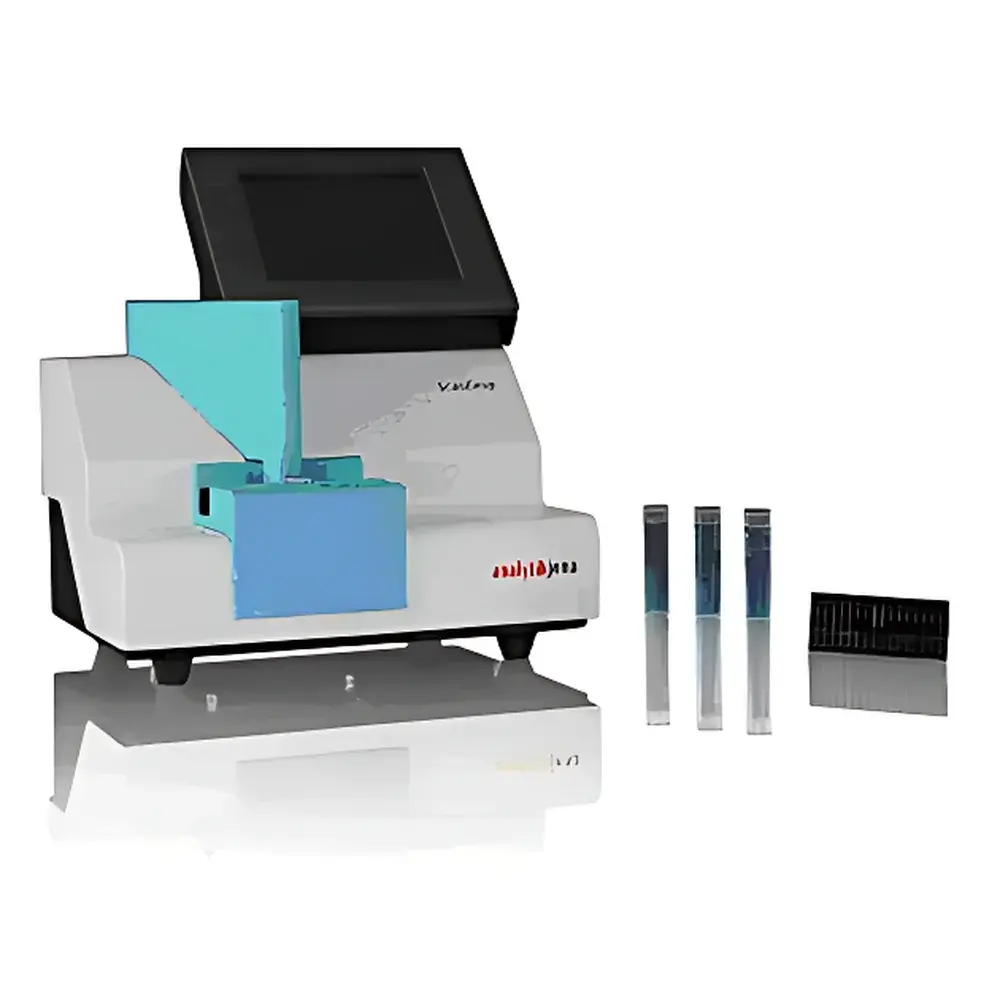
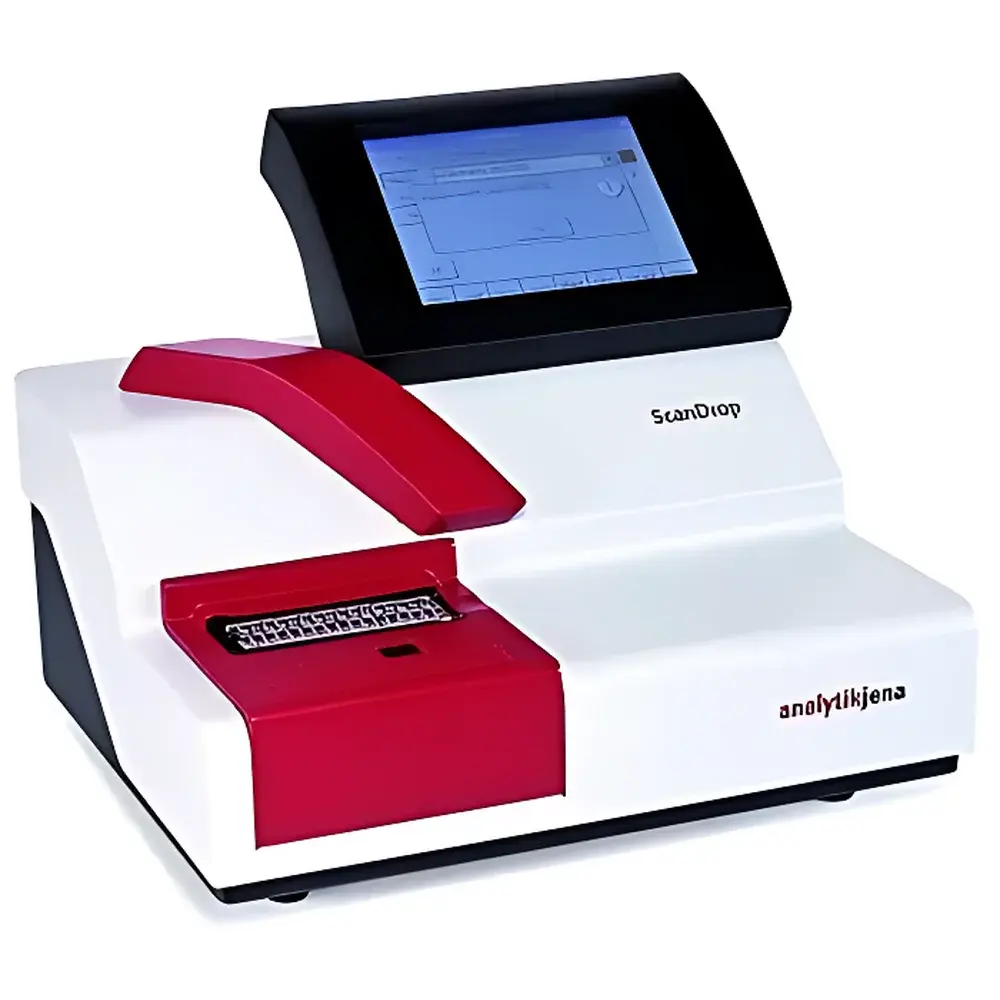
Analytik Jena Scandrop Ultra-Micro Volume UV/Vis Spectrophotometer
| Brand | Analytik Jena |
|---|---|
| Origin | Germany |
| Manufacturer | Analytik Jena GmbH |
| Product Type | Imported Instrument |
| Model | Scandrop |
| Price | Upon Request |
| Optical Principle | Diode Array Spectrophotometry |
| Wavelength Range | 190–720 nm |
| Wavelength Accuracy | ±0.5 nm |
| Photometric Stability | 0.002 A/h |
| Photometric Range | 0.02–300 A (equivalent to 10 mm pathlength) |
| Photometric Accuracy | ±0.02 A (UV), ±0.01 A (VIS) |
| Measurement Time | 1 s per full spectrum |
| Sample Volume (CHIPCUVETTE) | 0.3–4 µL |
| CHIPCUVETTE Pathlengths | 0.1 mm or 1.0 mm |
| Cuvette Mode Sample Volume | ≥1.7 mL |
| Cuvette Pathlength | 10 mm |
| Interfaces | USB, RS-232 |
| Dimensions (W×H×D) | 240 × 170 × 200 mm |
| Weight | 5 kg |
Overview
The Analytik Jena Scandrop is an ultra-micro volume UV/Vis spectrophotometer engineered for precision quantification and quality assessment of nucleic acids, proteins, peptides, and cell lysates in life science laboratories. It operates on a high-performance diode array optical architecture—free of moving parts—ensuring long-term alignment stability and reproducible spectral acquisition. Unlike conventional scanning monochromator systems, the Scandrop employs a fixed-grating polychromator coupled with a linear photodiode array detector, enabling simultaneous full-spectrum capture (190–720 nm) in under one second. Its xenon flash lamp provides instant-on operation without warm-up delay and delivers stable, pulse-to-pulse intensity across the entire UV and visible range. The instrument supports dual measurement modalities: standard 10 mm cuvette-based analysis and chip-based microvolume analysis using the proprietary CHIPCUVETTE platform—eliminating sample evaporation, cross-contamination, and pipetting-induced variability.
Key Features
- Ultra-low sample requirement: as little as 0.3 µL for direct microvolume measurement using CHIPCUVETTE technology
- Dual-pathlength CHIPCUVETTE options (0.1 mm and 1.0 mm) enable dynamic range extension—from high-concentration RNA (>1000 ng/µL) to dilute protein samples (<0.1 mg/mL)—without dilution
- 16-channel CHIPCUVETTE format allows parallel analysis of up to 32 samples (two pathlengths × 16 positions), supporting replicate verification and concentration-optimized pathlength selection
- Optical system built upon Zeiss-derived optics with no mechanical wavelength scanning components, ensuring drift-free performance over extended operation cycles
- Full-spectrum acquisition in 1 second with photometric accuracy of ±0.02 A (UV) and ±0.01 A (VIS), meeting requirements for routine QC in molecular biology and biopharmaceutical workflows
- Three operational modes: absorbance, transmittance, and energy (intensity); compatible with user-defined methods for custom extinction coefficient inputs or multi-wavelength ratio calculations (e.g., A260/A280, A260/A230)
- Flexible control interface: standalone operation via HID-Pro 320 handheld controller or PC-based control using ASpect Nano software with audit-trail-capable method storage
- Optional Peltier-based temperature control module (4–90 °C) enables thermal stability studies, enzyme kinetics, or temperature-dependent conformational analysis
Sample Compatibility & Compliance
The Scandrop accommodates diverse biological matrices—including aqueous nucleic acid solutions, denatured or native protein preparations, bacterial cell suspensions, and small-molecule buffers—without requiring dilution or filtration in most cases. Its sealed CHIPCUVETTE design prevents solvent evaporation during measurement, critical for volatile solvents (e.g., ethanol-containing eluates) or low-volume purified samples. In cuvette mode, compatibility extends to standard 10 mm quartz or UV-transparent plastic cuvettes (minimum fill volume: 1.7 mL). The instrument complies with ISO 8573-1 for optical cleanliness and meets the mechanical and electrical safety requirements of IEC 61010-1. When used with ASpect Nano software under configured user roles and electronic signature protocols, it supports data integrity practices aligned with FDA 21 CFR Part 11 and GLP/GMP documentation standards.
Software & Data Management
ASpect Nano software provides a validated, Windows-based environment for instrument control, method development, and report generation. It includes pre-configured assays for DNA (dsDNA, ssDNA, oligos), RNA, and protein (Bradford, BCA, A280), with automatic calculation of concentration, purity ratios, and molar extinction coefficients. All measurements are timestamped and logged with operator ID, method name, and instrument serial number. Audit trail functionality records parameter changes, calibration events, and result exports—enabling traceability for regulatory submissions. Raw spectral data (.csv and .jdx formats) are exportable for third-party analysis in tools such as OriginLab or R. The HID-Pro 320 controller offers offline operation with onboard storage for up to 1000 results and intuitive touchscreen navigation—ideal for cleanroom or biosafety cabinet deployment.
Applications
- Routine quantification and purity assessment of extracted genomic DNA, plasmid preps, and in vitro transcription products
- High-throughput screening of CRISPR guide RNA integrity and concentration prior to RNP complex formation
- Verification of protein expression yield and buffer exchange efficiency in purification workflows
- Monitoring of enzymatic reactions (e.g., DNase/RNase activity) via time-resolved A260 kinetics
- Characterization of nanoparticle-protein corona formation using UV-Vis spectral shifts
- Validation of oligonucleotide synthesis yield and desalting efficiency in oligo QC pipelines
- Supporting QC release testing for mRNA vaccine intermediates in compliance with ICH Q5A and Q5B guidelines
FAQ
Does the Scandrop require warm-up time before measurement?
No—the xenon flash lamp enables immediate operation upon power-on; no thermal stabilization period is required.
Can the same CHIPCUVETTE be reused for multiple measurements?
CHIPCUVETTE is designed for single-use to prevent carryover; however, its inert quartz surface allows thorough cleaning with 70% ethanol and deionized water if validated for specific applications.
How does the Scandrop handle highly viscous or particulate-containing samples?
For turbid or viscous samples (e.g., lysates), cuvette mode with background subtraction or optional centrifugation is recommended; CHIPCUVETTE is best suited for clarified, low-viscosity solutions.
Is wavelength calibration traceable to NIST standards?
Yes—factory calibration uses NIST-traceable holmium oxide and didymium filters; users may perform periodic verification using supplied reference standards.
What is the minimum detectable dsDNA concentration using the 0.1 mm CHIPCUVETTE pathlength?
At A260 = 0.02 (instrument lower detection limit), the theoretical detection threshold is ~0.9 ng/µL for dsDNA (ε₂₆₀ = 50 L·g⁻¹·cm⁻¹), assuming 0.3 µL sample volume.
Related Products




