
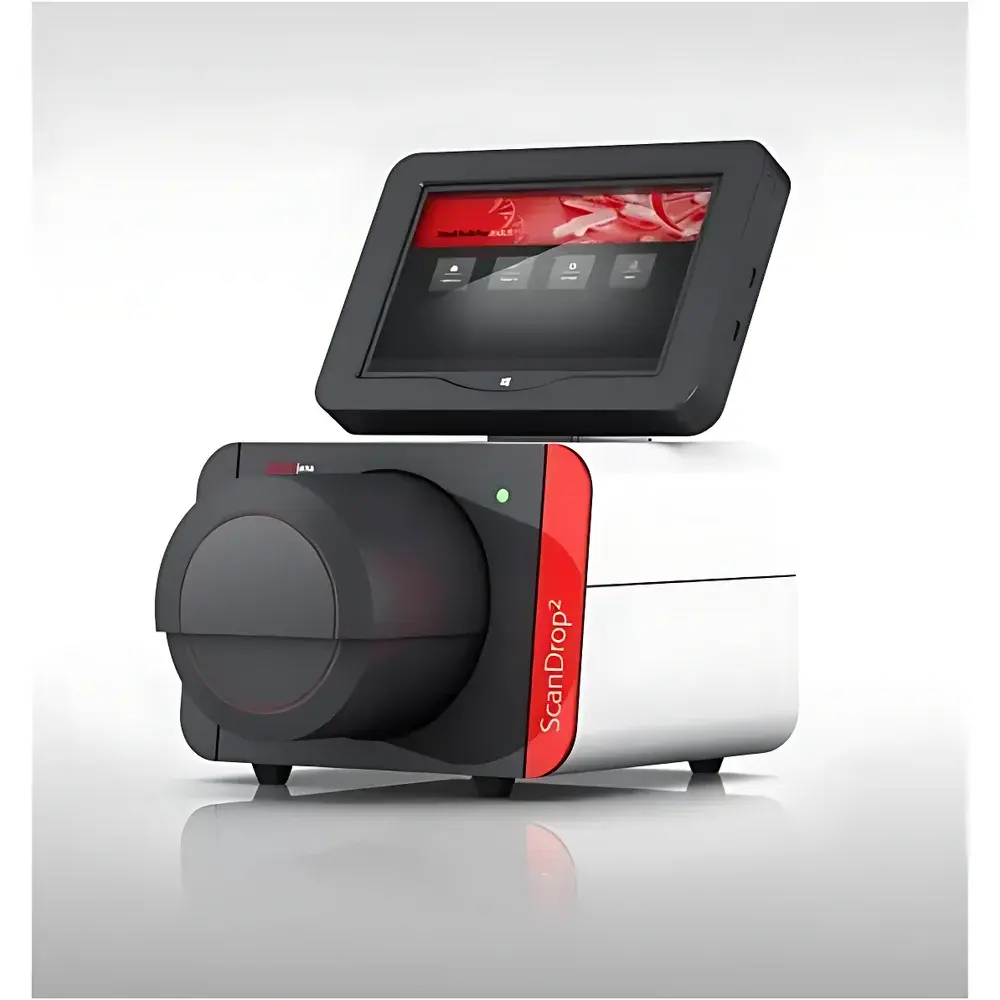
Analytik Jena ScanDrop2 Microvolume Spectrophotometer
| Brand | Analytik Jena |
|---|---|
| Origin | Germany |
| Manufacturer Type | Original Equipment Manufacturer (OEM) |
| Product Category | Imported Instrument |
| Model | ScanDrop2 |
| Pricing | Available Upon Request |
Overview
The Analytik Jena ScanDrop2 Microvolume Spectrophotometer is a second-generation, high-precision UV-Vis spectrophotometric platform engineered for life science laboratories requiring accurate, reproducible quantification and characterization of nucleic acids, proteins, and whole cells at ultra-low volumes. Unlike conventional cuvette-based systems, the ScanDrop2 employs a dual-beam optical architecture derived from Carl Zeiss optics—ensuring exceptional photometric stability and minimizing baseline drift during spectral acquisition. Its core measurement principle relies on absorbance spectroscopy across a broad 190–1000 nm spectral range, with 0.5 nm wavelength resolution and ±0.5 nm accuracy—enabling compliance with ASTM E275, ISO 6425, and USP guidelines for spectrophotometric performance verification. The instrument integrates advanced microfluidic sample positioning and fixed-pathlength capillary-based measurement technology, eliminating the need for dilution or calibration curves in many routine applications while maintaining traceability to NIST-traceable standards.
Key Features
- Dual-beam optical design with Zeiss-sourced optics for enhanced photometric precision and long-term signal stability
- High-intensity xenon flash lamp source providing uniform spectral output from 190 nm to 1000 nm without warm-up delay or lamp aging artifacts
- Modular detection configuration supporting single-channel, 8-channel, 9-channel, and 16-channel microvolume measurement modes
- Adjustable pathlength options (0.1 mm, 0.2 mm, 1 mm, and 10 mm) enabling flexible dynamic range coverage—from sub-ng/μL DNA concentrations to >100 mg/mL protein solutions
- Full-spectrum acquisition completed in ≤1 second per sample, facilitating high-throughput screening workflows
- Multi-mode operation: absorbance (A), transmittance (%T), and energy (mJ/cm²) measurement modes with user-definable wavelength combinations
- Optional 10-inch Windows 8.1 touchscreen controller with integrated software interface for standalone operation
Sample Compatibility & Compliance
The ScanDrop2 accommodates a wide range of biological samples—including double-stranded DNA, RNA, oligonucleotides, purified proteins (e.g., BSA, IgG), crude lysates, cell suspensions (e.g., E. coli, mammalian cells), and even viscous glycerol-stabilized formulations—without requiring centrifugation or filtration. Its microvolume capability (0.3–5 μL loading volume) minimizes sample consumption and reduces cross-contamination risk. The system meets key regulatory expectations for analytical instrumentation used in GLP- and GMP-compliant environments: audit trail functionality (via optional software license), electronic signature support (aligned with FDA 21 CFR Part 11 requirements), and configurable user access levels. All firmware and method files are stored with time-stamped metadata, ensuring full data integrity and traceability throughout the instrument lifecycle.
Software & Data Management
The ScanDrop2 operates via the proprietary BioSpectrometer Software Suite, compatible with Windows 7/8.1/10 environments. It supports customizable method creation—including multi-wavelength ratio calculations (up to six wavelengths per formula), kinetic time-course analysis, and spectral derivative processing. Raw spectral data is exportable in CSV, ASCII, and JCAMP-DX formats for integration into LIMS or third-party analysis platforms such as MATLAB, GraphPad Prism, or Python-based bioinformatics pipelines. Method templates can be password-protected and locked against unauthorized modification, satisfying internal SOP enforcement protocols. Data backups are performed automatically to external USB drives, and all measurement events—including parameter changes, user logins, and instrument diagnostics—are recorded in an immutable audit log.
Applications
- Quantification and purity assessment of nucleic acids (A260/A280, A260/A230 ratios) per standard molecular biology protocols
- Direct protein concentration determination using aromatic amino acid absorbance (280 nm) or dye-binding alternatives (e.g., Bradford, BCA)
- Enzyme kinetics monitoring via continuous absorbance tracking at defined wavelengths (e.g., NADH oxidation at 340 nm)
- UV-Vis spectral fingerprinting of novel biomolecules, nanoparticles, or synthetic polymers
- Quality control of CRISPR guide RNAs, mRNA vaccine intermediates, and oligonucleotide therapeutics
- Cell density estimation (OD600) and viability assessment in microbial and suspension culture systems
FAQ
Does the ScanDrop2 require routine lamp replacement?
No—the xenon flash lamp has a rated lifetime exceeding 1 × 10⁹ flashes and does not degrade in intensity over time like traditional deuterium/tungsten lamps.
Can I validate the instrument’s wavelength accuracy in-house?
Yes—users may perform periodic verification using NIST-traceable holmium oxide or didymium filters, with built-in calibration verification routines accessible through service mode.
Is the 16-channel high-throughput module compatible with standard 96-well plate geometries?
No—the 16-channel configuration uses a dedicated microfluidic cartridge; it is not designed for direct well-to-well mapping but enables parallel analysis of discrete low-volume samples with independent pathlength selection.
How is carryover prevented between measurements?
Each sample channel features automated surface tension-driven aspiration and air-gap separation; optical surfaces are cleaned via integrated ethanol-compatible wipe protocol executed between runs.
Does the system support 21 CFR Part 11 compliance out-of-the-box?
Full Part 11 functionality—including role-based access control, electronic signatures, and audit trail generation—requires activation of the optional Compliance Package license and proper IT infrastructure configuration.
Related Products




